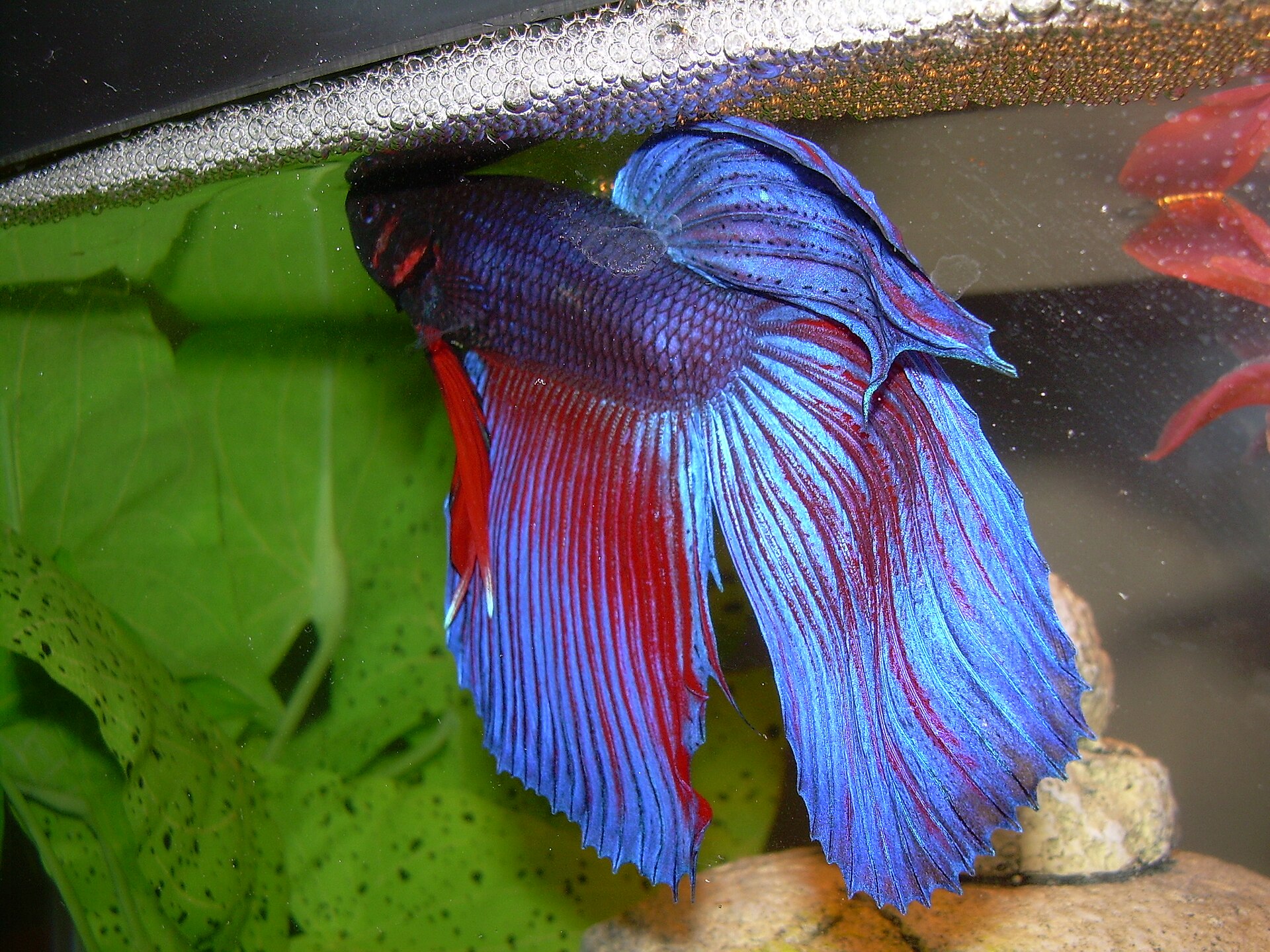
Three dominant spawning methods exist in modern betta breeding. Thai village jarring (outdoor shallow clay jars, high-volume production), Western open-tank (10-gallon with styrofoam and plants, show-quality selection), and foam-lid (sealed nest for small spaces). Each evolved from local conditions. Most Western hobbyists should use the open-tank method; see spawning setup for the setup. This spoke describes the actual spawning process and what you watch (IBC Exhibition Standards and breeding).
The spawning sequence (all methods)
Once the female is released from the chimney:
Minute 0 to 30: Courtship. Male displays around the nest. Full flaring, saturated color, circling the female. Female orients toward the nest. Some chasing, not violent.
Minute 30 to 60: Approach. Female approaches the nest. Male positions himself below the nest. Female drops under the male’s belly, face down.
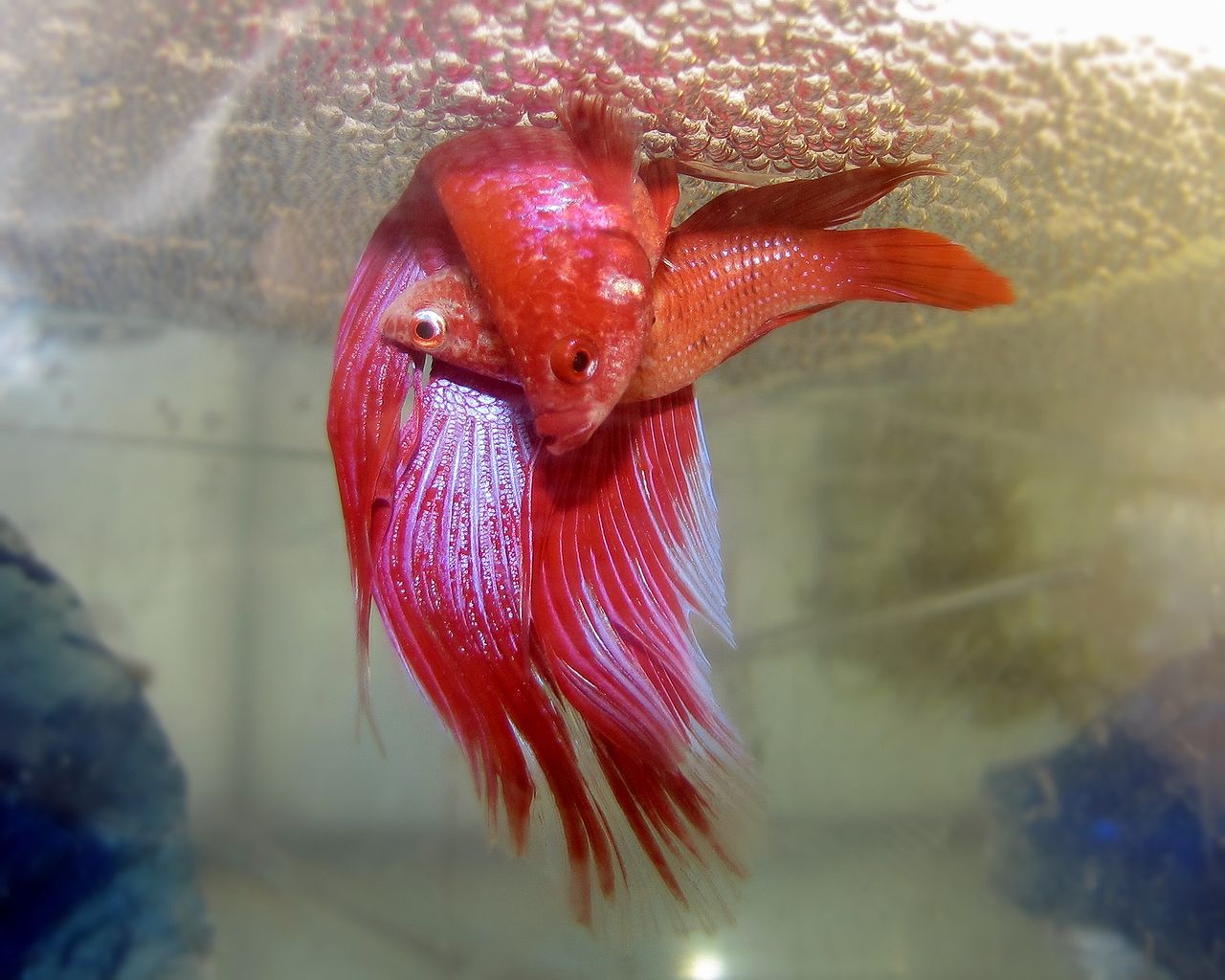
First wrap. Male curls his body around the female’s belly, upside down, squeezing gently. Female releases 5 to 40 eggs. Male simultaneously fertilizes. Both fish float motionless for 10 to 30 seconds.
Egg recovery. Eggs sink. Male unwraps, dives after eggs, catches each in his mouth and spits it into the bubble nest. Female, momentarily stunned, sinks or drifts.
Repeat. Wrap, release, recover. 10 to 50 times. Each wrap produces eggs. Total eggs: 100 to 700 over 1 to 3 hours.
End of spawning. Female, now empty, retreats to the female-cover area. Male chases her off the nest (aggressive, normal). Female hides.
Remove female. Net her out immediately. The male will damage her fins or kill her if left with the nest.
Male tends. For the next 36 to 48 hours, the male guards the nest, catches falling eggs, repositions them, blows fresh bubbles. Do not disturb. Low light, warm, no feeding.
Hatch. Day 2 to 3 after spawning, depending on temperature. Fry emerge tail-first, hang from the nest, yolk sac visible.
Free swim. Day 4 to 5, fry swim horizontally in short bursts. They’ve absorbed yolk and need food.
Remove male. At free-swimming, remove the male. Some males continue tending peacefully; many start eating fry. Default to removing.
Method 1: Thai village jarring
Traditional Thai breeding uses shallow clay jars (about 2 to 5 gallons each) kept outdoors or in open sheds. The climate does thermal work. Pairs are introduced in the morning, spawn during the day, and the female is removed at dusk. Jars are stacked dozens or hundreds per facility.
Characteristics:
- High volume, low per-spawn tending.
- Outdoor/semi-outdoor temperature control.
- Strong selection pressure (weak fry don’t survive).
- Common live food: mosquito larvae from nearby standing water, naturally cultured.
This is the method behind most Thai fighter-fish lineages and most commercial export production. Not practical in Western apartments, but it’s where the core protocols came from.
Method 2: Western open-tank
The method described in spawning setup. 10-gallon long, 4-6 inches of water, styrofoam anchor, plants, chimney introduction. Controlled lighting, filtration during fry-rearing, temperature via heater.
Characteristics:
- One spawn at a time, intensive focus.
- Careful pair selection, documented lineage.
- Optimized for show-quality selection.
- Most common method for Western hobbyists and IBC breeders.
This is the standard. If you’re reading this as a first-time breeder, use it.
Method 3: Foam-lid (small-space)
Developed for apartment hobbyists without room for a 10-gallon spawning tank. Uses a small container (2 to 5 gallons) with a floating plastic lid that seals the nest area from air movement.
Setup:
- 3-gallon container, 4 inches deep.
- 6 × 6 inch plastic lid (from a takeout container) floating at the surface.
- Nest built under the lid, sealed from drafts.
- Plants at the opposite end.
- Heater.
Characteristics:
- Works in small spaces.
- Nest protection from drafts is better than open-top.
- Lower fry count than open-tank because of limited volume.
- Harder to observe spawning; the lid blocks top-down view.
Good for constrained living situations. Not optimal for breeding goals that require lots of fry.
Reading the spawn
Going well:
- Wraps are consistent (every 3-10 minutes).
- Male reliably retrieves eggs.
- Female returns to the nest area between wraps.
- Both fish full color, active, no damage.
- Nest growing larger over the session.
Going badly:
- Male attacks female repeatedly without pause; she’s not wrapping.
- Female flees constantly, hides for long stretches, doesn’t return.
- Eggs falling and not being retrieved (male exhausted or distracted).
- Female fins being shredded (excess aggression).
- No wraps after 2 hours of chimney release.
If it’s going badly for 30+ minutes with no improvement, separate the pair. Try again in a week with more conditioning, or swap out a fish.
The after-spawning steps
Once the last wrap happens and the female retreats:
- Net the female out. Return her to her conditioning tank. Keep her warm, feed, let her recover 2 weeks before breeding again.
- Dim the lights in the spawning tank.
- Cover the tank (lid plus a towel if needed) to keep warm still air above the nest.
- Don’t disturb. Don’t feed the male.
- Check daily for 2 days. Eggs look like tiny white dots in the nest. If the male is actively replacing fallen eggs, he’s tending correctly.
- Day 2-3: hatch. Fry hang from the nest.
- Day 4-5: free-swim. Remove the male.
First food is infusoria or vinegar eels. See fry: first 30 days for the full fry protocol.
What not to do
- Don’t move the tank during the 2-day egg phase. Vibration knocks eggs from the nest.
- Don’t do water changes during the 5-day pre-free-swim phase. Temperature or parameter shifts disrupt tending.
- Don’t add food during male-tending. He’ll eat it; fine. Live food can be confused with fry; skip it.
- Don’t peek under the lid 50 times a day. Lift once daily for a quick check.
- Don’t panic if some eggs fall to the bottom. Infertile or damaged eggs fall. The male leaves them.
The spawning is the dramatic part. The 5 days after the spawn are the quiet, nerve-wracking part. Trust the male (mostly) and the process, remove him when the fry free-swim, and the next 30 days of fry care begins.
Related on this site
- How to Breed Betta Fish: A Breeder’s Complete Guide
- Betta Spawning Tank Setup: 10 Gallons, Shallow, and Carefully Staged
- Betta Breeding Conditioning: The 14-Day Protocol
- Culling in Betta Breeding: The Ethical Framework
- Betta Breeding FAQ: The 20 Questions New Breeders Ask
Frequently asked
- What's the difference between methods?
- Container, scale, and tending style. Thai village jarring produces high numbers with low per-spawn tending. Western open-tank optimizes for carefully bred show lines in controlled conditions. Foam-lid works in tight spaces.
- Which method produces best quality?
- Western open-tank with careful selection gives the most consistent show-quality fry. Thai jarring produces high numbers and strong selection pressure but more variable individuals. For home hobbyists, open-tank is the standard.
- Do I need to feed the male during nest tending?
- Light feeding only. 2 to 3 pellets per day. The male will pick them up if eaten near the nest. Avoid live food that could be confused for fry. Stop feeding once fry free-swim; remove the male.
- When exactly do I remove the male?
- When fry are free-swimming horizontally, around day 4 to 5 post-spawn. If the male starts eating fry (yes, some do), remove immediately. Better early than late.
- What happens if the male eats the eggs?
- Some males do. First-time breeders often eat their first spawn. Remove the male, let the eggs tumble, and try again with more conditioning. A repeat offender male is a non-breeder; use a different male.