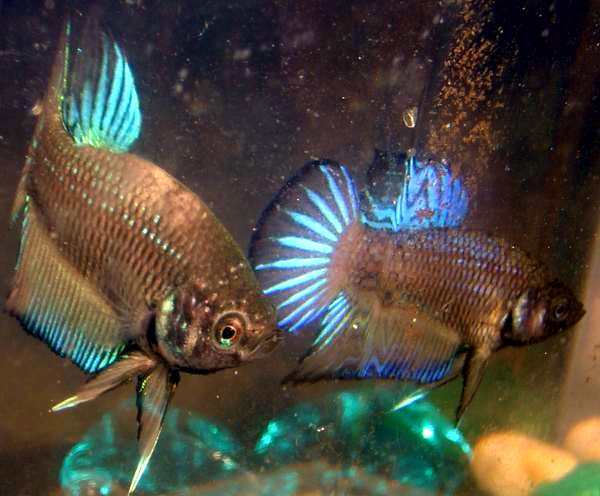
The peace-lily vase is animal cruelty. A betta kept in 1 to 2 liters of cold, un-cycled water with a plant on top dies of starvation, ammonia poisoning, and cold-induced immune collapse, usually within three to six months. Bettas don’t eat plant roots. They’re obligate insectivores from tropical rice paddies, and everything the 1990s vase marketing said about them was wrong.
Where the myth came from
Sometime around 1995, florists and home-goods chains began selling an ornamental setup: a clear glass vase (cylindrical or bell-shaped, typically 1 to 2 liters), a Spathiphyllum (peace lily) suspended at the top with its roots dangling into the water, a single Siamese fighting fish below. Brands like “Vases de Paris” packaged the combination. Mail-order catalogs picked it up. Martha Stewart Living ran photo spreads. The claim sold alongside the object: the fish ate the lily’s roots, the lily filtered the fish’s waste, a self-contained ecosystem needed no attention.
None of that was true.
What was actually happening
The fish didn’t eat the roots. Betta splendens has a gut designed for chitin and soft-bodied invertebrate protein. Laboratory and field diet studies consistently show wild and captive bettas eat mosquito larvae (the dominant prey item), bloodworms, daphnia, cyclops, adult flies, and juvenile crustaceans. Zero plant matter. A betta in a vase with nothing else in the water starves. Wildlife biologists and hobbyist breeders flagged this from the start.
The lily didn’t filter waste. Peace lilies are terrestrial plants. Their roots take up some dissolved nitrate when submerged, but not meaningfully; they prefer moist, not flooded, root zones. The lily stressed in standing water, the fish poisoned on ammonia the lily couldn’t keep up with. A hydroponic filter it was not.
The water was cold. Vases were kept on desks and coffee tables, room temperature, which is 19 to 22 °C for most homes. Betta splendens is tropical; below 23 °C they become sluggish, stop eating, and suppress immune function. Cold also slows the nitrogen cycle, compounding the ammonia issue.
There was no cycle. 1.5 liters is too little water and too little substrate to host a meaningful population of nitrifying bacteria. Ammonia from gill waste climbed unchecked. A vase owner changed “the water” (actually topping up evaporation) weekly or monthly. Ammonia peaks, chronic exposure, gill burn, death in months.
The pushback
PETA ran a sustained campaign against the vase starting in the late 1990s. Hobbyist organizations like the International Betta Congress published educational material. The “fish live in puddles so they’re fine in a vase” counter-argument was thoroughly debunked. Wild bettas live in rice paddies connected to larger water bodies, measured in cubic meters; see the 2022 Aceh habitat survey (Taylor & Francis) and wild betta habitat.
By around 2010, the vase had declined as a mainstream product. Pottery Barn, Bed Bath & Beyond, and Martha Stewart Living stopped featuring them. Florists still occasionally sell the setup, mostly at weddings. Every such setup is cruelty.
What “small container” actually means
The minimum for a betta is 5 US gallons (19 L), filtered, heated to 25 to 27 °C, fully cycled. Full breakdown at tank setup. A peace lily on top of that 5-gallon tank, roots dangling in the water, with a real heater and a real filter under the waterline, is fine. That’s an aquarium with a plant; it’s not a vase.
The rule: if the container needs the fish to be in it because the fish is a “feature” and not a fish being kept well, the setup is wrong.
What to do if you’ve inherited a vase setup
- Buy a 5-gallon tank, preset heater, sponge filter, dechlorinator, and API test kit. Total cost new in 2026: about $110.
- Move the fish to the new tank with a 50% acclimation (half tank water, half vase water over 45 minutes).
- Do fish-in cycling with daily 50% water changes and Seachem Prime until the tank reads 0/0/nitrate. See the nitrogen cycle.
- Keep the lily as a houseplant. It’ll do better in a pot of soil than suspended over a dying fish.
The broader lesson
The vase was the 1990s signature case. The 2020s version is the “betta cube”: a 2-liter Amazon-listing desktop tank marketed with cute graphics and a betta photo. Same cruelty, different shape. The rule is constant: a betta in under 5 gallons, unfiltered, unheated, un-cycled, is a fish being slowly killed.
If you read nothing else on this site, read that sentence again. Then buy the 5-gallon tank.
Related on this site
- Betta Fish Care: The Evidence-Based Guide
- Pet-Store Betta Ethics: What the Cup Costs the Fish
- Rice Paddies: The Real Wild Habitat of Betta splendens
- Betta Anatomy: What You’re Looking At When You Look at a Betta
- Betta Feeding: What to Feed, How Often, How Much
Frequently asked
- Do bettas eat plant roots?
- No. Betta splendens is an obligate insectivore. They eat mosquito larvae, bloodworms, daphnia, and small crustaceans. They have no gut for plant matter. The vase marketing claimed they fed on lily roots; it was a lie.
- How long does a betta survive in a vase?
- Three to six months, sometimes less. Cold water suppresses immunity, un-cycled water chronically poisons with ammonia, and the fish starves on nothing but the rare fruit fly that falls in.
- Is there any safe vase setup?
- A 'vase' with 5+ gallons, a heater, a filter, and a cycled biofilter is a 5-gallon aquarium in a round glass container. Sure. But the aesthetic desktop vase of 1 to 2 liters with a lily on top is never safe.
- Who started the vase myth?
- The 1990s Vases de Paris marketing campaign and imitators claimed bettas lived on lily roots and thrived in small unheated containers. Florists and home stores sold the combination as a living ornament. PETA and hobbyist organizations pushed back starting in the late 1990s.