Female bettas are not simply smaller, less colorful males. They have distinct identification features, different housing options (including the controversial sorority tank), and behavioral patterns that differ enough from males to warrant a separate treatment.
Sexing a betta: the ovipositor
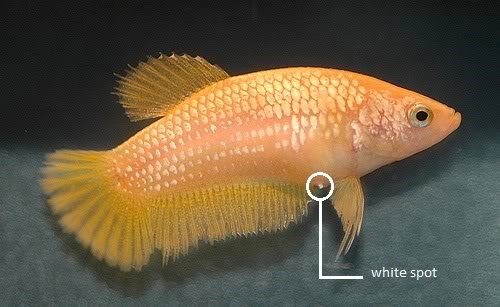
The definitive way to identify a female betta is the ovipositor — a small, white, rounded dot visible between the ventral fins, pointing downward toward the substrate. It is the egg-laying tube. Males cannot have one. If you see it, the fish is female, period.
Secondary indicators (less definitive, especially in juveniles):
- Body size: Females are typically 3–5 cm standard length; adult males reach 5–7 cm
- Fin length: Female fins are shorter and less elaborate than mature male fins
- Body shape: Females are often rounder in the abdomen, especially when gravid (carrying eggs)
- Color: Males are typically more intensely colored, but this is unreliable — female bettas can be vivid, and some males are pale
Juvenile bettas under 8–10 weeks are difficult to sex reliably. The ovipositor becomes clearly visible around 8–12 weeks of age.
Individual care requirements
Female bettas require the same fundamental care as males:
| Parameter | Requirement |
|---|---|
| Tank size | 5 gallons minimum, 10 preferred |
| Temperature | 76–82°F (24–28°C) |
| Filtration | Gentle sponge or baffled HOB |
| Cycle | Fully nitrogen-cycled before adding fish |
| pH | 6.5–7.5 |
| Ammonia / Nitrite | Zero |
Females in solo tanks are straightforward to keep. They are often more active and exploratory than males, less likely to spend time displaying to their reflection (though they do display), and generally at least as hardy as males in good conditions.
Feeding
Same diet as males: high-protein pellet staple (40%+ protein, fish or insect meal as first ingredient), with live or frozen supplementation (bloodworm, daphnia, brine shrimp 2–3 times per week). See betta feeding for the full guide.
Females in sorority groups require observation at feeding to ensure subordinate fish are eating. Dominant individuals sometimes monopolize feeding areas.
Sorority tanks: an honest assessment
A sorority is a group of female bettas kept in the same tank. The concept has significant popular appeal and real management complexity. Here is what the evidence actually shows.
When sororities work
- Tank: 20 gallons minimum, 29–40 gallons preferred. Below 20 gallons, there is insufficient space to establish and maintain territory without constant contact between individuals.
- Group size: 5 or more females. In groups smaller than 5, the most dominant individual can focus aggression on one or two subordinates relentlessly. More fish distribute aggression across the group and dilute the impact on any one individual.
- Heavy planting: Dense live plant cover creates visual breaks that allow subordinate fish to escape line of sight from dominant individuals. A tank with minimal decoration concentrates aggression.
- Multiple feeding sites: Feeding in two or three locations prevents a dominant fish from controlling all food access.
- Stability: Once a sorority hierarchy is established, disruption resets the hierarchy. Removing and re-adding fish, changing tank layout significantly, or introducing new females triggers re-establishment fighting that can be severe.
- Ongoing observation: A working sorority requires regular observation for signs that one fish is being persistently targeted.
When sororities fail
- Fish are too few (fewer than 5 reliably leads to one fish being bullied to death)
- Tank is too small
- Planting is insufficient
- A new female is introduced after the hierarchy has stabilized
- One female is noticeably larger or more aggressive than the others
The failure mode is a chronic low-level war where one subordinate fish cannot escape harassment. Signs: persistent fin damage on one fish, one fish hiding constantly, one fish with stress stripes and poor body condition while others look healthy.
Remove the victim, not the aggressor. The aggressor’s behavior is normal for the species. The solution is changing the group composition or tank conditions, not punishing the dominant fish.
The honest bottom line
Sororities are manageable — serious, experienced betta keepers run them successfully. They are not a beginner setup. A single female in a well-planted 10-gallon tank is more reliable, lower-stress, and better for the fish than a sorority managed without experience.
If you want multiple bettas in the same tank space, a divided tank — one male per section — is more reliable than a sorority and does not carry the aggression management burden.
Female bettas and breeding
The female’s role in a spawn is straightforward: she releases eggs during the embrace. After spawning, she should be removed from the spawning tank immediately — the male will become aggressive toward her once she has spawned, protecting the nest.
See pair selection for the conditioning protocol and how to read breeding readiness signals (vertical bars, ovipositor visibility, gravid abdomen).
Related on this site
- Tank Setup: A 5-Gallon Minimum Build
- Betta Feeding
- Tank Mates: What Actually Works
- Pair Selection: Breeding Readiness in Males and Females
- Betta Behavior: What Normal Looks Like
Frequently asked
- How do I tell if my betta is male or female?
- The definitive female identifier is the ovipositor — a small white dot visible between the ventral fins, pointing downward. Females are also typically smaller (3–5 cm vs 5–7 cm for males), have shorter fins, and show less vivid coloration. Adult males cannot have an ovipositor; if you see it, the fish is female.
- Are female bettas less aggressive than males?
- Less aggressive than male bettas — but still aggressive fish. Female bettas fight each other, establish dominance hierarchies, and injure each other seriously enough to cause death in the wrong conditions. The 'peaceful female betta' framing is misleading. They are less likely to fight to the death than males in a single encounter, but chronic aggression in a confined group is a serious management problem.
- Can female bettas live alone?
- Yes, and for most keepers, this is the recommended setup. A single female in a 5–10 gallon planted tank is straightforward and avoids the management complexity of sorority tanks. Female bettas kept alone are fine — they do not require companion fish.
- Can I keep a male and female betta together permanently?
- No. Outside of a supervised breeding attempt, a male and female should not be permanently cohoused. Males will harass females aggressively, especially in spawning condition. Prolonged cohabitation results in torn fins, stress, injury, and frequently the death of the female.
- How many females can I keep in a sorority?
- The standard recommendation is 5 or more in a well-planted tank of 20 gallons or larger. Fewer than 5 allows a dominant individual to focus aggression on one subordinate, which leads to death. More fish distribute the aggression across the group. The number alone does not guarantee success — setup, observation, and willingness to intervene are equally important.