The API Freshwater Master Test Kit is what to buy. That is the short answer.
This page has affiliate links. See our affiliate disclosure.
This page explains why, what else is worth having, and why testing matters enough to warrant a guide of its own.
Why you need to test at all
Ammonia is colorless, odorless, and invisible. A betta living in water with 0.5 ppm ammonia looks completely normal until its immune system has been suppressed for two weeks and a bacterial infection takes hold. By the time the fish shows visible disease, the water quality problem has been running for days.
Test kits make invisible chemistry visible. The alternative, waiting until the fish looks sick, means the problem has already progressed far enough to cause damage.
A reading of 0 ammonia doesn’t mean the same thing in every tank. In a cycled tank, it means the nitrifying bacteria are processing waste faster than it accumulates, which is the actual goal. In a brand-new, uncycled tank, 0 ammonia can just mean the bacteria colony hasn’t caught up yet, not that anything is safe. What confirms a tank is fine is that the cycle is active and progressing through its stages, not a single zero reading on day one.
What to test
The four parameters that matter for daily betta keeping (per the Merck Veterinary Manual aquarium-fish environmental requirements and PMC9334006):
| Parameter | What it indicates | Test frequency |
|---|---|---|
| Ammonia (NH₃/NH₄⁺) | Nitrogen cycle status; fish waste accumulation | Weekly; daily during cycling or illness |
| Nitrite (NO₂⁻) | Nitrogen cycle status; partial cycle failure | Weekly; daily during cycling |
| Nitrate (NO₃⁻) | Water change frequency effectiveness | Weekly |
| pH | Acid/base balance; cycle health | Weekly; daily if fish show stress |
GH and KH are tested at setup and occasionally for troubleshooting, not weekly routine.
Step testing up from weekly to daily during the first six weeks of cycling a new tank, any time a fish shows illness symptoms, after dosing medication (several treatments can crash the nitrogen cycle right along with the pathogen), and after any equipment failure or other disruption. Drop back to weekly once things settle.
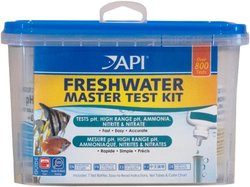
API Freshwater Master Test Kit
The industry standard. Tests ammonia, nitrite, nitrate, and pH using liquid reagent drop tests. Each test involves adding drops of reagent to a water sample in a glass tube, waiting a few minutes, and comparing the color to a chart.
Why liquid over strips:
- Liquid reagents are significantly more accurate at low concentrations where strips fail
- Each test is independent. A bad test strip batch ruins the whole package; one bad test doesn’t affect the others
- Cost per test is lower when used routinely over a year
The kit includes enough reagent for approximately 800 total tests across the four parameters. At weekly testing for one tank, a kit lasts 2–3 years.
One limitation: The ammonia test in the Master Test Kit uses a color comparison that can be difficult to read at very low levels (0.25 ppm). If you suspect low-level ammonia that the test shows as borderline, use the Seachem Ammonia Alert as a secondary confirmation.
Check price on Amazon Affiliate link. See our disclosure.
Seachem Ammonia Alert
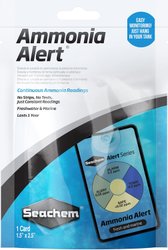
A passive chemical sensor badge that sits in the tank water at all times. The badge contains a chemical indicator that changes color through four stages as free ammonia concentration rises: yellow (safe) → green (alert) → grey (alarm) → blue (toxic).
It does not require any action. It simply monitors continuously. The badge lasts approximately 1 year before needing replacement.
Use it as a real-time safety net between liquid test days. If the badge turns green on a day you haven’t tested, test immediately. It won’t tell you exactly how much ammonia is present, but it tells you there is ammonia.
Check price on Amazon Affiliate link. See our disclosure.
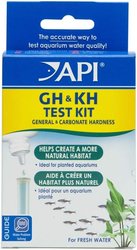
API GH and KH Test Kit
A separate kit that tests general hardness (GH) and carbonate hardness (KH). Not included in the Master Test Kit.
Test when:
- Setting up a new tank (establish your tap water baseline)
- Fish show unexplained stress with normal ammonia/nitrite/nitrate/pH
- You switch water sources
- You use RO water that requires remineralization (RO water has zero GH and KH, unsafe for fish without mineral supplementation)
Most keepers using municipal tap water within normal parameters do not test GH/KH routinely.
Check price on Amazon Affiliate link. See our disclosure.
What to skip
Test strips: inaccurate at the concentrations that matter most for fish health, and they degrade quickly once the package is opened, which worsens an already borderline-prone reading. A false-negative on ammonia (the strip reads zero when the tank actually sits at 0.5 ppm) is dangerous: you do nothing while the fish’s immune system quietly degrades. Do not use strips as your primary testing method. If you already have strips: use them as a rough first indicator, then confirm with a liquid test before taking action.
pH-only testers (pens): useful for precision pH work but do not test ammonia or nitrite. A pH meter as your only test tool leaves the most dangerous parameters unchecked.
Expensive digital nitrate/ammonia meters: the benchtop lab equipment used by professionals. Not necessary for a single betta tank. The API Master Kit gives you everything you need.
Testing correctly
A few technique mistakes produce inaccurate results:
- Rinse test tubes with tank water, not tap water. Chlorinated tap water affects reagents.
- View color in natural light or under a white light source. Yellowish room light makes ammonia readings look lower than they are.
- Read the color immediately after the designated wait time. Colors continue to shift.
- Check reagent expiration dates. Liquid reagents degrade. A kit more than 3 years old may give inaccurate readings.