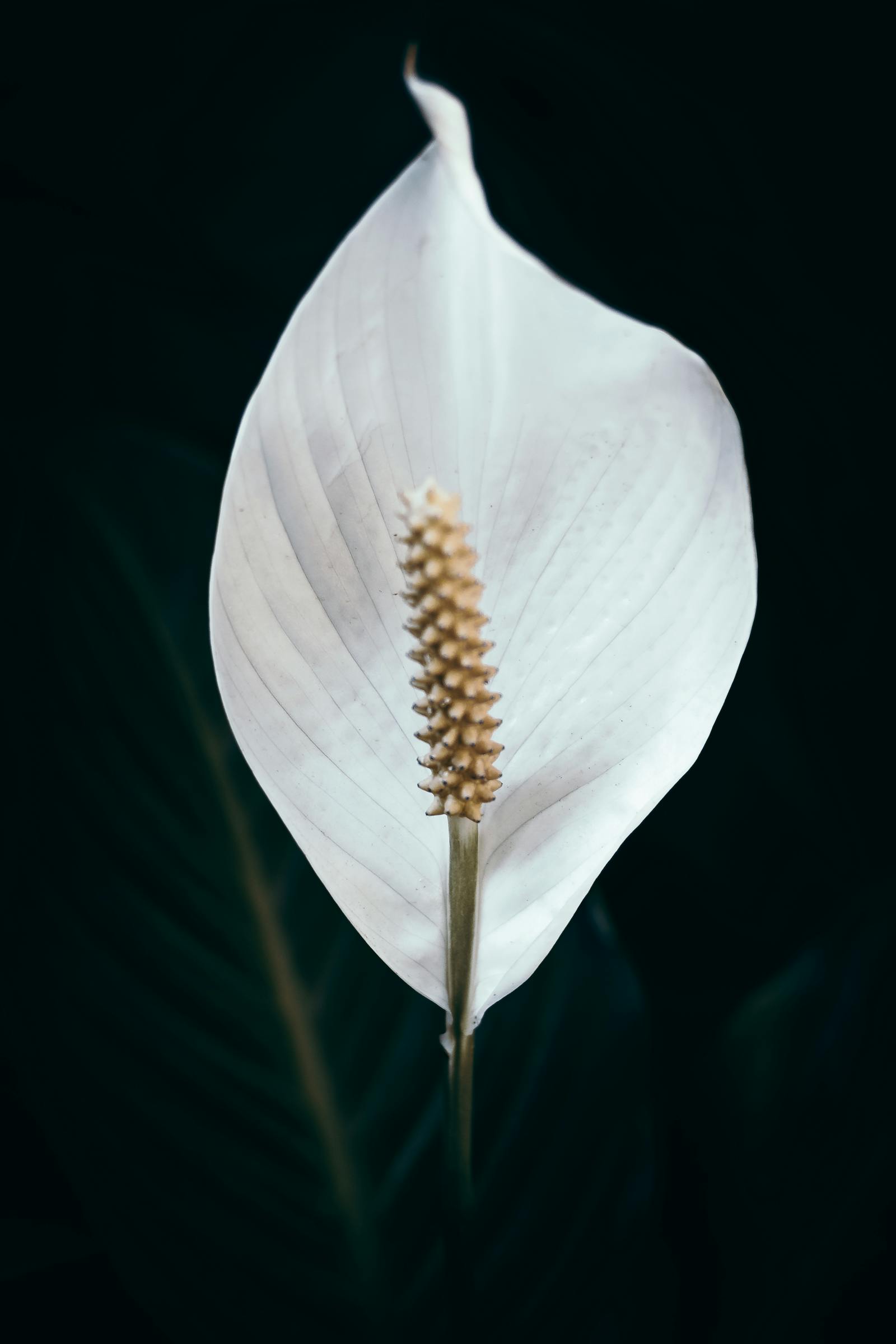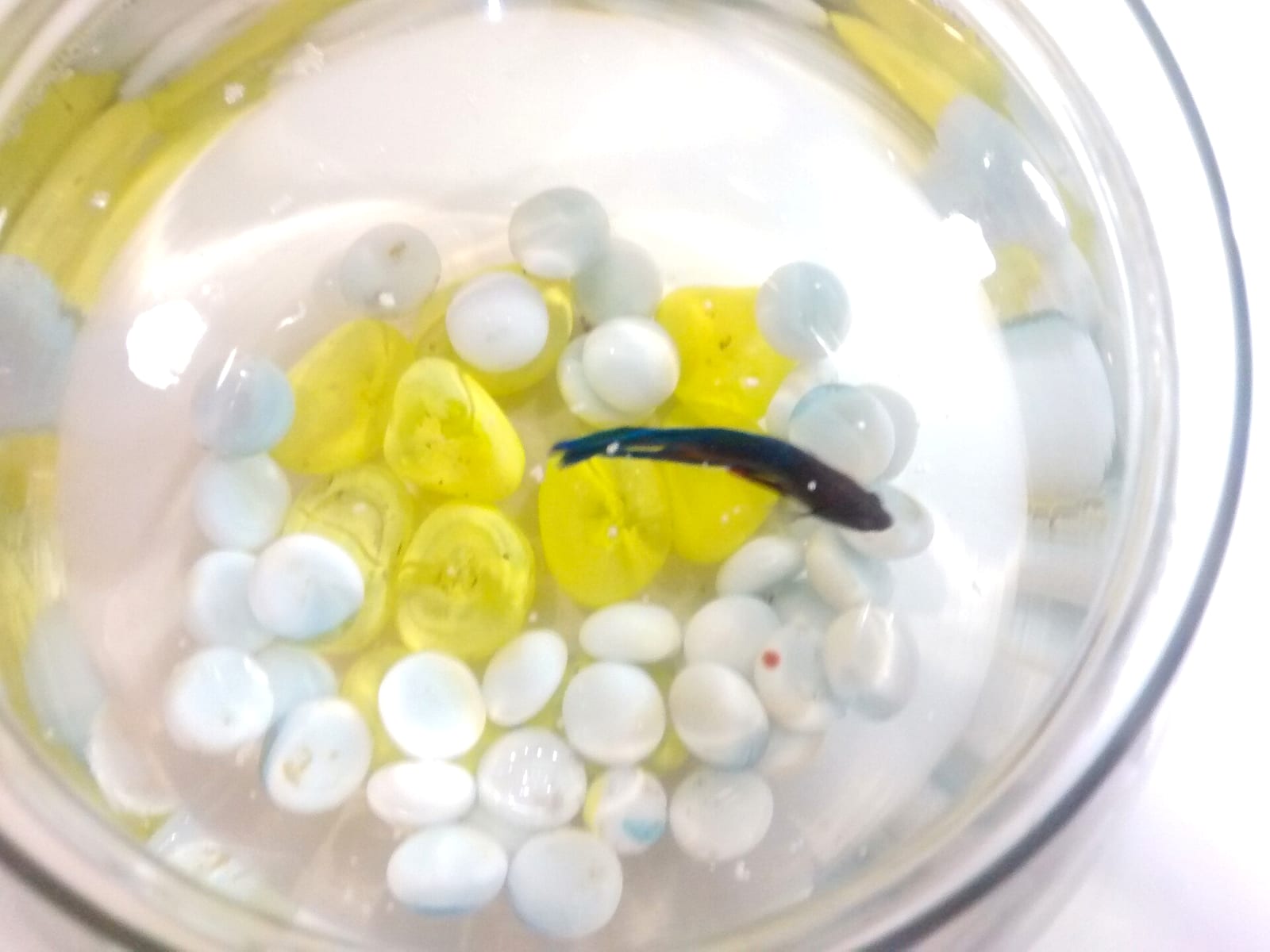
The peace-lily vase is animal cruelty. A betta kept in 1 to 2 liters of cold, un-cycled water with a plant on top dies of starvation, ammonia poisoning, and cold-induced immune collapse, usually within three to six months. Bettas don’t eat plant roots. They’re obligate insectivores from tropical rice paddies, and everything the 1990s vase marketing said about them was wrong.
Where the myth came from
The exact origin is hard to pin down. No trade publication or patent filing documents who packaged the combination first, and this site won’t invent a brand name or a magazine spread just to make the story tidier. What is well documented, across hobbyist retrospectives and forum histories going back two decades, is the shape of it: through the 1990s and into the early 2000s, florists, gift shops, and mail-order catalogs sold a clear glass vase, typically holding a liter or two, with a Spathiphyllum (peace lily) suspended at the rim so its roots trailed into the water below, and a single Siamese fighting fish swimming underneath. One long-running fishkeeping care site notes it hadn’t seen the kit on mainstream shelves since around 2001, which puts its retail peak in the mid-to-late 1990s. Florists still sell a version of it today, mostly for weddings and offices.
The marketing claim was consistent everywhere the setup appeared: the fish ate the lily’s roots, the lily filtered the fish’s waste, a self-contained ecosystem needed no attention.
None of that was true.
What was actually happening
The fish didn’t eat the roots. Betta splendens has a gut designed for chitin and soft-bodied invertebrate protein. Laboratory and field diet studies consistently show wild and captive bettas eat mosquito larvae (the dominant prey item), bloodworms, daphnia, cyclops, adult flies, and juvenile crustaceans. Zero plant matter. A betta in a vase with nothing else in the water starves. Wildlife biologists and hobbyist breeders flagged this from the start.
The lily didn’t filter waste. Peace lilies are terrestrial plants. Their roots take up some dissolved nitrate when submerged, but not meaningfully; they prefer moist, not flooded, root zones. The lily stressed in standing water, the fish poisoned on ammonia the lily couldn’t keep up with. A hydroponic filter it was not.
The water was cold. Vases were kept on desks and coffee tables, room temperature, which is 19 to 22 °C for most homes. Betta splendens is tropical; below 23 °C they become sluggish, stop eating, and suppress immune function. Cold also slows the nitrogen cycle, compounding the ammonia issue.
There was no cycle. 1.5 liters is too little water and too little substrate to host a meaningful population of nitrifying bacteria. Ammonia from gill waste and uneaten food climbed unchecked, with nothing in the system converting it to something less toxic. The numbers make the timeline concrete: un-ionized ammonia (NH3), the form fish actually absorb across their gills, is roughly 100 times more toxic than the ionized ammonium (NH4+) form, and fish tissue damage begins at concentrations as low as 0.05 mg/L, per a University of Florida IFAS extension bulletin on ammonia toxicity. A single betta producing waste into 1.5 liters of standing water can push past that threshold in days, not weeks. A vase owner who “changed the water” (really just topped up evaporation) wasn’t intervening anywhere near often enough to matter. Gill burn, chronic stress, death within months.
The lily blocked the one thing the fish actually needed access to. Bettas are anabantoids: alongside gills, they carry a labyrinth organ, a folded, heavily vascularized structure above the gills that lets them gulp atmospheric air and absorb oxygen directly from it, an adaptation to the seasonally low-oxygen rice paddies and roadside pools of Southeast Asia. That ability is often misread as evidence bettas can “handle” bad water or a tight container, since surely a fish that breathes air doesn’t need much from the water itself. It’s backwards. The labyrinth organ evolved precisely because betta gills are comparatively underdeveloped relative to other fish their size, which makes surface access non-negotiable rather than optional; a betta that can’t reach the surface can suffocate even in water that holds plenty of dissolved oxygen for its gills alone, because gulping air isn’t a backup system, it’s obligate. A peace lily’s root mass sitting across the water’s surface is exactly the kind of physical obstruction that cuts off that access.
Why “5 gallons” isn’t really about the gallons
It’s worth being precise about what actually kills a vase betta, because the counterargument always surfaces eventually: researchers keep bettas in containers smaller than a vase, so why is 5 gallons the rule for a home tank? They’re right that raw volume isn’t the mechanism. A 2022 methods paper on laboratory betta husbandry, published in Comparative Medicine by a Columbia University team, documents adult bettas housed individually in tanks as small as 0.8 to 1.4 liters. The difference is everything else in the system: those tanks run on multi-stage filtration engineered to hold ammonia, nitrite, and nitrate at non-detectable levels, water quality checked on a fixed schedule, and temperature held at a controlled 28°C. The same paper sets the ammonia tolerance ceiling at 0.25 ppm before health measurably declines, a figure consistent with the UF/IFAS toxicity thresholds above.
The vase had none of that: no filtration, no cycle, no monitoring, no heater. The 5-gallon recommendation for a home tank isn’t an arbitrary line drawn because small containers are inherently cruel. It’s a proxy for margin. At 5 gallons with real filtration, ammonia and temperature swings are slow and forgiving enough that an owner without a laboratory water-quality protocol can still keep the fish safe. Shrink the water and that margin shrinks with it, until at vase scale there’s none left at all.
The pushback
PETA has campaigned against bowl- and vase-keeping for years, and hobbyist organizations like the International Betta Congress publish educational material aimed at the same myths (both linked on our resources page). The rebuttal to “wild bettas live in puddles so a vase is basically the same thing” is straightforward: wild bettas live in rice paddies connected to much larger, cooler, oxygenated water bodies, not sealed containers, per the 2022 Aceh habitat survey (Taylor & Francis) and our wild-habitat coverage. Cold sensitivity isn’t theoretical either: the USGS Nonindigenous Aquatic Species database records that an introduced Betta splendens population established in the wild in the United States was wiped out by a hard freeze in January 1977. A species that can’t survive one cold snap outdoors isn’t built for the room-temperature swings a desk or windowsill vase goes through every winter.
The mainstream version of the vase kit has mostly disappeared from big retailers since the early 2000s, though florists still sell a version of it, usually for weddings. Whenever it shows up, it’s cruelty, regardless of who’s selling it.
What “small container” actually means
The minimum for a betta is 5 US gallons (19 L), filtered, heated to 25 to 27 °C, fully cycled. Full breakdown at tank setup. A peace lily on top of that 5-gallon tank, roots dangling in the water, with a real heater and a real filter under the waterline, is fine. That’s an aquarium with a plant; it’s not a vase.
The rule: if the container needs the fish to be in it because the fish is a “feature” and not a fish being kept well, the setup is wrong.
What to do if you’ve inherited a vase setup
- Buy a 5-gallon tank (affiliate), preset heater (affiliate), sponge filter (affiliate), Seachem Prime (affiliate), and API test kit (affiliate). Total cost new in 2026: about $110.
- Move the fish to the new tank with a 50% acclimation (half tank water, half vase water over 45 minutes).
- Do fish-in cycling with daily 50% water changes and Seachem Prime until the tank reads 0/0/nitrate. See the nitrogen cycle.
- Keep the lily as a houseplant. It’ll do better in a pot of soil than suspended over a dying fish.
The broader lesson
The vase was the 1990s signature case. The 2020s version is the “betta cube”: a 2-liter Amazon-listing desktop tank marketed with cute graphics and a betta photo. Same cruelty, different shape. The rule is constant: a betta in under 5 gallons, unfiltered, unheated, un-cycled, is a fish being slowly killed.
Read that sentence again. Then buy the 5-gallon tank.