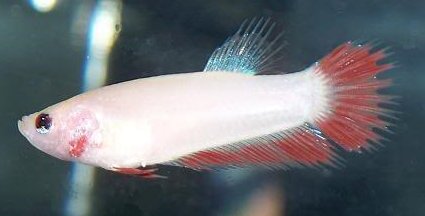
A betta’s color pattern is not purely cosmetic. Two types of stripe patterns carry specific diagnostic information that every keeper should know: horizontal stress stripes (a warning) and vertical breeding bars on females (a readiness signal).
Getting them confused, or ignoring them, is a common mistake. The direction of the stripes is the entire distinction.
Horizontal stripes: the stress signal
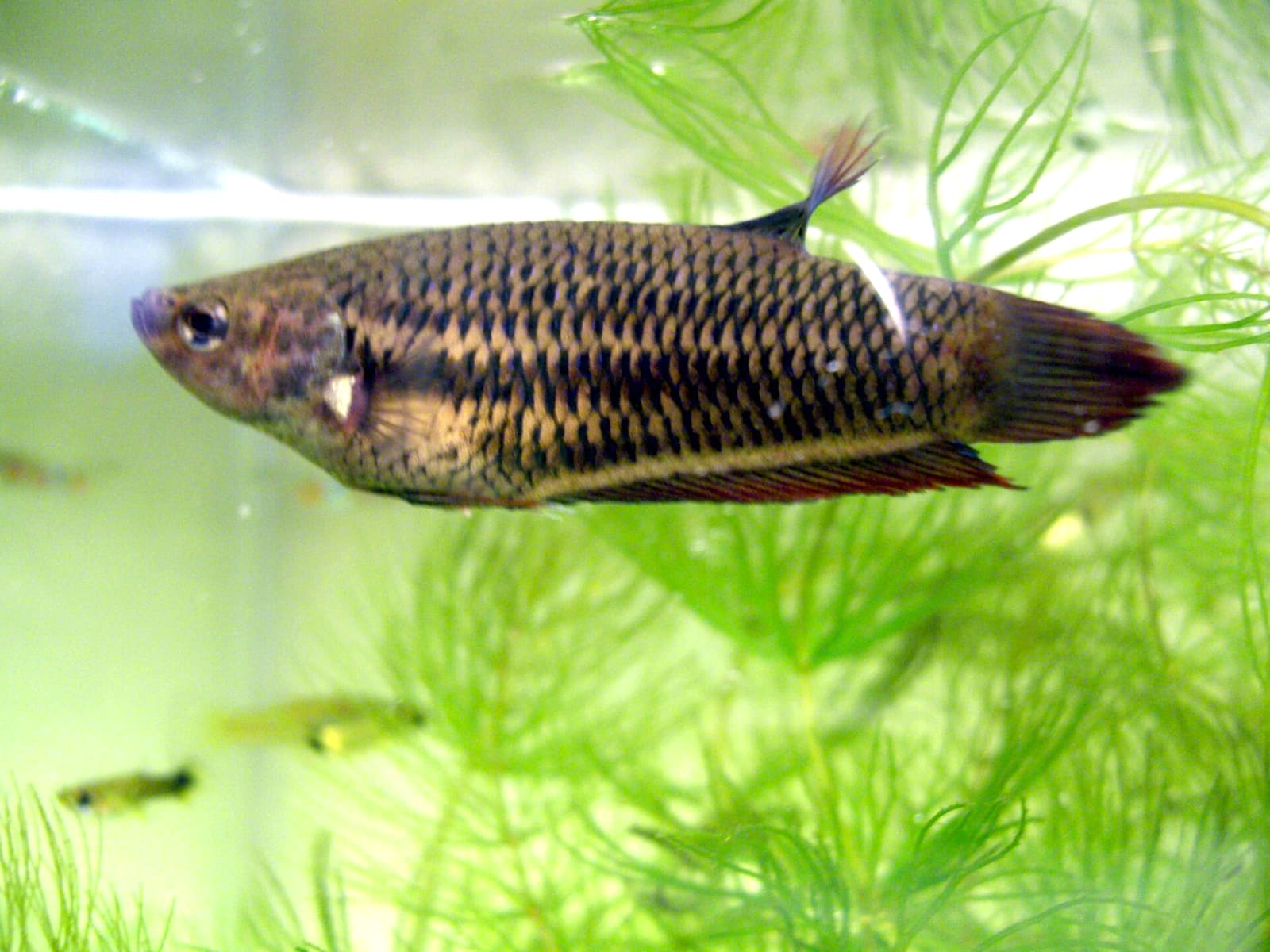
Horizontal stripes run along the length of the body, parallel to the spine. They appear as dark bands, often 4–6 lines running from behind the head to the tail base. In bettas with light or iridescent base colors, they show as brownish or charcoal bands that were not there before.
These are stress stripes. They appear when the fish’s body releases stress hormones: the same physiological response that produces faded color and clamped fins, just manifesting differently in different individuals. Oliveira et al. (1998) documented measurable cortisol elevation in bettas exposed to social stress, and the 2022 laboratory-care review (PMC9334006) identifies horizontal stripe development as one of the observable stress indicators used in captive betta welfare assessment.
The stripes themselves aren’t the problem, they’re a symptom. What matters is the cause. A stripe or two on an otherwise active, eating fish that just came home from the store is almost always transport stress working itself out. It’s only when stripes show up alongside clamped fins, lethargy, or a fish that’s stopped eating that something is actually wrong.
Common causes
| Cause | How to identify | How to fix |
|---|---|---|
| Cold water (below 76°F) | Thermometer reads low | Heater adjustment |
| Ammonia or nitrite in the water | Test kit positive | Water change + investigate cycle |
| Recent transport or tank move | Appeared after a disturbance | Usually resolves in 24–48 hours |
| Constant reflection aggression | Tank is highly reflective | Add background paper to three sides |
| Neighboring aggressive fish | Adjacent tank with visible betta | Separate or block line of sight |
| Underlying disease | Other symptoms present | Diagnose and treat the disease |
What to do
Work through the list above. Temperature and water quality are always first, and that means testing nitrate along with the two acute toxins, ammonia and nitrite. If both are correct and the fish has been in the tank more than 48 hours, look for external stressors (reflection, adjacent fish). If all environmental factors are eliminated and the stripes persist beyond 3–4 days, inspect for disease: look for spots, fin damage, or swelling alongside the stripes. Stripes still present after two weeks aren’t a one-time event anymore, they’re a chronic stress problem with an uncorrected cause, and they warrant a fuller workup than a single water change.
Stress stripes that fade and return intermittently usually indicate an intermittent stressor: lights being suddenly turned on in a dark room, vibration near the tank, or a pet approaching the glass regularly.
Vertical bars: the female readiness signal
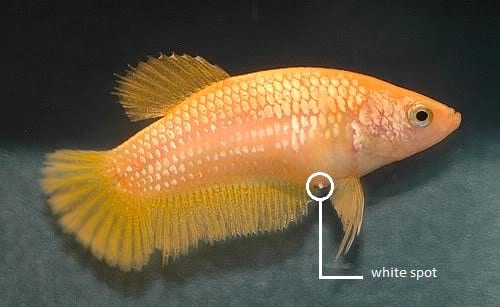
Vertical bars are perpendicular to the spine: they run from the dorsal surface to the ventral surface. On females in spawning condition, they appear as 4–6 dark bands crossing the width of the body.
These are breeding bars. A female displaying vertical bars is receptive to spawning. Combined with:
- Visible white ovipositor spot between the ventral fins (the egg-laying tube)
- Rounded, gravid belly
- Increased activity and display behavior
…this is the complete signal of a conditioned, ready female. See pair selection for how to read this in the context of a planned spawn.
Vertical bars on a female that is not being conditioned for breeding are less common but can still appear; she may have been triggered by seeing a male or by hormonal cycling. They are not a health concern.
Males can show vertical bars too, rarely, and the meaning is different. It isn’t a breeding-readiness signal for them the way it is for females; a barred male more likely reads as extreme stress or fright. If a male’s color shift is pronounced and doesn’t resolve, treat it as a disease flag and work through the causes above, not as a breeding cue.
Why direction matters
The difference is orientation:
- Horizontal = along the length (head to tail) = stress
- Vertical = across the width (back to belly) = breeding readiness in females
A common error is describing bars as “stripes” without noting which direction they run. When reporting a color change to a veterinarian or experienced keeper, specifying horizontal vs. vertical leads to a useful answer immediately.
Color fading vs. stripes
Stress stripes are a specific patterning change. General color fading (the entire fish becoming paler, less saturated) is a separate signal that also indicates stress or illness but is not the same as stripe development. Both can occur together. Fading alone (no stripes) most commonly indicates temperature stress or early disease. Stripes plus fading together indicate significant stress.
Distinguishing stress stripes from color fading
They look similar in casual description (“the fish looks duller”) but are distinct under close observation.
Stress stripes are discrete, dark, banded markings that appear as added pattern on top of the fish’s base color. The fish may retain most of its base color saturation; what changes is the appearance of the horizontal bands. Often visible in 4–6 lines from the head toward the tail. In lighter-colored fish they show as dark gray or charcoal; in darker fish they appear as a contrast shift.
Color fading is a general loss of saturation across the entire fish. The base color itself washes out: a royal blue becomes steel gray, a red becomes pink, an orange becomes cream. No discrete banding.
Both indicate stress, but general fading often means the stressor is severe or ongoing (temperature crash, ammonia spike, active disease). Stress stripes in an otherwise normally colored fish more commonly indicate acute or moderate stress such as a recent move or reflection exposure.
A fish with both stripes and fading simultaneously has a significant, ongoing problem. Test water and temperature before anything else.
The two tools for diagnosing and resolving stress stripes: an API Freshwater Master Test Kit (affiliate) to confirm water parameters, and Seachem Prime (affiliate) for the water change that resolves them. Ninety percent of stress-stripe cases clear within 24 hours of a 25% water change with Prime-treated water at the correct temperature.