Most betta swim bladder problems are constipation or overfeeding, not disease. A 48-hour fast followed by a small skinned pea resolves 70 to 80% of cases. Persistent cases past a week suggest bacterial infection in the swim bladder tissue, which is treatable with kanamycin. Genetic predisposition in heavily finned strains produces chronic issues that can only be managed, not cured (Merck Veterinary Manual, Aquarium Fish; PMC9334006, Care and Use of Siamese Fighting Fish, 2022).
How to recognize it
Floating sideways or upside down. Most common. Fish lists at the surface, swims at an unnatural angle, has trouble diving.
Sinking. Less common. Fish sits on the substrate, struggles to rise, labored swimming.
Vertical positioning. Head-up or head-down vertical hang. Often seen with severe dysfunction.
Spiral or erratic swimming. Loss of orientation in the water column.
In all cases the swim bladder (a gas-filled organ that regulates buoyancy) is either over- or under-inflated. The cause determines the fix.
The five causes, in order of frequency
- Constipation/overfeeding (60-70% of cases). Enlarged intestine compresses the swim bladder. Pea + fast works.
- Gulped air from surface feeding (10%). Bettas occasionally swallow air with floating pellets. Resolves on its own in 24-48 hours. Switch to sinking pellets.
- Bacterial swim bladder infection (10%). Aeromonas or Pseudomonas colonizing the bladder lining. Needs kanamycin.
- Physical injury (5%). Trauma from tank-mate attack, sharp décor, or jumping into the lid. Usually self-resolves.
- Genetic/spinal (5-15%, depends on strain). Rosetails, heavily finned halfmoons, giants. Chronic, not curable. Lower water helps.
A rarer cause worth ruling out if nothing above fits: an internal tumor pressing on the bladder from outside produces the same floating or sinking symptoms without any digestive or bacterial cause. If the fish also shows body distension, see Betta Fish Lumps: Lymphocystis, Cysts, Tumors Explained.
Treatment: the constipation protocol
Day 1 to 3: Fast
Withhold all food for 48 to 72 hours. Bettas handle a 3-day fast fine. Bloat and intestinal pressure resolve during this window.
For a fish struggling to swim, also lower the water level to 4 to 6 inches deep. Less water depth means less effort to reach the surface to breathe, which matters because the fish is tiring quickly.
Day 3: The pea
Thaw one frozen green pea (frozen preferred; canned peas contain sodium). Skin it (skin can further constipate). Mash the inner pea. Offer a quarter to a half of the pea, no more, and don’t make it a daily habit. Too much pea flips the problem: overfeeding fiber can bloat the fish right back into the same floating or sinking symptoms you’re trying to fix.
If the fish eats it, fiber promotes intestinal motility. Watch for a tiny visible stool within 6 to 12 hours. That’s the protocol working.
If the fish refuses the pea, try again 24 hours later. If still refused by day 5, the issue is likely not simple constipation. Move to antibiotic consideration.
Day 5 to 7: Reassess
- Improved swimming, normal feeding: resolved. Return to normal schedule with smaller portions.
- Still struggling but feeding: continue light feeding, add Epsom salt at 1 tablespoon per 5 gallons, give another week.
- Not improving, not eating: probably infection. Proceed to antibiotic.
Epsom salt (magnesium sulfate) works as a mild smooth-muscle relaxant, easing intestinal cramping rather than treating any pathogen. It’s optional, not essential, and shouldn’t be combined with aquarium salt: the two solve different problems and dosing both at once adds nothing.
Treatment: the infection protocol
When fast plus pea plus Epsom salt hasn’t worked in 7 days:
Setup: Hospital tank, 2-5 gallons, sponge filter, heater at 26 °C, no substrate, water level 4-6 inches.
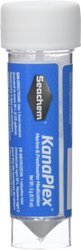
Medication: Seachem Kanaplex, 1 measure per 5 gallons, every 48 hours with 50% water change. 10-day course.
Seachem KanaPlex on Amazon Affiliate link. See our disclosure.
Food: Optional kanamycin-medicated food if the fish is still eating. Seachem Focus plus Kanaplex bound to pellets.
Seachem Focus on Amazon Affiliate link. See our disclosure.
The heavily finned strain case
Rosetails, feather-tails, heavily inbred halfmoons and giants have structurally compromised swim bladders from the same selection pressures that produce their dramatic fins. Chronic swim bladder dysfunction can be managed:
- Lower water permanently (4 to 6 inches depth in a 10-gallon footprint).
- Sinking pellets only; no floating food.
- Plants at the surface the fish can rest on.
- Small, frequent meals (2-3 pellets, twice a day) instead of one larger meal.
These fish can live relatively comfortable lives with accommodation. A breeder’s note: selection for shorter, simpler fins in your own line would reduce this over generations.
What not to do
Don’t dose broad-spectrum antibiotics on day 1. Constipation is more common. Try the pea first.
Don’t skip the fast. Feeding through a bloat incident worsens it.
Don’t force-feed. A fish that refuses food for 2 days often resumes when the bloat resolves. Force-feeding stresses.
Don’t add a “buoyancy aid.” There’s no such product that actually helps. Keep the water shallow, let the fish rest.
Don’t put a swim-bladder-affected fish back in a normal-depth tank too soon. Give it a week of stable swimming before returning.
Prevention
- Don’t overfeed. 4 to 6 small pellets once a day, one fast day per week.
- Switch to sinking pellets if your fish gulps air at the surface.
- Don’t feed freeze-dried bloodworms as a staple; they swell in the gut.
- Keep water parameters stable.
- If you’re breeding, select against spinal deformity and extreme fin elaboration.
Swim bladder episodes happen. Most resolve in a week with simple intervention. The fish that doesn’t resolve with a pea and a fast is the fish that needs a vet’s-level diagnosis, which in practice means antibiotics and patience. Swim bladder crosses into terminal territory when it shows up alongside pineconing, severe spinal curvature, or a fish that’s stopped eating altogether. At that point, stop extending the antibiotic course and read dropsy and the euthanasia protocol instead.
Related on this site
- Betta Disease: Diagnosis and Treatment, Evidence-Based
- Betta Feeding: What to Feed, How Often, How Much
- Betta Columnaris: Fast-Moving Bacterial Disease with a 5-Day Window
- Betta Dropsy: Bloat, Pineconing, and a Terminal Prognosis
- Betta Euthanasia Protocol: When Treatment Isn’t the Right Answer
- Constipation: Fasting Protocol and the Daphnia Fix
- Betta Not Eating: Diagnostic Guide