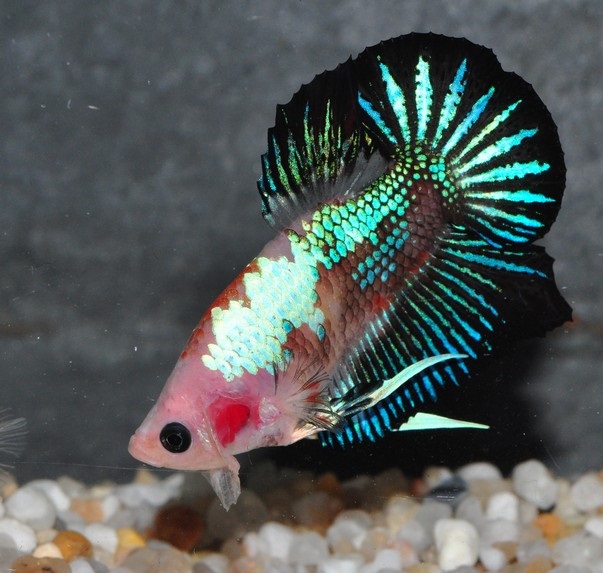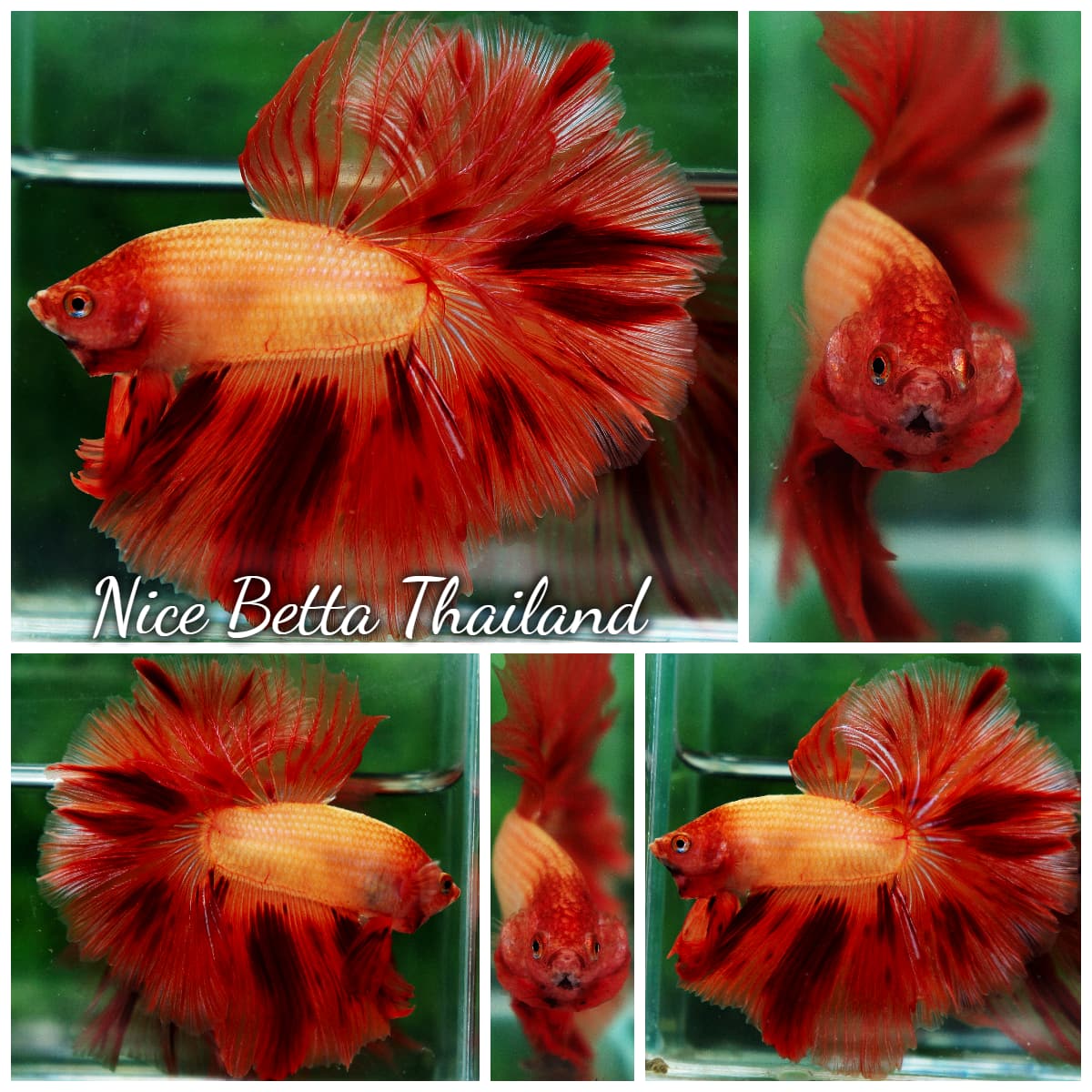
Marble pattern in bettas is the hobby’s most unpredictable colour trait, and it is far less understood than most sources claim. The 2022 genetic-architecture paper (PubMed 36129976) performed a case-control GWAS on 209 solid fish against 55 mosaic fish and found the pattern to be polygenic, spread across multiple loci rather than driven by one gene. That same paper states plainly that for mosaic pattern, “the underlying molecular basis has not been investigated.” If you have read that marble comes from a transposable element in a specific pigmentation gene, that claim is hobby explanation. It is repeated widely, including in earlier versions of this page, and it is not what the research says.
The science in brief
Transposable elements are DNA sequences that can change position within the genome. They carry with them the ability to activate or suppress nearby gene expression.
The honest position is that nobody has identified the molecular switch. What is documented is the inheritance behaviour: pattern instability is heritable, it expresses differently between cell lineages during development, and it keeps expressing through adult life. A mechanism that fits those observations has been proposed by hobbyists for decades, but proposing is not the same as mapping.
Result: patchwork. Some regions fully pigmented, others white, others intermediate. The pattern is unique to each fish and can keep changing as new cells form and old cells die.
The 2020 chromosome-level genome assembly (PubMed 32385046) is what made the 2022 mapping possible, and it is the reference any future work on this will build from. The mechanism question is open, and it is a genuinely good one for someone with sequencing access.
Why marble shifts over time
In most animals, once development establishes pattern, it stays. In marble bettas:
- Pattern expression continues to change in adult tissues, not only during development.
- New pigment cells form and may or may not express the adjacent gene.
- Old patterns fade as pigment cells die and are replaced.
- Over months to years, the overall pattern visibly shifts.
A fish photographed at purchase (week 10) and again at year 2 can look like two different fish.
Breeding behavior
Marble (Mb) behaves as dominant: one copy is enough to produce the pattern, which is why crosses to non-marble partners still throw marble fry at close to Mendelian dominant ratios.
Mb × non-Mb: approximately 50% of offspring express marble. Expression level highly variable.
Mb × Mb: high percentage marble offspring, some with extreme expression. Highly variable pattern.
Because expression appears partly stochastic, even siblings from the same spawn with identical marble-locus genotype can look wildly different. Selection for specific patterns requires:
- Raise large broods.
- Select offspring with desired pattern at weeks 8-12.
- Breed selected offspring to each other or to complementary marbles.
- Accept that offspring pattern remains unpredictable.
Modern marble-related phenotypes
- Classic marble: irregular patches of white, red, blue, black. Asymmetric.
- Koi: specific red-black-white calico pattern inspired by koi fish. Marble genetics with selection.
- Galaxy koi: koi pattern with iridescent spots (opaque gene added).
- Candy koi: koi with pastel colors.
- Multicolor: marble-like but with more uniform color distribution.
- Butterfly marble: marble body with fin color bands.
All are the same underlying pattern instability under different selection backgrounds, which is why they interconvert so readily in a spawn.
The practical breeder perspective
Marble is fun but hard to line-build. If you want predictable fry, don’t start with marble. If you want beautiful unpredictable fry with one-of-a-kind patterns, marble is excellent.
Tips for marble breeding projects:
- Photograph each fish weekly to track pattern shift.
- Select offspring at week 12 when adult pattern is mostly set (though it’ll still shift somewhat).
- Cross marble to solid colors to reintroduce genetic diversity.
- Expect 15 to 30% of fry to show the most desirable pattern in any given spawn.
- Be ready for patterns to drift over months. A “perfect” koi at week 10 may be mostly white by month 8.
The non-marble alternative
If pattern predictability matters:
- Solid colors (red, blue, yellow, black melano) produce mostly-uniform offspring.
- Bi-color patterns (cambodian, pineapple) are more stable than marble.
- Butterfly patterns with distinct fin-body contrast are somewhat stable.
Marble trades predictability for uniqueness. Each marble fish is one-of-a-kind. Each marble fish also may look different next year.
The scientific significance
Marble is interesting beyond the hobby because it is a commercially selected, visually dramatic trait whose molecular basis is still unresolved in a species with a published reference genome. The 2022 paper notes the same pattern appears in koi carp and medaka and that none of them have had the mechanism worked out.
Future work could include:
- Identifying the causal variants across wild and captive populations.
- Determining whether the instability can be stabilised without losing colour diversity.
- Exploring whether similar mechanisms produce pattern variation in other ornamental fish (koi, goldfish, guppies).
The hobbyist takeaway
Marble is beautiful, unpredictable, and genetically interesting. It’s one of the few color traits where breeding two identical-looking parents can produce wildly different fry, and where the fish you bought last year may not look the same today. For the fish itself: marble is a pattern trait with no welfare implications. The same baseline care applies, stable temperature, good water quality (Seachem Prime (affiliate) for dechlorination, API Freshwater Master Test Kit (affiliate) for weekly monitoring), and quality protein.
Embrace the unpredictability or avoid the trait. Middle ground is harder to achieve than most beginners assume.
A marble betta is a small living demonstration of a genuinely unsolved question. Every visible patch reflects something switching on or staying quiet in a particular cell lineage during development, and nobody has yet published what that something is. That is unusual for a trait this commercially selected, and it is worth appreciating.