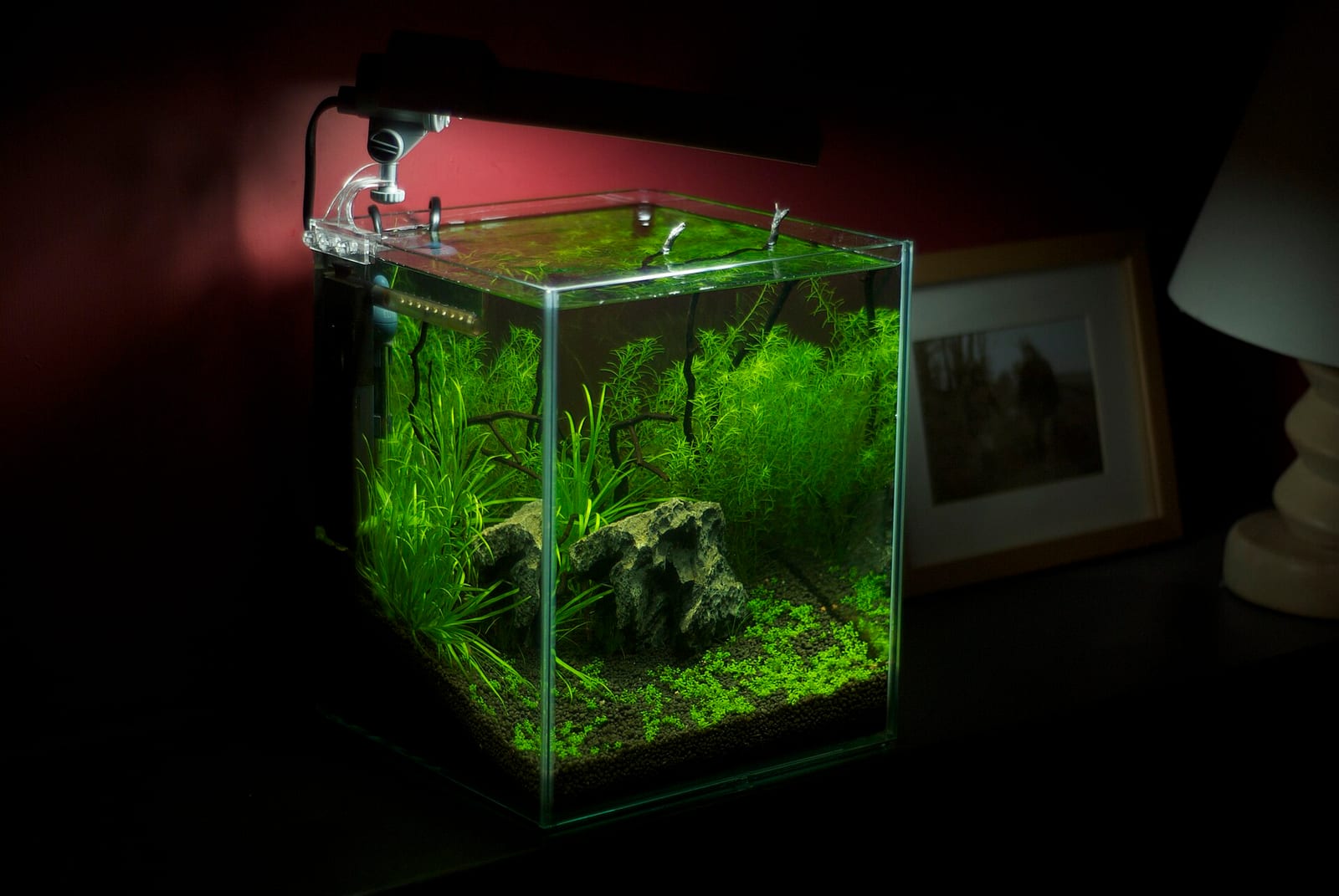
Run a betta tank light 8 to 10 hours a day, on a timer, at the same hours every day, and leave the tank genuinely dark the rest of the time. Cut to about 6 hours if algae takes hold. The betta himself does not need an aquarium light at all; the plants do, and the fish needs the darkness more than he needs the light.
How many hours should the light be on?
Eight to ten. That is the number the planted-tank world has settled on, and Aquasabi’s aquascaping reference puts it plainly: the light should be on for 8 to 10 hours a day for a nature-style planted aquarium, and the regular light period should be controlled daily.
Two adjustments to that baseline:
- New tank, new plants: start at 6 to 8 hours. Freshly planted stems and crypts are still converting from emersed growth. They cannot use a long day yet, and the light they do not use feeds algae instead. Work up over a month.
- Algae taking hold: drop to about 6 hours. Same source, same reasoning. Reducing the light period is the first lever, before you buy anything.
If you keep no live plants, you do not need a fixture at all. Ambient room light on a normal domestic cycle is sufficient for the fish, and it is the option least likely to produce algae. That is not a compromise; it is the setup Seriously Fish implicitly describes when it calls for a well-planted, shady aquarium with heavy surface cover.
Why does a consistent schedule matter more than the number?
Because the damage from lighting is not about brightness. It is about a day that never ends or never starts at the same time.
The clearest evidence comes from a 2023 goldfish study in Animals, “Assessing Chronodisruption Distress in Goldfish.” Fish held under a normal 12 hours light and 12 hours dark cycle were compared against fish held under 24 hours of continuous light for 53 days. The continuous-light group showed elevated plasma cortisol throughout the experiment and increased thigmotaxis, meaning they hugged the edges of an open-field arena instead of exploring it, which is the standard fish read-out for anxiety-like behavior. The authors’ conclusion was that these conditions cause distress in the animals and should be considered for welfare improvement.
That is goldfish, not Betta splendens, and the honest translation is a directional one rather than a number. But the mechanism is shared across teleosts: melatonin is suppressed by light, the stress axis runs on a daily rhythm, and removing the rhythm removes the recovery window. A betta left under a light you switch on and off whenever you walk past is living in that experiment at low intensity.
The practical version of this is boring and effective. Pick two clock times. Never move them. A tank lit 9am to 7pm every single day is better for the fish than one lit for a “correct” nine hours that lands somewhere different each day.
Do betta fish need light at night?
No. Nothing. Not a blue moonlight, not a dim night mode, not a lamp left on in the room.
Blue LED night settings are sold as a way to keep watching the tank after dark, and they are marketed with a story about moonlight. Moonlight at the water surface of a Thai rice paddy is a fraction of a lux. An LED moonlight mode over 5 gallons is orders of magnitude brighter than that, and it sits directly above a fish who cannot leave. Bettas rest at night, wedged on a leaf or in a cave, and they do it properly only in the dark. There is more on what that rest actually looks like in do betta fish sleep.
If you want to see the tank in the evening, extend the photoperiod later rather than adding a second dimmer light: lights on at noon, off at 10pm, is a perfectly good 10-hour day for someone who is out during the working day.
What does the research say a betta’s photoperiod should be?
Here is the honest answer, and it is more useful than a confident one: nobody has established it.
The 2022 laboratory husbandry review for Betta splendens in Comparative Medicine describes its own colony as running a 14 hour light, 10 hour dark cycle under fluorescent lighting, chosen to mimic summer conditions in the species’ natural range, because that colony exists to breed fish. In the same passage the authors state directly that published studies have not determined the optimal lighting for betta reproduction. That is a research colony documenting a working assumption, not a validated target, and they say so.
So there are two numbers in circulation and they are answering different questions. 14:10 is a breeding-colony number aimed at maximizing spawning in a bare tank with no plants and no algae to worry about. 8 to 10 hours is a display-tank number balancing plant growth against algae in a tank you have to look at. For a pet betta in a planted 5-gallon, take the display number. If you are running a spawning setup, the longer day is defensible and is what the literature actually describes.
How do you keep plants alive without stressing the fish?
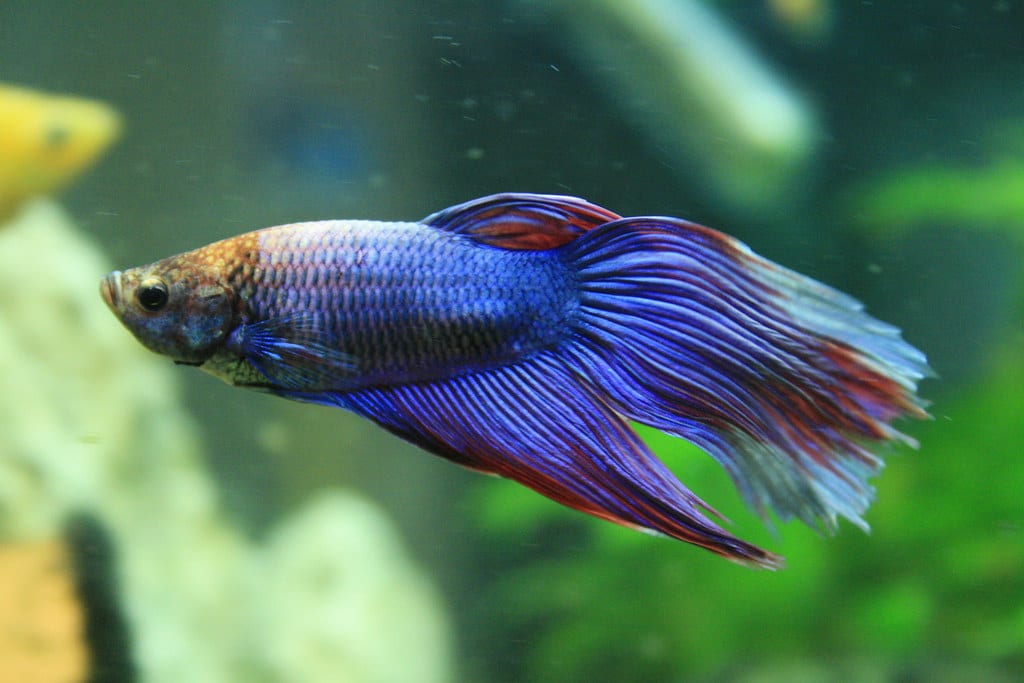
By breaking the light up rather than turning it down. A betta is a shade animal. Seriously Fish describes the appropriate aquarium as well-planted and shady, with plenty of surface cover from tall stem plants, floating species such as Salvinia or Riccia, or a Nymphaea lily. Every one of those diffuses the fixture above it.
Floating plants are the single best fix here, and they solve three problems at once: they cut the intensity that reaches open water, they give the fish somewhere shaded to hold station, and they strip nitrate that would otherwise feed algae. Red root floaters, frogbit and salvinia all work. Duckweed also works and you will never be rid of it, so decide that one deliberately. Which species suit a betta tank, and which grow under a low-output nano fixture, is covered in best live plants.
Two structural notes worth more than any wattage number:
- Height above the water changes intensity more than the fixture spec does. The same LED sat on the rim of a 5-gallon delivers far more light to the substrate than one on legs three inches up. If plants are melting under a light you were told was low, raise it before you replace it.
- A tank near a window has a second, uncontrolled light source. Direct sun through glass will grow algae faster than any fixture and will swing temperature as well, which matters for the reasons covered in temperature. Keep the tank out of direct sun, full stop.
Do you need a timer?
Yes, and it is the cheapest piece of equipment on this site.
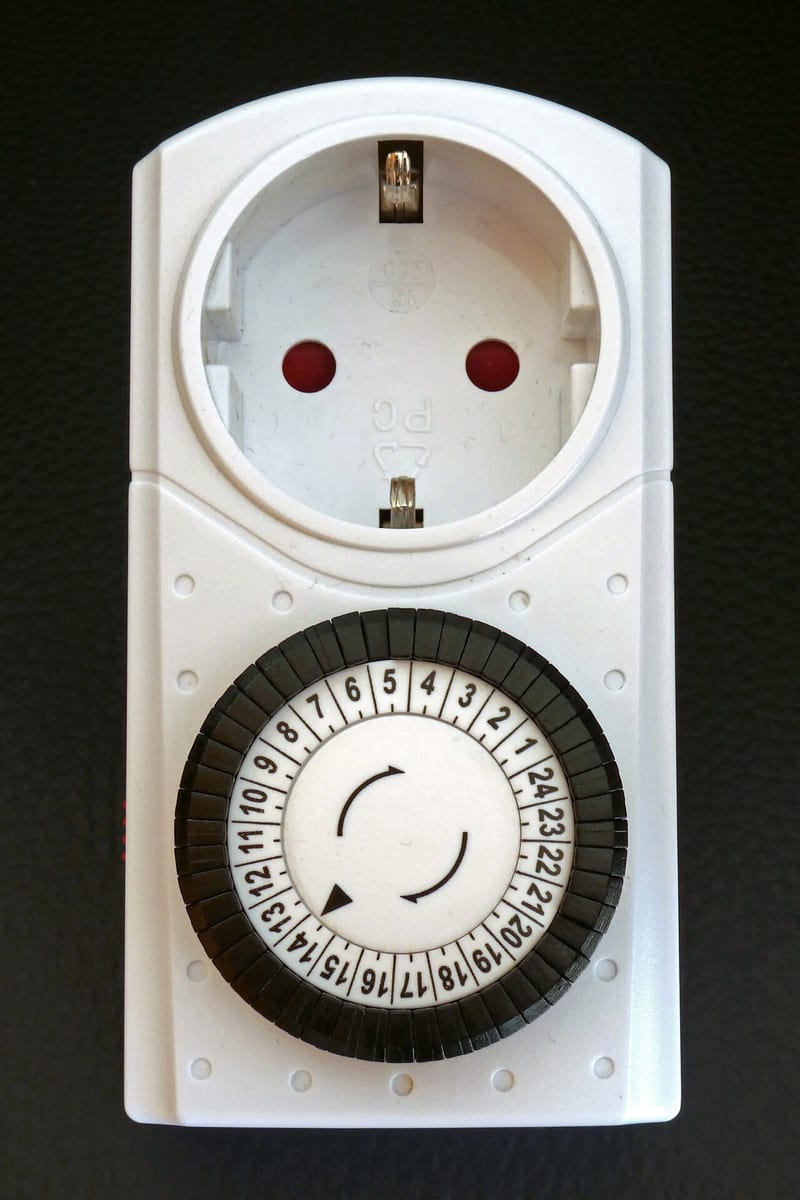
A mechanical dial timer costs around $10 and cannot lose its programming. A digital outlet timer gives you exact minutes and multiple on and off blocks. A smart plug gives you a schedule you can change from your phone, which sounds useful and mostly means you will change it, which is the thing this whole article is arguing against. Many nano LEDs, including the NICREW ClassicLED Plus, now have the timer built into the controller, which removes the outlet timer entirely.
Whichever you use, the point is that the schedule survives you being ill, distracted, or on holiday. Consistency delivered by a person is not consistency. It is worth noting that the same timer can carry your vacation care plan without any further thought.
Check BN-LINK 24-hour mechanical timer on Amazon Affiliate link. As an Amazon Associate we earn from qualifying purchases. See our disclosure.
Which light should you buy for a 5-gallon?
Two are worth the money, and the split is whether you want the timer inside the fixture or on the wall.
NICREW ClassicLED Plus, 10W, 12 to 18 inch. Built-in timer and a daylight and moonlight cycle, brightness adjustable, sized for exactly the footprint a 5-gallon betta tank occupies. Set the daylight block and ignore the moonlight function, for the reasons above. This is the default recommendation.
Check NICREW ClassicLED Plus on Amazon Affiliate link. See our disclosure.
Fluval Plant Nano, 15W, Bluetooth. More light than a low-tech 5-gallon needs, which is the point if you are growing carpeting plants or anything demanding. Full spectrum control and a programmable 24-hour cycle with gradual sunrise and sunset ramps, which is genuinely kinder than a fixture that slams on at full output. It costs roughly three times the NICREW.
Check Fluval Plant Nano on Amazon Affiliate link. See our disclosure.
What to skip: the colored LED strips bundled with cheap kits, which are tuned to make fish look vivid and grow nothing, and any fixture with no way to control on and off other than a switch on the cord.
Check smart plugs and light timers on Amazon Affiliate link. See our disclosure.
How do you use a blackout to clear algae?
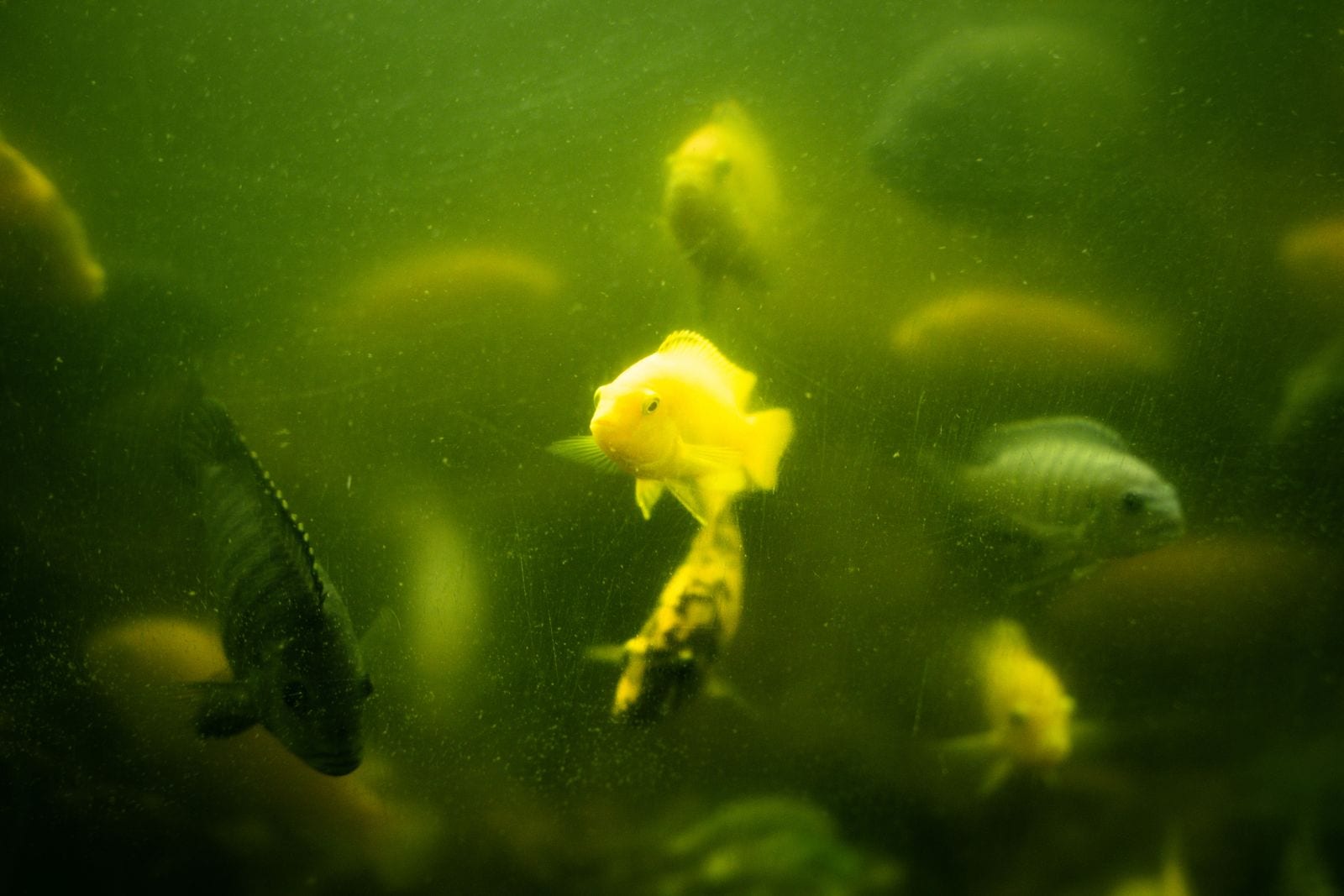
A blackout is total darkness for several consecutive days. It works because algae hold almost no reserves, while your plants can run on what is stored in their roots and leaves for a week without lasting harm.
The protocol, following Aquasabi’s black-out treatment:
- Siphon and scrub off as much algae as you physically can first. The blackout kills what remains; it does not clean the glass for you.
- Cover the tank completely. Dark cloth or card over every pane. A light-tight cover matters more than the number of days.
- Keep the tank well aerated. Raise the filter outlet or add an airstone. Dying algae consume oxygen as they break down, and this is the step people skip.
- Turn off CO2 and stop dosing liquid fertilizer.
- Feed very sparingly. You can switch the light on briefly to feed every three or four days. A betta will not suffer from a light week; skipping food entirely for seven days is a different matter, so feed him, just less.
- Cap it at 7 days if the tank holds stem plants or sun-loving carpet species. Shade plants such as mosses, ferns, Anubias and Cryptocoryne tolerate up to two weeks.
- Large water change immediately afterwards. The dead algae will foul the water otherwise. Test ammonia after, because a big die-off can dent the biofilter.
It works well on blue-green algae, most filamentous green algae and algae films. It is close to useless against red algae, meaning black beard and staghorn, which need a different approach.
And then the part that decides whether you do this again next month: a blackout does not remove the reason the algae appeared. That reason is almost always light and nutrients out of balance. Come back on at 6 hours, not at the 10 you were running, add floating plants, and check nitrate against the numbers in water parameters. Then walk the photoperiod back up over several weeks.
Related on this site
- Betta Tank Setup: A 5-Gallon Minimum Build, Step by Step
- Do Betta Fish Sleep? What It Looks Like and When to Worry
- Best Live Plants for Betta Tanks in 2026
- Betta Fish Water Parameters: The Complete Reference Table
- Betta Water Temperature: 76 to 82°F and Why Stability Wins
- Betta Fish Vacation Care: 1 Day, 1 Week, and 3 Weeks Away
- Best Substrate for a Betta Tank: Sand, Gravel, or Aquasoil