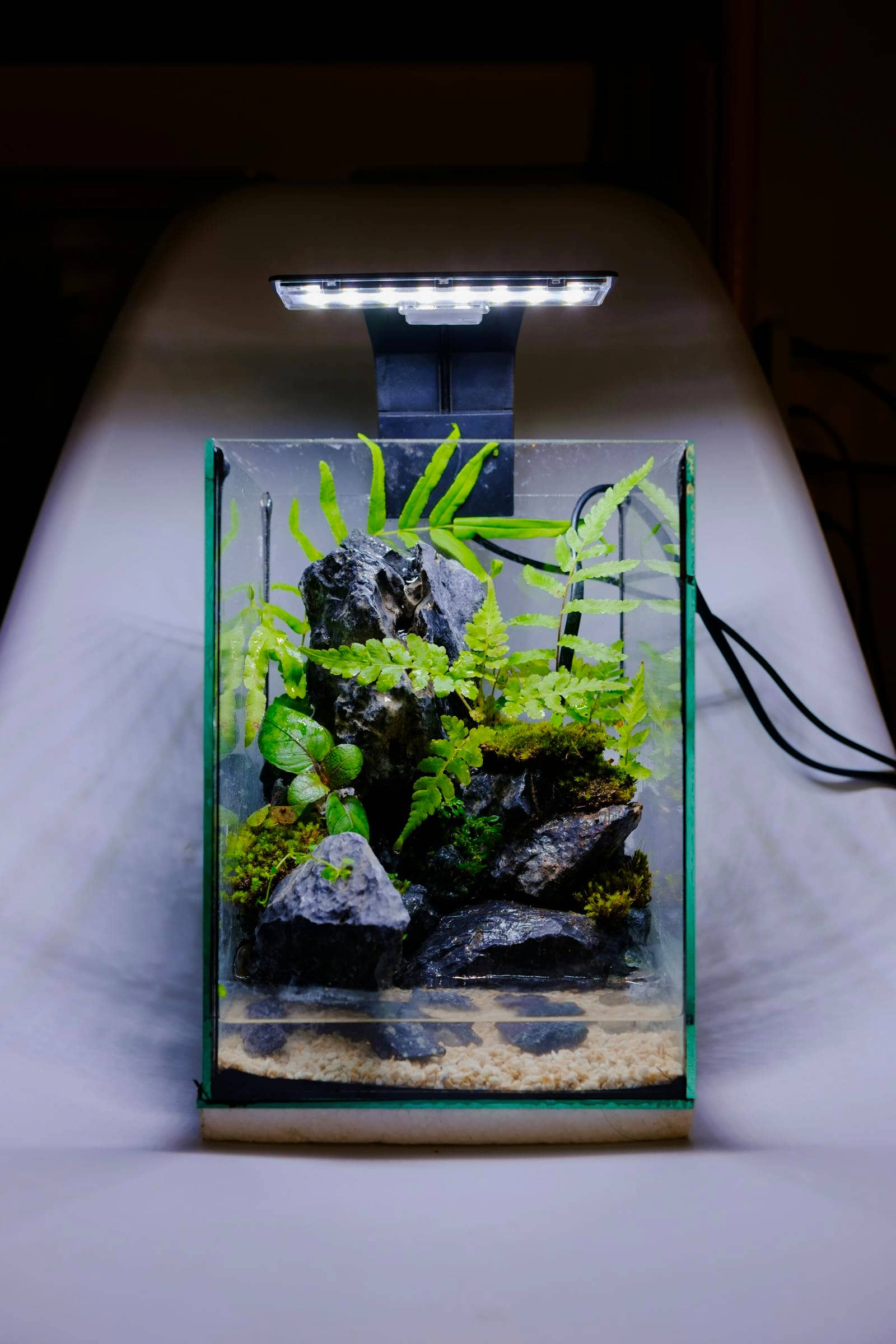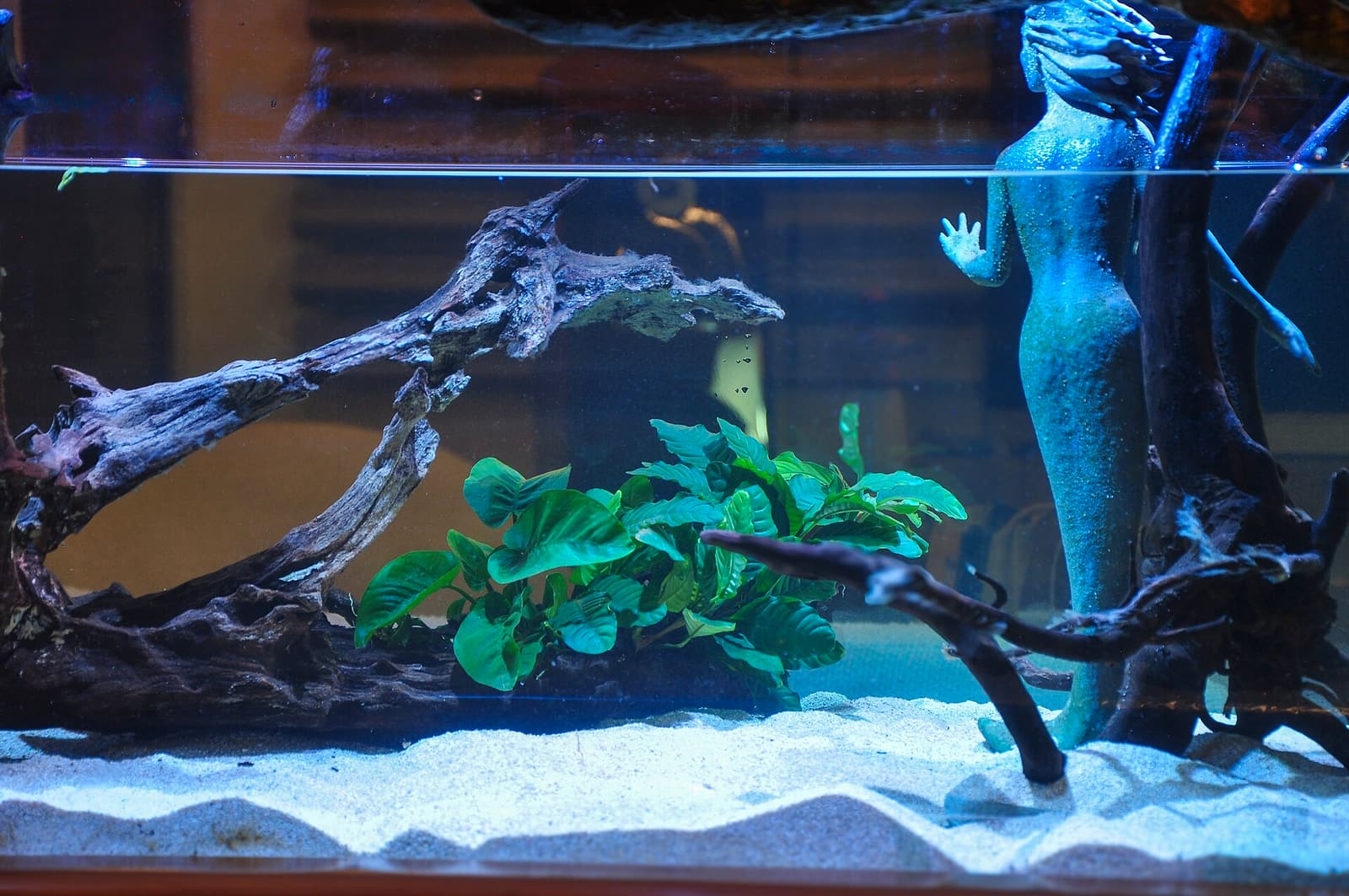
Four options that meet the 5-gallon minimum, all glass. Acrylic 5-gallons exist too; they weigh less but scratch far more easily, so glass is the better default unless weight is a real constraint for you. Tank-size recommendations align with IBC husbandry standards.
This page has affiliate links. See our affiliate disclosure.
Quick comparison
| Tank | Volume | Filter | ~Price | Verdict | Buy |
|---|---|---|---|---|---|
| Fluval Spec V | 5 gal | Included (3-stage) | $90 | Best overall | Amazon |
| Marineland Portrait 5 | 5 gal | Included | $100 | Great aesthetics | Amazon |
| Aqueon MiniBow 5 | 5 gal | Included | $60 | Budget acceptable | Amazon |
| Bare 5-gal glass + separate gear | 5 gal | Sponge filter | $45–85 | Cheapest real setup | Amazon |
Filtration flow: what to actually target
Every tank on this list ships with, or needs, a filter, and the spec that matters more than brand is turnover: how many times the pump cycles the whole tank’s water per hour. The general aquarium-industry guideline is 4x tank volume per hour as an upper bound, which is 20 gallons per hour (GPH) for a 5-gallon tank, but that figure comes from community fish, not bettas. In practice, 10-15 GPH is the sweet spot for a single betta in 5 gallons: enough turnover to keep ammonia and debris moving to the filter media, gentle enough that a long-finned fish isn’t fighting a current all day.
This is why the “flow rate adjustable” pro on every kit tank below matters more than it sounds. A sponge filter, the gold standard for bettas (see our filter buyer’s guide), doesn’t have a fixed GPH rating at all; its flow is entirely a function of the air pump driving it, so an air pump with an adjustable output valve is what actually lets you dial a sponge filter down to betta-appropriate flow. An air pump without a valve runs the sponge filter at full output regardless of tank size, which is exactly the wrong tool for a 5-gallon.
1. Fluval Spec V
The safe recommendation for a single betta owner.
Pros:
- Actually 5 gallons (sometimes listed as 19 L).
- Integrated three-stage filter at the back, rated at 53 GPH from the manufacturer’s own circulation-pump spec, with adjustable output.
- Good LED light, respects aquatic plants.
- Curved front glass looks nice.
- Flow rate adjustable (important for bettas; reduce to minimum, well under the 53 GPH ceiling).
Cons:
- Filter flow can be too strong out of box even at reduced settings; baffle with filter floss for a fully-finned male.
- No heater included; add a Fluval P25 separately (~$25).
- Pump noise noticeable in a bedroom.
Price 2026: $85-95.
Check price on Amazon Affiliate link. See our disclosure.
2. Marineland Portrait 5
The aesthetic choice.
Pros:
- Portrait (tall) shape, 5 gallons.
- Rimless curved glass, minimalist look.
- LED integrated with a 3-way white/blue/off switch.
- Three-stage hidden filtration with an adjustable-flow pump.
Cons:
- Tall shape gives bettas less horizontal swimming area. Manufacturer dimensions put this tank around 14 inches tall on a footprint of roughly 9.6 by 9.6 inches, meaning a betta gets a narrow square of floor space rather than the long horizontal run a labyrinth fish actually prefers for cruising.
- Filter impeller can catch long fins; baffle.
- More expensive than Spec V.
- Add heater separately.
Price 2026: $45-70 depending on retailer and sale cycle.
Check price on Amazon Affiliate link. See our disclosure.
3. Aqueon MiniBow 5
The budget option that still meets minimums.
Pros:
- Actually 5 gallons (older MiniBow 3 does not qualify).
- Affordable.
- Widely available at PetSmart, Petco, online.
- Includes a basic filter.
Cons:
- Basic filter is not great; upgrade to a sponge filter or baffled HOB.
- The stock cartridge filter uses proprietary replacement cartridges the manufacturer recommends swapping roughly every 4 weeks. Budget for that ongoing cost, or replace the whole cartridge assembly with a sponge filter once and skip it entirely.
- LED is weak.
- Add heater.
- Bowl shape (curved sides) limits planting.
Price 2026: $50-65.
Check price on Amazon Affiliate link. See our disclosure.
4. Bare 5-gallon glass + separate gear
Often the best total value.
Shopping list:
- Aqueon 5-gallon glass aquarium: $15-20.
- Hikari or Hygger sponge filter rated 5-10 gal: $10.
- Tetra Whisper 10 air pump: $12.
- Airline tubing + check valve: $3.
- Fluval P25 preset heater: $25.
- Glass lid: $15.
Total: $80-85 new. Often under $50 if you source used on Facebook Marketplace.
Pros:
- Best filtration (sponge filter is the gold standard for bettas).
- Modular; upgrade or replace individual pieces.
- Quietest option.
- Most reliable heater included.
Cons:
- Slightly more assembly.
- Aesthetics vary; cheaper look than Spec V.
- No integrated LED.
Check Aqueon 5-gallon on Amazon Affiliate link. See our disclosure.
What to skip
Anything under 5 gallons. Explicit welfare floor. Don’t buy.
Rounded betta bowls. Poor footprint, often undersized.
“Complete kits” under $40. Usually inadequate.
Tanks with non-removable or weak LED lights claiming aquatic plant support. Most integrated LEDs are mediocre at best.
Add-ons regardless of tank choice
- Heater (if not in kit): Fluval P25, preset 78 °F. Buying an oversized heater “for safety margin” is a common mistake specific to nano tanks: a heater doesn’t lower its wattage output when the water’s already warm, it just switches off and on around the setpoint, so an adjustable heater rated for a 20- or 40-gallon tank still dumps its full wattage into 5 gallons every time it cycles on. Less water means less thermal mass to absorb that burst, so an oversized heater in a small tank overshoots the setpoint more, not less. Match wattage to volume; see our heater buyer’s guide for the sizing table.
- Thermometer stick-on or glass: $3.
- Test kit: API Freshwater Master Kit: $30.
- Dechlorinator: Seachem Prime 100ml: $8.
- Substrate: 2-5 lb aquarium sand: $15.
- Live plants: Anubias, Java fern, cryptocoryne: $20 total.
- Cover/hiding spots: Mopani driftwood or ceramic cave: $10-15.
Don’t forget the weight
A filled 5-gallon setup is heavier than it looks on the shelf. Five US gallons of water alone is about 41.7 lbs (water weighs roughly 8.34 lbs per gallon), and once you add the glass tank, a few pounds of substrate, and decor, a filled 5-gallon commonly lands in the 45-55 lb range. That’s fine on a proper stand or a sturdy piece of furniture, but it’s worth checking the surface can actually hold it before filling, rather than after. A drawer-front dresser or a flimsy particleboard shelf is not rated for that.
The 10-gallon upgrade
If you have space and a few extra dollars:
- Aqueon 10-gallon bare: $20.
- Basic filter, heater, lid: $50.
Total ~$70 for double the water volume. Better parameter stability, room for tank mates eventually, more planting options. Worth the upgrade if possible.
Honest final take
Fluval Spec V for most buyers who want a nice-looking kit and minimal assembly.
Bare 5-gallon with separate components for buyers who want the best-performing setup at the lowest price.
Skip everything else. The tank is the foundation of the whole system; getting it right is the first step toward a fish that actually thrives.