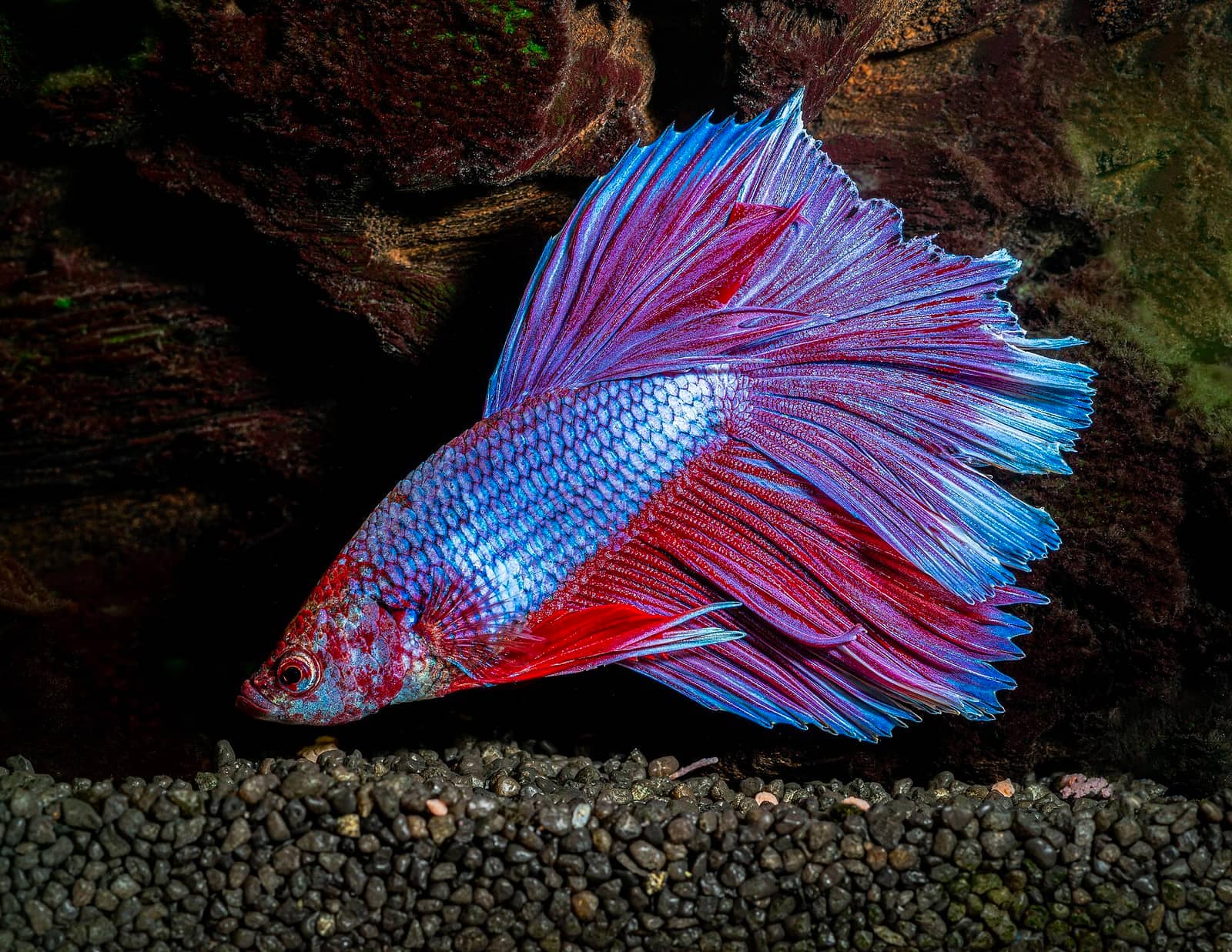
Four pellets worth buying as the staple diet for a pet betta. All have fish or insect meal as the first ingredient and protein above 36%. Priced $8 to $15 per jar. Protein and ingredient targets follow PMC9334006 on ornamental fish nutrition.
This page has affiliate links. See our affiliate disclosure.
Quick ranking
| Pellet | Protein % | First ingredient | Size | ~Price | Buy |
|---|---|---|---|---|---|
| New Life Spectrum Betta | 37% | Krill | 1mm | $8 | Amazon |
| Fluval Bug Bites Betta | 45% | Black soldier fly larvae | 0.25–1mm | $10 | Amazon |
| Hikari Betta Bio-Gold | 38% | Fish meal | ~1.4mm | $7 | Amazon |
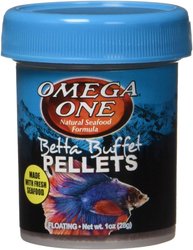
| Omega One Betta Buffet | 42% | Whole salmon | 1.5mm | $9 | Amazon |
All four work regardless of whether they float or sink. Hikari Bio-Gold floats, which matches how bettas naturally feed at the surface. NLS and Omega One are slow-sinking. Fluval Bug Bites sink slowly too, just in a smaller granule, giving the fish time to intercept mid-water. The one thing to avoid on any brand: pellets that sink so fast the fish can’t catch them, or that swell noticeably once wet, since both waste food and foul the water.
Size matters as much as brand. Adult bettas do best in the 1 to 1.5mm range shown in the table above; go smaller for juveniles. Too large and the fish spits the pellet out repeatedly, dirtying the water each time; too small and it can eat a full portion without ever looking satisfied.
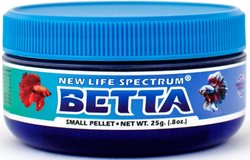
1. New Life Spectrum Betta Formula
The default recommendation.
Why:
- 37% crude protein.
- Krill listed first on the ingredient panel. Whole krill, not krill meal.
- Natural pigments for color enhancement.
- Widely trusted among breeders.
- No wheat or corn in formula.
Cons:
- Small 1mm pellets. Some fish struggle initially; soak briefly in tank water to soften.
- Jar size runs small; 1 oz (28 g).
Check price on Amazon Affiliate link. See our disclosure.
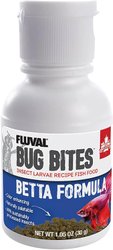
2. Fluval Bug Bites Betta
The newer insect-meal option.
Why:
- 45% crude protein, the highest of the four.
- Black soldier fly larvae first ingredient; sustainable protein source.
- Bettas take to it enthusiastically.
- Micro-granule format; sinks slowly, so bettas get several seconds to intercept it mid-water instead of chasing it to the substrate.
Cons:
- Higher price per ounce.
- Granules are 0.25–1.0mm. Very small. Easy for bettas to eat, but difficult to control exact portion size.
Check price on Amazon Affiliate link. See our disclosure.
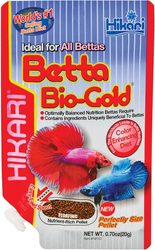
3. Hikari Betta Bio-Gold
The legacy option.
Why:
- Long track record; established brand since the 1980s.
- 38% crude protein.
- Fish meal first ingredient.
- Floating pellets. Bettas feed at the surface, which matches their natural feeding posture.
- Usually the cheapest of the four.
Cons:
- Ingredient list includes some filler ingredients lower down.
- Formulation unchanged for decades; newer options have edge on sustainability.
- Slightly larger pellet (~1.4mm); suitable for adult bettas, may be large for small juveniles.
Check price on Amazon Affiliate link. See our disclosure.
4. Omega One Betta Buffet
The whole-fish option.
Why:
- 42% protein.
- Whole salmon first ingredient (not meal).
- Pungent, real-fish smell (a good sign).
- Color enhancement.
Cons:
- Pellets on the larger side (1.5 mm).
- Availability can be spotty.
Check price on Amazon Affiliate link. See our disclosure.
What to skip
TetraBettaMin and other generic pet-store betta pellets. Wheat or similar filler first ingredient. Under 40% protein. Skip.
Freeze-dried bloodworms as staple. Cause constipation. Occasional treat only.
Tropical flakes. Not betta-specific. Too low in protein.
“Gel food” sold in fishkeeping communities. Niche and requires freezer space. For advanced keepers only.
How to feed
- Count pellets. 4-6 per meal for an adult, roughly the total volume of the fish’s eye. Not a pinch.
- Drop at one end of the tank; wait 30 seconds.
- Observe. Uneaten pellets at 60 seconds means you overfed.
- Remove uneaten food with a small net.
- Fast one day per week.
The supplement plan
Pellets as staple, plus variety 2-3 times per week:
- Frozen bloodworms (Hikari cubes, $8).
- Frozen brine shrimp (San Francisco Bay, $6).
- Frozen daphnia (Hikari, $7).
- Occasional live blackworms if sourced clean.
Variety matters for long-term health. Single-food diets produce nutritional gaps.
Storage
- Keep lid tight. Oxygen exposure oxidizes oils and destroys nutrient content.
- Store at room temperature in a dry cupboard.
- A 1 oz jar feeding one fish runs 4 to 6 months; a 3 oz tub stretches close to a year. Regardless of size, pellets go stale roughly 4 months after the lid is first opened, so date the jar with a Sharpie on day one.
- Stale pellets are a common cause of “my betta stopped eating.” Replace every 4-6 months even if the jar isn’t empty.
The value-per-year calculation
A $8 jar of NLS Betta lasts 6 months feeding one fish. Annual pellet budget: ~$16. Plus ~$40/year in frozen supplement foods. Total: ~$60 annual feeding cost per fish.
Cheaper than most pet store “complete betta kits” priced at $40. Real nutrition isn’t expensive when you buy the right staple.
The bottom line
Start with New Life Spectrum Betta Formula or Hikari Betta Bio-Gold. Both are excellent. Both are cheap. Both have track records.
Rotate in Fluval Bug Bites or Omega One for variety.
Never make generic tropical flakes or sub-standard pet store pellets the main diet. Your fish is a small insectivore; feed accordingly.