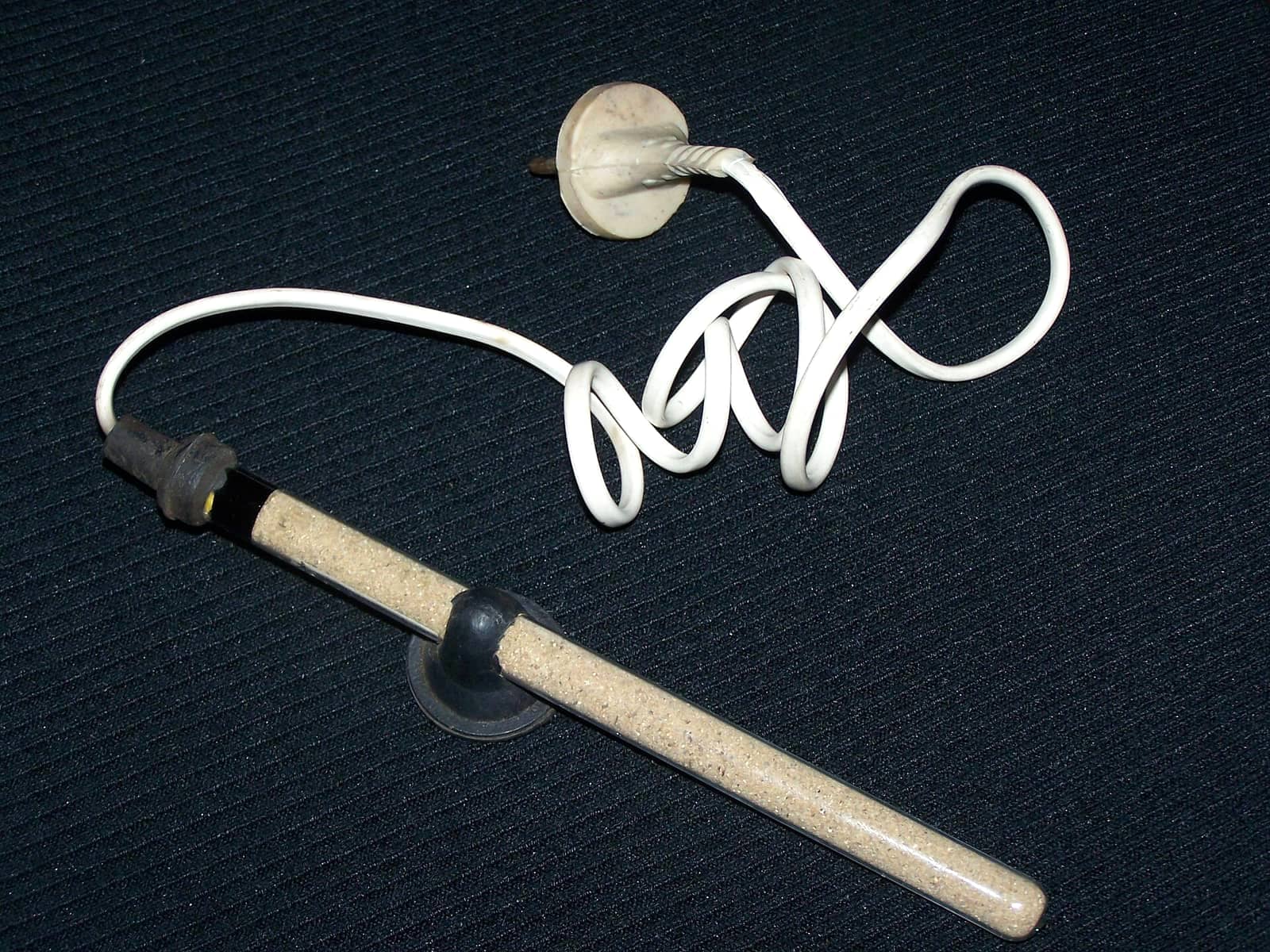
Three heaters worth buying for a betta tank. One preset, two adjustable. All priced $20 to $40. Temperature targets follow the Merck Veterinary Manual aquarium-fish reference.
This page has affiliate links. See our affiliate disclosure.
Quick recommendations
| Heater | Wattage | Type | ~Price | Best for | Buy |
|---|---|---|---|---|---|
| Fluval P25 | 25W | Preset 76–78°F | $25 | Default 5-gallon | Amazon |
| Eheim Jager 25W | 25W | Adjustable | $35 | Breeders, wild keepers | Amazon |
| Cobalt Neo-Therm 25W | 25W | Adjustable | $40 | Flat-shape preference | Amazon |
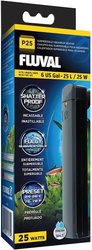
1. Fluval P25 preset
The default. Preset to 76–78 °F. No user adjustment needed. Built-in thermostat. LED status indicator. Shatterproof polymer casing, not glass.
Pros:
- Set-and-forget.
- Reliable thermostat across years of use.
- Compact; rated for tanks up to 6 gallons.
- Shatterproof polymer casing.
Cons:
- No adjustment. Holds 76–78 °F, not a user-selectable point.
- Single point of failure (if it fails on, it overheats).
Use with a thermometer as sanity check.
Check price on Amazon Affiliate link. See our disclosure.
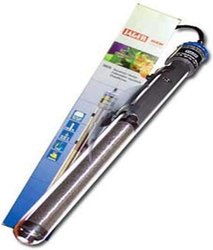
2. Eheim Jager 25W adjustable
German build quality. Adjustable from 65 °F to 93 °F, per Eheim’s own spec sheet for the 25W model (their Model 3611), which rates it for 5-7 gallon tanks specifically, tighter than the generic “5-10 gallon” range often quoted for this heater. Used by most serious aquarists.
Pros:
- Adjustable range useful for breeders and wild species.
- Decade-long reliability track record.
- Recalibration possible via a dial ring, with a ±2 °F correction margin if the factory setpoint runs slightly hot or cold against your own thermometer.
- Run-dry protection: the Thermo Safety Control shuts the element off automatically if the heater is removed from water while still powered, a real failure mode with careless maintenance.
- Housed in laboratory-grade shatterproof glass rather than plastic, which handles heat cycling better over years of use.
Cons:
- Larger than preset options (about 9 inches).
- Adjustable means potential for misadjustment.
- Slightly higher price.
Check price on Amazon Affiliate link. See our disclosure.
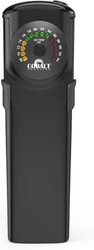
3. Cobalt Neo-Therm 25W adjustable
Flat rectangular shape vs. cylindrical. Cobalt’s own spec sheet lists ±0.5 °F accuracy and a 68-94 °F adjustable range for the Neo-Therm Pro line, with a dual LED readout showing both the setpoint and the live tank temperature at once, so you can catch drift without pulling out a separate thermometer.
Pros:
- Flat shape fits nano tanks better.
- Adjustable, with the tightest published accuracy of the three heaters here.
- Shatter-resistant casing with automatic overheat shutoff.
- Cobalt sells the same design from 25W (rated to 6 gallons) up through 200W (55 gallons), so if you outgrow the 5-gallon tank the sizing logic and interface carry over.
Cons:
- Priciest of the three.
- Less track record than Eheim.
Check price on Amazon Affiliate link. See our disclosure.
What wattage for what tank
- 2-5 gallon: 25W.
- 5-10 gallon: 25W or 50W (25W runs more often in 10 gal; 50W cycles less).
- 10-20 gallon: 50W.
- 20-40 gallon: 100W.
This table lines up closely with the manufacturer sizing on Cobalt’s own Neo-Therm line (25W to 6 gal, 50W to 12 gal, 75W to 20 gal, 100W to 29 gal), which is a useful cross-check since manufacturer ratings tend to assume closer to the outer edge of what a heater can hold. The underlying rule of thumb across the aquarium trade is roughly 2.5 to 5 watts per gallon for a typical household temperature swing, scaled up if the room runs cold or the target temperature sits far above ambient; each additional 9 °F (5 °C) of lift generally calls for another 2.5 to 5 watts per gallon on top of the baseline.
Use a larger heater than you need if your room temperature fluctuates (basement, garage conversion). Smaller heater in a stable warm room. Undersizing costs you on reliability too: a heater working below its comfortable range runs close to constantly to hold temperature, and that near-continuous duty cycle wears out the thermostat faster than one sized with headroom.
Oversizing has its own, less obvious cost in a nano tank. A heater’s thermostat doesn’t throttle its wattage down as the tank approaches setpoint; it simply switches the full element on and off around the target. In 5 gallons of water, which has comparatively little thermal mass to soak up a burst of heat, an oversized heater rated for a 20- or 40-gallon tank delivers the same full-power burst every time it cycles on, and that burst raises the smaller volume’s temperature by more before the thermostat catches up and switches off. The practical result is a wider swing around the setpoint than a correctly-sized heater would produce, exactly the kind of instability that stresses a fish rather than protects it. Undersizing risks a heater that can’t keep up; oversizing risks a heater that overshoots. Match the wattage to the actual gallons, not to “just in case.”
What to avoid
Sub-$10 Amazon unbranded heaters. Thermostats fail. Multiple reported cases of stuck-on heaters cooking tanks.
Suction-cup-only mounts that come loose in soft water. Check daily during first week of use.
Heaters rated for larger tanks than you have. See the wattage section above for why: less water means less thermal mass to absorb the burst, so oversizing overshoots the setpoint rather than protecting against it.
Heaters without a thermostat at all. Aquarium “heating elements” without feedback control should be illegal for indoor pet use.
Installation best practices
- Place heater horizontally near the filter outflow for even distribution.
- Submerge fully. Verify waterline above “MIN” marking.
- Let equilibrate 30 minutes before turning on.
- Verify temperature with an independent thermometer for the first week.
- Replace every 3-5 years regardless of apparent function. Thermostats degrade.
The temperature target
Pet betta: 77-80 °F (25-26.5 °C). Preset at 78 is the sweet spot.
Breeding: 80-82 °F (27-28 °C). A 2022 laboratory husbandry paper (Comparative Medicine, Columbia University) puts its working target at 28 °C specifically, describing it as ideal for bubble-nest construction and ovarian development, and flags both directions of drift: temperatures below 23-25 °C measurably bias sex ratios toward females, while temperatures above 33 °C increase larval mortality. That’s a wide-looking margin on paper, but it’s a reminder that “close enough” heating is a bigger risk during breeding than during ordinary pet-keeping.
Wild species: 75-78 °F (24-25.5 °C). Some highland species lower.
Temperature stability matters beyond comfort. The Merck Veterinary Manual’s clinical reference on bacterial fish disease lists “marked temperature changes” among the recognized predisposing factors for bacterial disease outbreaks, and names Flavobacterium columnare (columnaris) specifically as a warmwater-associated pathogen. A heater that holds a steady setpoint isn’t just about a happier fish; it’s removing one of the documented triggers for exactly the diseases this site covers elsewhere.
The thermometer is not optional
A $3 stick-on thermometer or glass thermometer is insurance against heater failure. Check it whenever you check the tank. Noticeable drift from setpoint is the early warning of a failing heater.
Budget backup
If budget forces a cheaper option, the Hygger 25W adjustable titanium heater (~$19–22) is the best sub-$25 choice in 2026. It is adjustable, not preset. Set it to 78 °F, verify with a thermometer on day one, and check weekly. Slightly less reliable than the Fluval P25, but acceptable with vigilant monitoring. Not recommended as first choice; recommended if $25 isn’t in the budget.
Check Hygger 25W heater on Amazon Affiliate link. See our disclosure.
The warm-room alternative (almost never)
Cold water isn’t just uncomfortable for a betta, it’s a disease risk. Water that drifts below roughly 24 °C suppresses immune function and opens the door to fin rot, columnaris, and other cold-opportunistic infections, which is why skipping a heater is a real gamble outside a genuinely stable warm room.
Some hobbyists keep tanks in rooms stable at 26 °C year-round and skip heaters. Only viable if:
- Room thermostat holds within 1 °C.
- HVAC failure doesn’t drop the room below 23 °C ever.
- Summer AC doesn’t cool the room below 23 °C.
For most settings, dedicate a heater to each tank. Don’t rely on room temperature control.
Heaters are the cheapest piece of essential betta gear. Buy once, buy well, replace on schedule. A $25 heater across a 4-year fish life is $6 per year. Budget for it.