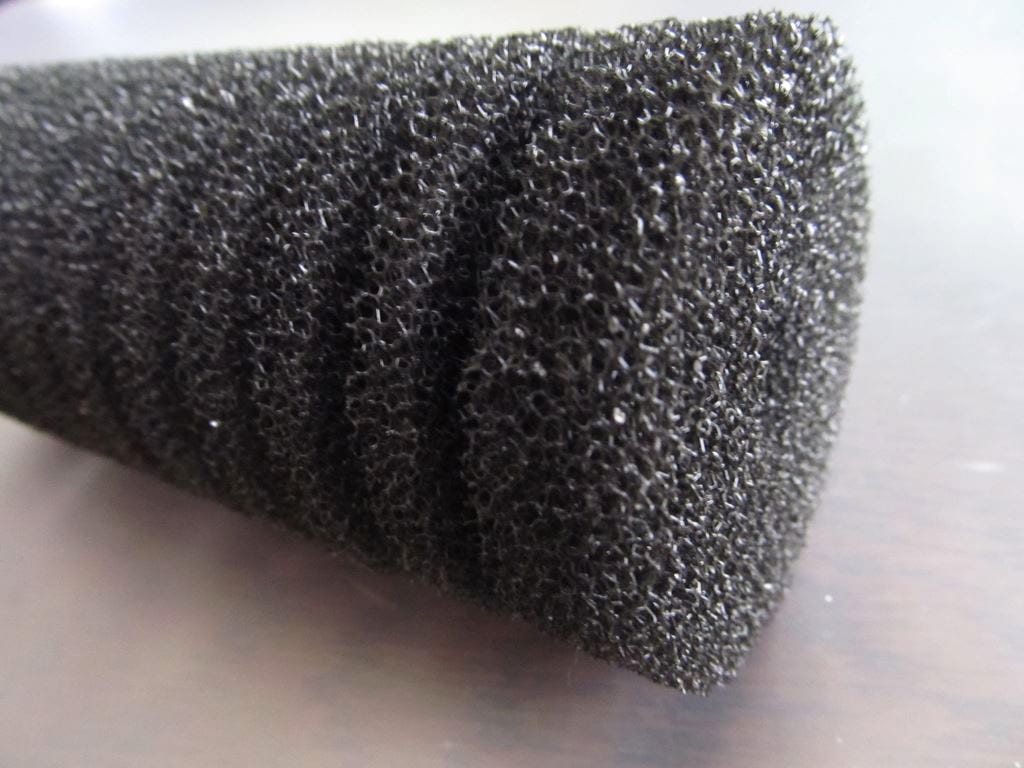
The betta fish filter market is full of products designed for community tanks where high flow and strong surface agitation are considered virtues. Most of them are wrong for bettas. This page explains why, and identifies what to buy instead.
This page has affiliate links. See our affiliate disclosure.
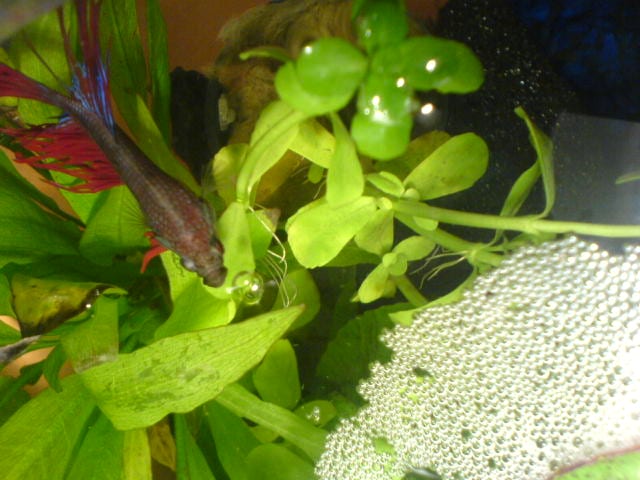
The core problem: flow
Betta splendens evolved in shallow, densely vegetated, low-flow habitat: rice paddies, peat swamps, drainage channels. The wild fish occasionally experiences current during monsoon flooding, but its day-to-day existence is in near-still water.
Long fins create drag. A strong current forces a long-finned betta to constantly work against it, exhausting the fish, stressing it, and potentially damaging fin tissue at the edges where current tears rather than flows. Even a wild-type short-finned plakat will display stress behaviors in a strongly circulating tank.
The filter you choose should provide biological filtration (beneficial bacteria) with the minimum flow rate necessary to maintain water quality. Sponge filters are designed for exactly this. As a working number, total filter flow shouldn’t exceed roughly 4 times the tank volume per hour: about 20 GPH (gallons per hour) or less for a 5-gallon tank. Most hang-on-back filters ship rated at 50 to 100 GPH, well past that line, which is exactly why they need modification before they belong on a betta tank.
What to buy: sponge filters
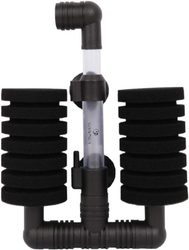
A double sponge filter powered by an air pump is the standard recommendation from experienced betta breeders and the IBC community (IBC Betta Husbandry Standards). The air pump drives air through the sponge, creating a gentle uplift flow that draws water through the sponge medium at very low velocity. The sponge itself is where the biological filtration happens: its porous surface colonizes nitrifying bacteria that convert ammonia to nitrite and then nitrite to nitrate, which is the mechanism that actually protects the fish (see the nitrogen cycle for the full process). What a sponge filter doesn’t do is chemical filtration (no activated carbon) or much mechanical filtration of fine particles, but biological filtration is the function that matters most for fish health. Adequate biological filtration is required for all captive Betta splendens; the peer-reviewed husbandry study at PMC9334006 documents how filter quality affects water parameter stability and fish immune function.
Why double sponge:
- Two sponges provide twice the bacterial surface area
- You can rinse one sponge while leaving the other in place. The established bacteria continue the nitrogen cycle without crashing.
- Double sponge rated for 10 gallons works efficiently in a 5-gallon betta tank
What to look for in a sponge filter:
- Fine-pore sponge (prevents fry from being drawn into the filter if you ever breed)
- A standpipe or uplift tube long enough to reach near the surface
- Rated appropriately for your tank volume
Sponge filters require an air pump and airline tubing. The air pump should be adjustable so you can dial down the flow if the uplift is too strong.
Check double sponge filters on Amazon
Affiliate link. See our disclosure.
Hang-on-back filters with flow reduction
HOB filters (brands like Aquaclear, Fluval, Marineland) provide excellent mechanical and biological filtration but are designed for flow rates that are too high for bettas straight out of the box. They can be made betta-appropriate with two modifications:
- Pre-filter sponge on the intake: covers the intake tube, protecting betta fins from being sucked against it and providing additional biological surface area
- Outflow baffle: either point the outflow toward the tank wall to diffuse the current, or fill the outflow chamber with filter foam to slow the water before it enters the tank
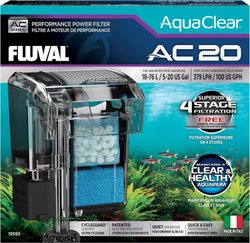
An Aquaclear 20 (rated for 10–20 gallons) modified this way provides good mechanical filtration and appropriate flow for a 10-gallon betta tank. The basket design allows flexible media: sponge, ceramic bio media, or a thin layer of activated carbon.
Check Aquaclear 20 on Amazon Affiliate link. See our disclosure.
Internal power filters: proceed with caution
Small internal power filters (submersible, rated for 5–10 gallons) work for bettas only if the flow is fully adjustable and turned down to minimum. Many internal filters at minimum flow still produce more current than a sponge filter at optimal flow. Test the tank current before leaving the fish with the filter running.
Signs of too much flow: the betta is being pushed against decorations, is constantly swimming against the current, or has frayed fin edges that appear at random.
What to avoid
Strong canister filters: designed for larger tanks with stocking levels that require significant filtration. For a 5-gallon betta tank, a canister filter is absurd overkill and will produce significant current.
Undergravel filters: outmoded and incompatible with planted tanks. The gravel-level current is not appropriate for bettas.
Power filters without flow adjustment: if the filter doesn’t let you reduce the flow, it will likely run too fast for a betta.
Filters with strong surface agitation: bettas are labyrinth fish that need calm surface access to breathe atmospheric air. Strong surface disruption makes this harder and causes stress.
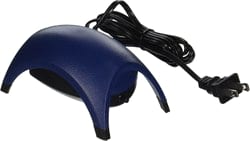
Air pumps for sponge filters
The air pump driving a sponge filter should have an adjustable output valve so you can dial the flow down. Aquarium air pumps sold without flow adjustment will run the sponge filter at full power, which may be too strong for small tanks.
For a single sponge filter in a 5-gallon tank, a minimal-output adjustable air pump is ideal. For a double sponge in a 10-gallon tank, a standard adjustable 1–2 LPM pump works well.
Check adjustable air pumps on Amazon Affiliate link. See our disclosure.
Maintenance
Sponge filters require rinsing in old tank water (not tap water, which kills the beneficial bacteria) every 4–6 weeks or when flow visibly slows. Squeeze the sponge several times in a bucket of tank water removed during a water change. The slightly brownish water is normal and contains the bacteria. Do not discard it.
Never clean a sponge filter with hot water, bleach, or tap water.
See the nitrogen cycle for how biological filtration works and why the bacteria in the sponge are the mechanism that protects the fish from ammonia poisoning.