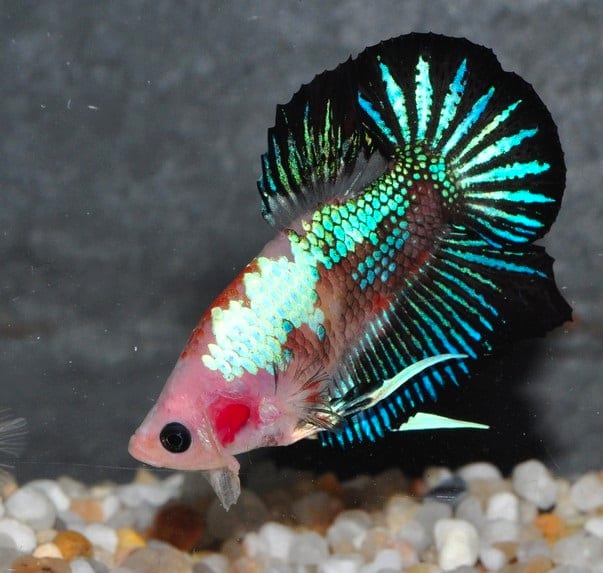
A koi betta is a colour pattern. The name describes an irregular patchwork of red, black, orange and white across the body and fins that looks like a Japanese koi carp, and it says nothing at all about the shape of the tail. Koi appears on plakat, halfmoon, crowntail and dumbo fish, because pattern and fin form are inherited on separate tracks. The 2022 Science Advances betta survey (PMC9491723) names koi as one of the commercial labels attached to a single underlying phenotype the paper calls the mosaic colour pattern.
That one sentence resolves most of the confusion around the term. If you are shopping and want to know what shape of fish you are buying, “koi” is not the word that tells you. Fin types is.
Is koi a fin type or a colour?
A colour pattern, and the naming convention hides it. The trade sells combined names, koi plakat, koi halfmoon, galaxy koi crowntail, in which the first word is pattern and the second is form. Read them as two independent facts rather than one variety name.
The same fish can therefore be described accurately in several ways at once. A koi plakat is a short-finned fish carrying a mosaic pattern. A koi halfmoon is a long-finned 180-degree fish carrying the same pattern. Neither is a grade of the other.
What produces the koi pattern?
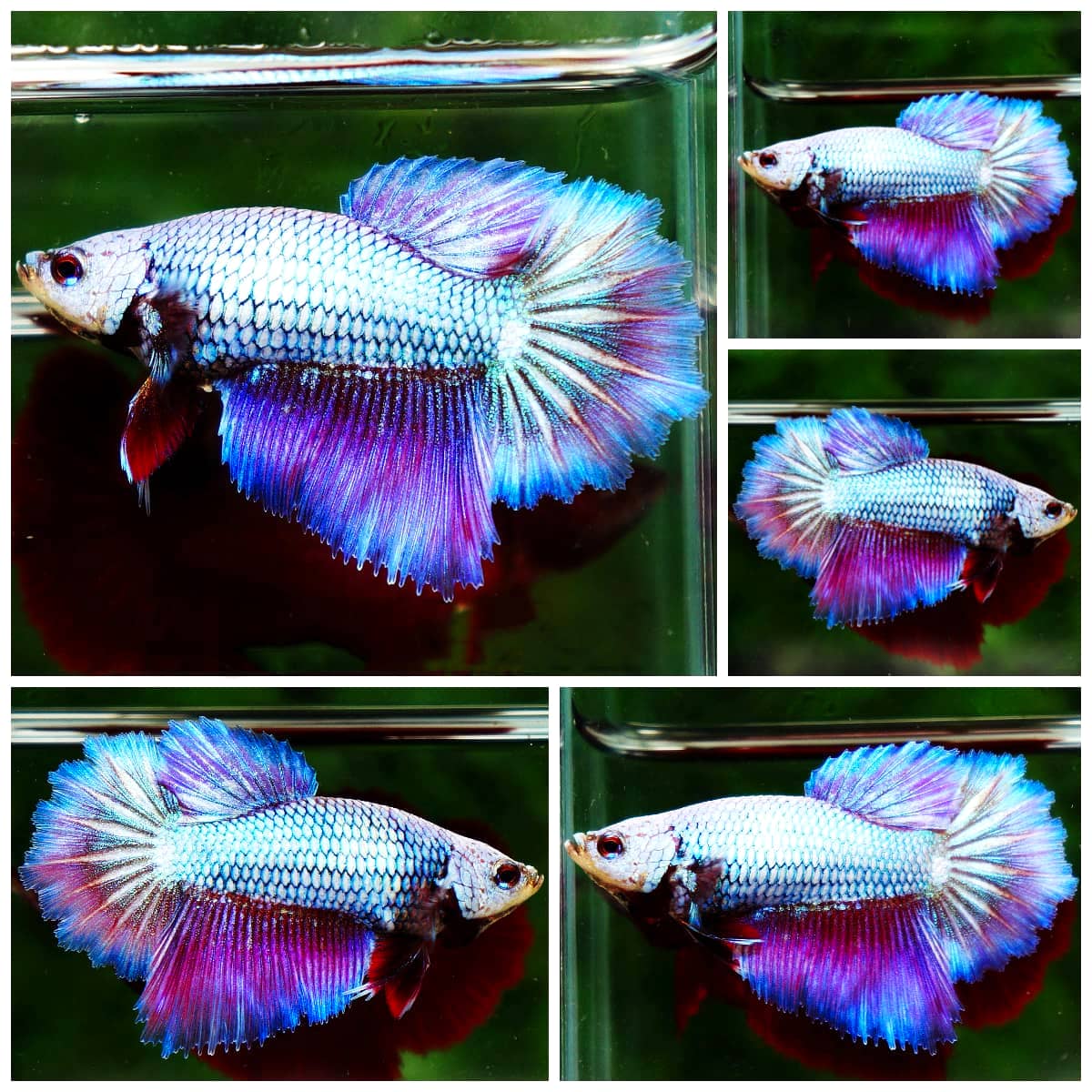
Mosaic patterning is polygenic, and the mapping backs up what breeders have always reported.
The 2022 survey ran a case-control comparison between solid-coloured fish (209 individuals) and mosaic fish (55 individuals) and found nine associated loci spread across eight chromosomes, which the authors read as evidence of a polygenic basis for the phenotype. Among the candidate genes they highlight are slc39a7, chs3, chs8 and col11a2, all with roles in pigmentation.
Nine loci on eight chromosomes is the technically important number here. A trait sitting on one locus segregates cleanly and can be bred to a ratio. A trait distributed across eight chromosomes recombines differently in every fry, which is exactly why a koi spawn produces fifty variations on one theme rather than fifty copies of the parents. There is no koi allele to fix.
Why does a koi betta keep changing?
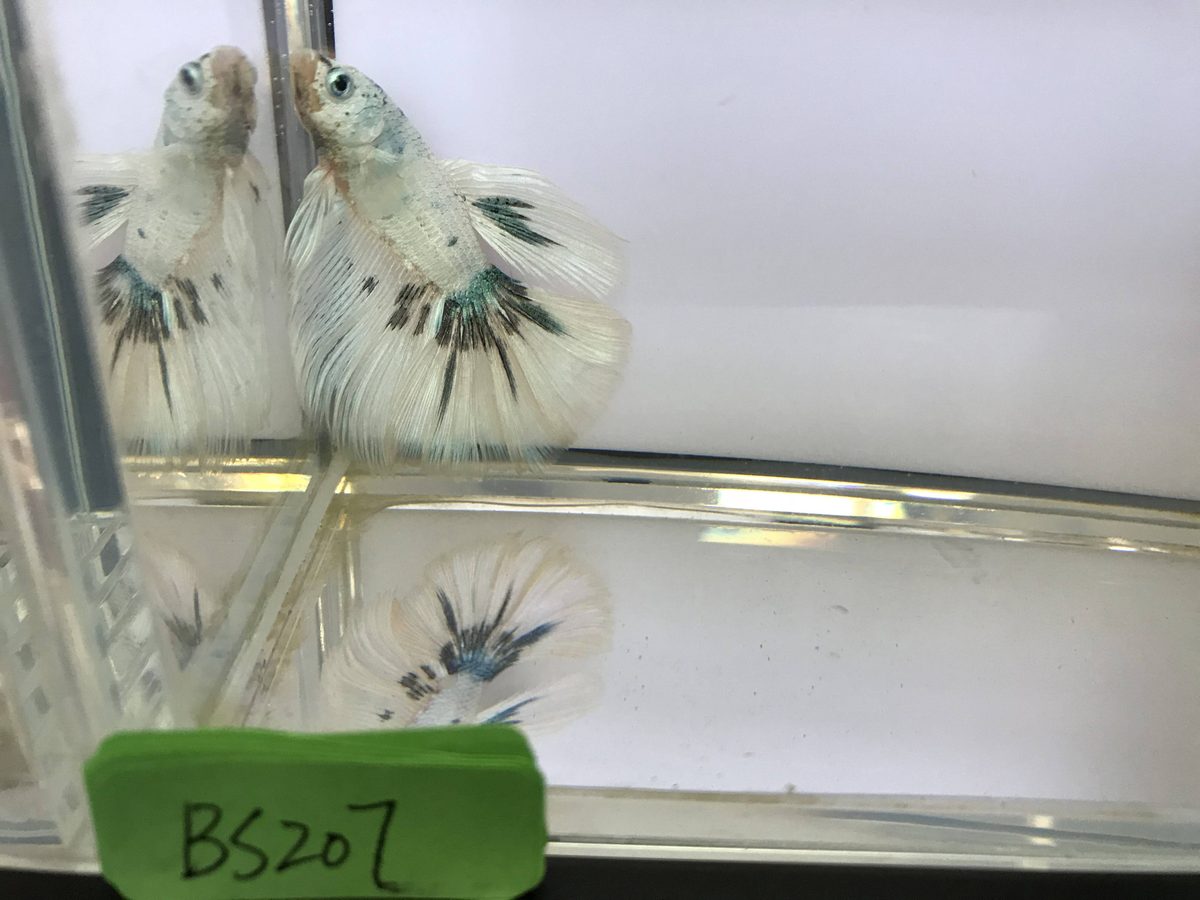
Because the pattern is unstable across the fish’s life, not just across a spawn. Patches migrate, white areas fill in with red, black blocks fade or expand, and a fish photographed at twelve weeks and again at eighteen months can be difficult to recognise as the same animal.
This instability is the marble family trait, and koi sits inside that family. The 2022 paper groups koi, candy, galaxy, lemon and marble together as commercial names for one mosaic phenotype, which is a useful corrective to the hobby habit of treating them as separate genetics. The marble gene covers the pattern-shift behaviour in more depth.
The practical rule for buyers: what you see in the cup is a snapshot, not a specification. Two consequences follow.
Buy older if the exact pattern matters. A fish at six months has settled more than one at ten weeks, though “settled” is relative and drift continues.
Do not pay a premium for a pattern you expect to keep. Paying for a colour set is reasonable. Paying for an arrangement of that colour set is paying for something the fish may not keep.
Koi, nemo, candy, galaxy: what is the difference?
Mostly marketing, applied to different regions of the same pattern space. The distinctions the trade draws in practice:
| Name | What sellers usually mean |
|---|---|
| Koi | Red, black and white blocks, koi carp reference |
| Nemo | Red and black with strong orange, clownfish reference |
| Candy | The same patchwork in pastels, pale blue and pink |
| Galaxy koi | Koi blocks plus dense iridescent speckling |
| Lemon | Yellow-dominant version of the same patchwork |
None of these are separately mapped phenotypes in the genetics literature, and the 2022 survey lists several of them explicitly as alternative commercial names for mosaic. The distinctions are real to the eye and to the price, and they are not a genetic taxonomy. Galaxy koi is the one worth treating as structurally different, because the speckling comes from iridophores rather than from pigment blocks.
Show classification follows the IBC exhibition standards rather than trade naming, so a fish sold as koi enters under whatever pattern class the current standards book defines.
Why do koi bettas cost more?
Three reasons stack, and only one of them is about the fish.
Yield. A spawn produces a wide spread of pattern quality, and the small fraction with clean, high-contrast blocks carries the cost of raising the rest. That is a real cost, not a markup.
Demand. Koi has been among the strongest-selling pet-trade patterns since the late 2010s and the pricing reflects it.
Photography. Listings are sold on a single image of a fish whose pattern will move. A high price attached to a specific arrangement is the least defensible part of the premium.
What a koi does not carry is a health penalty. Pattern genetics of this kind have no documented welfare cost, unlike black melano, where homozygous females are infertile, or extreme fin selection. A koi betta is an ordinary betta wearing an unusual coat.
Does a koi need different care?
No. Temperature, filtration, tank size and water chemistry are the same as for any Betta splendens, and the targets are in water parameters. The one thing worth attending to is diet, because carotenoid intake affects how saturated the reds read and how clean the whites stay. New Life Spectrum Betta Formula (affiliate) is the reference choice among colour-focused keepers for that reason.
Care affects intensity. It does not affect arrangement, and no food or additive will hold a pattern in place.
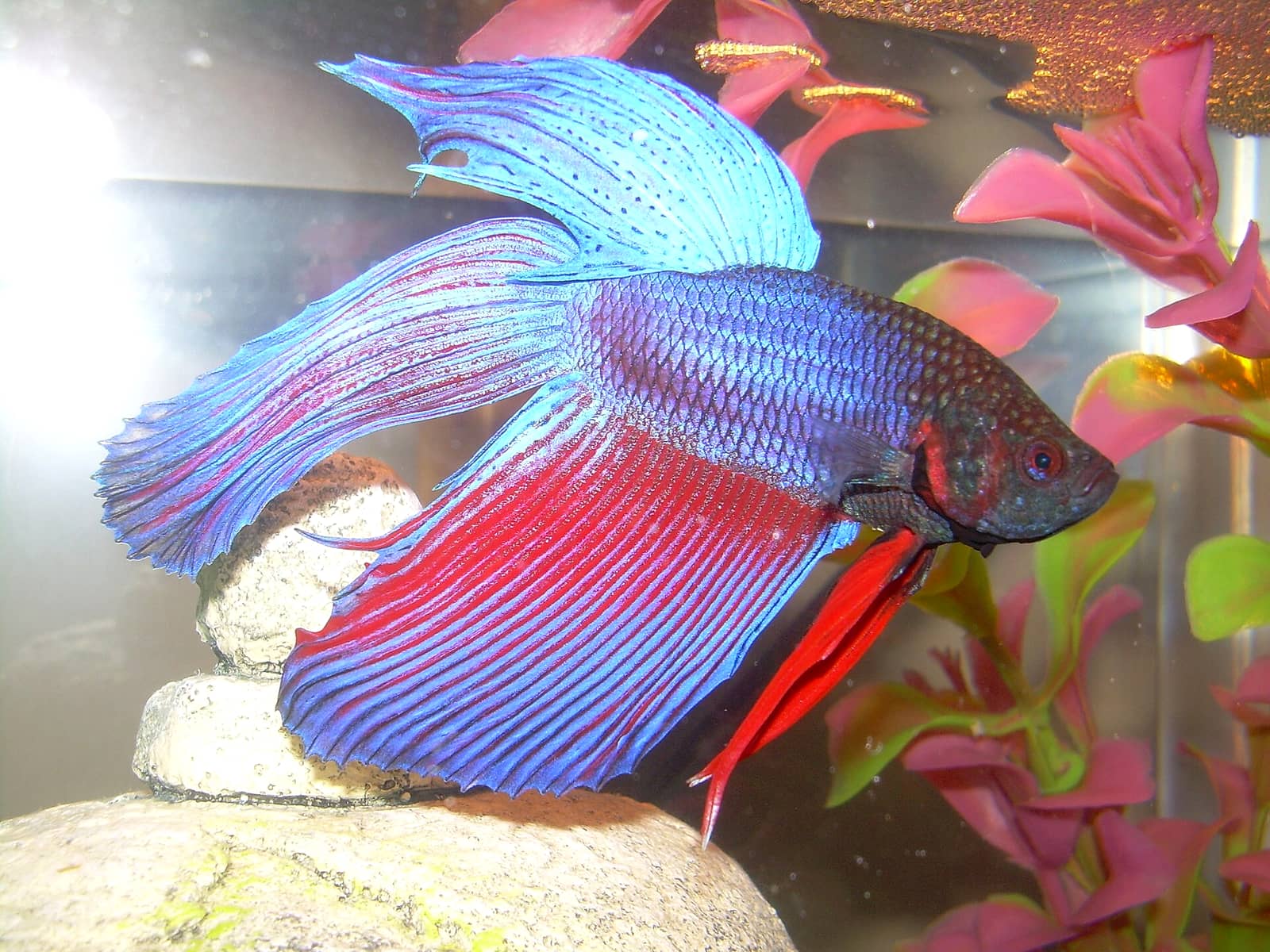
Breeding koi
Selection works on ingredients rather than layout. What a breeder can actually influence:
- Contrast. Crisp boundaries between blocks are heritable in a loose sense and improve under selection.
- Colour set. Whether a line throws red plus black plus white, or drifts toward orange, does respond to pairing.
- Coverage balance. Lines that run mostly white or mostly red can be pulled back toward an even split over generations.
What a breeder cannot influence is where the patches land on any individual fish. Raise large broods, grade late, and expect to keep a small fraction. Pair selection covers the grading side, and where to buy show bettas covers finding breeders who document their pattern lines instead of selling on a single photo.
Related on this site
- Betta Color Morphs: Modern Catalog and Genetics
- Galaxy Koi Betta: Koi Pattern Plus Iridescent Speckling
- The Marble Gene: Unstable Pattern in Betta splendens
- Betta Fin Types: Halfmoon, Crowntail, Plakat, IBC Forms
- Halfmoon Betta: The 180-Degree Caudal Spread
- Betta Iridescence: Blue, Steel, Green, and Structural Colour