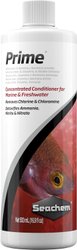
Seachem Prime is the water conditioner to buy for a betta tank. It strips chlorine, it handles chloramine without dumping ammonia into the tank, and it binds ammonia and nitrite for roughly 48 hours, which turns a routine dechlorinator into the first thing you reach for in an emergency. Seachem’s stated dose is 5 mL per 50 US gallons of new water, about two drops per gallon. Use it on every water change and every tap-water top-off.
This page has affiliate links. See our affiliate disclosure.
Check price on Amazon Affiliate link. See our disclosure.
What is actually in your tap water
Municipal water is disinfected, and the disinfectant is still in it when it reaches your kitchen. The EPA sets a maximum residual disinfectant level of 4.0 mg/L for both chlorine and chloramines, measured as Cl₂. That is a legal ceiling for water intended for people, and it sits two orders of magnitude above what a fish tolerates.
The Merck Veterinary Manual’s water-quality reference for aquatic systems puts adverse effects in fish at chlorine concentrations as low as 0.02 mg/L, with mortality at 0.04 mg/L. Its instruction is unambiguous: “No chlorine or chloramine should be detected at any time live animals are present.” Sublethal exposure is not dramatic and is easy to misread as disease. Merck lists the chronic signs as ragged fins, excess mucus on skin and gills, and cloudy corneas. A keeper watching that develop over three weeks usually reaches for an antibiotic, not a dechlorinator.
Chlorine is also lethal to the nitrifying bacteria living in your filter. Refilling a 5-gallon tank with untreated tap water damages the fish and the biological filter in the same pour, which is why an untreated water change so often ends in an ammonia spike a few days later.
| Concentration | What it is |
|---|---|
| 4.0 mg/L | EPA maximum residual disinfectant level for chlorine and chloramines in drinking water |
| 0.04 mg/L | Chlorine concentration at which Merck reports mortality in fish |
| 0.02 mg/L | Chlorine concentration at which Merck reports adverse effects begin |
| 0.00 mg/L | The only reading acceptable with a fish in the tank |
Why chloramine changes which bottle you buy
This is the part most product pages skip, and it decides the whole recommendation.
Older-style dechlorinators are sodium thiosulfate. Thiosulfate reduces free chlorine to chloride, and for a utility that chlorinates, that is the entire job. Roughly one in five Americans drinks water treated with chloramines instead, according to the EPA’s chloramine page, and chloramine is chlorine bonded to ammonia for a longer-lasting residual through the distribution pipes.
Break that bond and the ammonia goes somewhere. Merck states it plainly: when chloramines are dechlorinated with sodium thiosulfate, “ammonia is released into the system.” A plain thiosulfate product on chloraminated water solves the chlorine problem and hands you an ammonia problem in the same minute. In a cycled tank with an established bacterial colony, that load gets processed. In a new tank, a quarantine tub, or a tank recovering from a medication course that knocked back the filter bacteria, it does not.
So the practical question is not “does this remove chlorine.” Almost anything sold as a conditioner does. The question is what happens to the ammonia afterward, and whether the product also holds it while your filter catches up.
Find out which one your utility uses before you buy. Your municipal water supplier publishes an annual Consumer Confidence Report that names the disinfectant. If you are on chloramine, an ammonia-binding conditioner is not optional refinement.
Seachem Prime
Prime removes chlorine and chloramine and, per Seachem’s own product documentation, detoxifies ammonia, nitrite and nitrate. The binding is temporary. Seachem states the complex holds for up to 48 hours, after which the bound compounds release unless you re-dose. That expiry is a feature, not a flaw: the ammonia stays available to the nitrifying bacteria that need it as a food source, so the tank keeps cycling while the fish is protected.
Dose. Seachem’s figure is 1 capful (5 mL) per 200 L (50 US gallons) of new water. That works out to about 0.1 mL per gallon, roughly two drops. For a 50 percent change on a 5-gallon betta tank you are dosing about 0.25 mL, which is a fraction of a capful. A 100 mL bottle covers a small tank for well over a year.
Emergency dose. Seachem sanctions up to 5 times the normal dose for elevated nitrite, and re-dosing every 24 to 48 hours. This is the property that makes Prime the one bottle worth having in a tank with no backup: when your test reads ammonia and you cannot fix the cycle tonight, Prime buys you a day at a time while you do daily water changes. The full protocol is on the ammonia poisoning page.
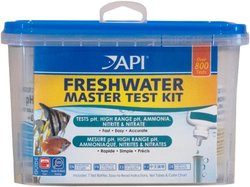
The test-kit trap, which almost nobody mentions on the bottle. Seachem’s documentation warns that a Nessler-based ammonia kit will not read correctly in the presence of Prime, and that salicylate kits must be read immediately because the ammonia-Prime complex breaks down during the test and skews the result. The API Freshwater Master Test Kit uses a salicylate method, so read the tube at the stated time and not ten minutes later. If you dosed Prime an hour before testing and got a puzzling result, this is why. See best test kits for the kit comparison.
Check price on Amazon Affiliate link. See our disclosure.
Seachem Safe, for anyone doing water changes at volume
Safe is the same chemistry as a dry powder. Seachem describes it as the concentrated dry conditioner for fresh and salt water, removing chlorine and chloramine and detoxifying ammonia, nitrite and nitrate. The dose rates show how concentrated it is: 1.25 g treats 1,250 L (300 US gallons) for chlorine and chloramine, or 300 L (75 US gallons) when you are dosing for ammonia.
One caveat straight from Seachem: Safe lacks the stabilizers that keep Prime shelf-stable in liquid form, so you cannot pre-mix a bottle of it and store the solution. Measure and dose dry.
For a single 5-gallon betta tank this is the wrong product. You will spend years failing to use a 50 g jar, and measuring a dose that small accurately is fiddly. For a breeder running a rack of jars, or anyone changing water on multiple tanks weekly, the cost per gallon is not close. See the breeding gear guide for the rest of that scale-up.
Check price on Amazon Affiliate link. See our disclosure.
API Stress Coat
Stress Coat removes chlorine and neutralizes chloramines and heavy metals, and it adds aloe vera to the water on the theory that it supports the fish’s slime coat. API’s dose is 5 mL per 10 gallons, doubled for slime-coat replacement and fin repair. That is ten times Prime’s dose rate by volume, so compare bottles on treated gallons rather than on shelf price.
Read API’s own claim list carefully. Stress Coat is described as removing chlorine, neutralizing chloramines and detoxifying heavy metals. Ammonia detoxification is not among its stated benefits. On chloraminated water that leaves the released ammonia unaddressed, which is exactly the gap Prime closes.
Where it earns a place: as a second bottle after physical injury. A betta that tore its caudal on a filter intake, or arrived from a shop with abraded flanks, is a reasonable candidate for the aloe formula alongside clean water. It is a supplement, not the primary conditioner. Torn fins have their own page at fin damage versus fin rot.
Check price on Amazon Affiliate link. See our disclosure.
Which water conditioners to skip
Tiny “betta” conditioner bottles. A 1.25 oz bottle sold in the betta aisle is the same category of product at four or five times the price per treated gallon. The word betta on the label changes the packaging, not the chemistry. Buy a 100 mL bottle of a general freshwater conditioner and it will still be half full when the fish is three years old.
Plain sodium thiosulfate on chloraminated water. Covered above. If your utility chloraminates, a chlorine-only product hands you a fresh ammonia reading. If your utility uses free chlorine, thiosulfate is chemically adequate, and you still lose the emergency-dosing capability that makes Prime worth the shelf space.
Conditioners bundled with “instant cycle” claims. Dechlorination and bacterial seeding are two different jobs. A combined product does the first well and the second unpredictably. Buy them separately, and read how to cycle a tank before you rely on any bottled bacteria at all.
Conditioner as a substitute for water changes. Binding ammonia does not remove it. Prime’s own 48-hour window is the tell. A tank dosed daily to keep a fish alive is a tank with a broken nitrogen cycle, and the conditioner is buying time you are supposed to be spending on the actual repair.
How much water conditioner do you actually need, and how often
Every drop of tap water that enters the tank gets conditioned. That includes the parts people forget.
- Water changes. Dose the new water in the bucket, or dose the tank for its full volume before pouring. Both work. Dosing the bucket is easier to get right.
- Evaporation top-offs. A 5-gallon tank in a heated room can lose a noticeable fraction of a gallon a week. Tap water going in to replace it carries the same chlorine as any other tap water.
- Rinsing equipment. Filter media rinsed under the faucet loses bacteria to chlorine. Rinse it in a bowl of old tank water instead.
- New tank fill. Condition the whole volume before adding a fish, and confirm with a test before the fish goes in.
Dechlorination is effectively immediate at these concentrations. There is no waiting period between dosing and adding the water to the tank.
Does letting water sit out overnight work instead?
For free chlorine, partly. Chlorine is volatile and off-gasses from standing water over roughly 24 hours, faster with agitation.
For chloramine, no. Chloramine is stabilized against exactly that, which is why utilities adopted it. It persists in standing water for days. Since a fifth of US households are on chloraminated supply and few keepers check which, the sit-it-out method fails silently for a large share of the people who try it. A bottle that treats several thousand gallons costs less than a bag of substrate. Buy the bottle.
The short version
For a single betta tank: one 100 mL bottle of Seachem Prime, dosed at about two drops per gallon of new water, replaced when it runs out in a year or two. Add a liquid test kit so you can confirm the result rather than assume it. The laboratory husbandry review for this species (Lichak et al., Comparative Medicine, 2022) targets nondetectable ammonia and holds working levels below 0.25 ppm, and hitting that reliably takes both a conditioner and something to read the water with.