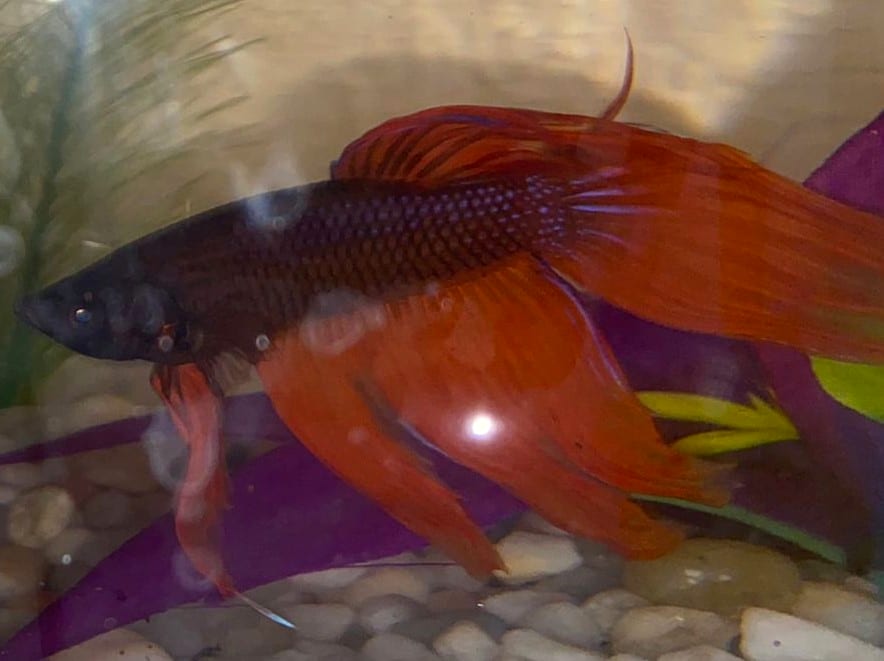
Ammonia poisoning shows up as lethargy, refused food, gasping at the surface, clamped fins, and gills that look red or inflamed. The response is immediate and in this order: test the water, change 50 percent with dechlorinated water matched to tank temperature, dose an ammonia-binding conditioner, and repeat daily until the test reads zero. Do not wait for a confirmed diagnosis before the first water change. Clean water is the treatment.
What ammonia poisoning looks like
There is no single dramatic symptom, which is the reason this kills so many fish. It presents as a fish that is slightly off, for a week, and then a fish that is obviously ill.
Early, and easy to dismiss:
- Sitting on the substrate or hanging low for long stretches during daylight hours
- Refusing food, or taking a pellet and spitting it out
- Clamped fins, held tight against the body instead of spread
- Faded or dulled color that does not brighten when you approach the glass
Established:
- Gasping at the surface, or holding at the filter outflow where oxygen is highest
- Gills that appear red, purple, or inflamed at the margins, sometimes held partly open
- Reddened streaks or patches on the body and fin bases
- Rapid gill movement with no exertion
Acute:
- Spinning, disorientation, or convulsions
That last group is worth naming precisely because it looks neurological rather than chemical. Merck’s aquatic-systems reference lists lethargy and poor appetite for ammonia exposure generally, and identifies “neurologic clinical signs such as spinning, disorientation, and convulsions” as the acute presentation. Merck’s fish disorders overview is blunt about the diagnostic order: ammonia and pH should always be tested when neurologic signs appear. A fish spinning in a tank is a water test, not a medication.
The laboratory husbandry review for this species lists clamped fins, lethargy, disinterest in food and dull coloration as its illness indicators, and holds ammonia below 0.25 ppm with nondetectable as the target. Those signs are not specific to ammonia. They are the fish’s general “something is wrong” display, and ammonia is the most common thing that is wrong.
Why the same test reading is not the same danger
This is the piece that gets left out of most hobby guidance, and it changes what a number on a test card means.
Your test kit measures total ammonia nitrogen, written TAN. That total is two chemically different things in equilibrium: ammonium (NH₄⁺), which is comparatively benign, and free or unionized ammonia (NH₃), which is the toxic form. What splits the total between them is pH, with temperature as a smaller secondary influence. Merck states the relationship directly and ranks it: the percentage of toxic unionized ammonia increases with pH and temperature, and pH has more influence than temperature.
So a reading of 0.5 ppm TAN in a tank at pH 6.6 is a different situation from 0.5 ppm TAN in a tank at pH 8.0. Same number on the card, materially more free ammonia in the second tank. This is why two keepers can compare identical test results and have completely different outcomes.
The thresholds Merck gives, all for unionized NH₃ rather than total:
| Free ammonia (NH₃) | Effect |
|---|---|
| Below 0.05 mg/L | Not considered harmful |
| 0.05 mg/L | High enough to cause histologic damage to gill tissue |
| 2 mg/L | Lethal for many fish |
The damage at 0.05 mg/L is specific: hyperplasia of epithelial and chloride cells, hypertrophy of chloride cells, and lamellar fusion. Lamellar fusion is the one that matters for a fish you are trying to save. The gill lamellae are the folded surfaces that do gas exchange, and fusing them permanently reduces the area available for breathing. A fish that gasps for weeks after the water is clean is often a fish carrying that damage.
For total ammonia, Merck’s tolerance figure is that freshwater fish can tolerate TAN concentrations below 1 mg/L. Tolerate is not the same as thrive. The EPA’s 2013 freshwater aquatic life criteria for ammonia are built around the same pH and temperature dependence, which is why regulatory criteria for ammonia are expressed as equations rather than a single number.
The practical version: test pH at the same time you test ammonia. A tank at pH 7.8 with any detectable ammonia is a faster emergency than a tank at pH 6.8 with the same reading.
Where the ammonia came from
Five causes account for nearly all of it.
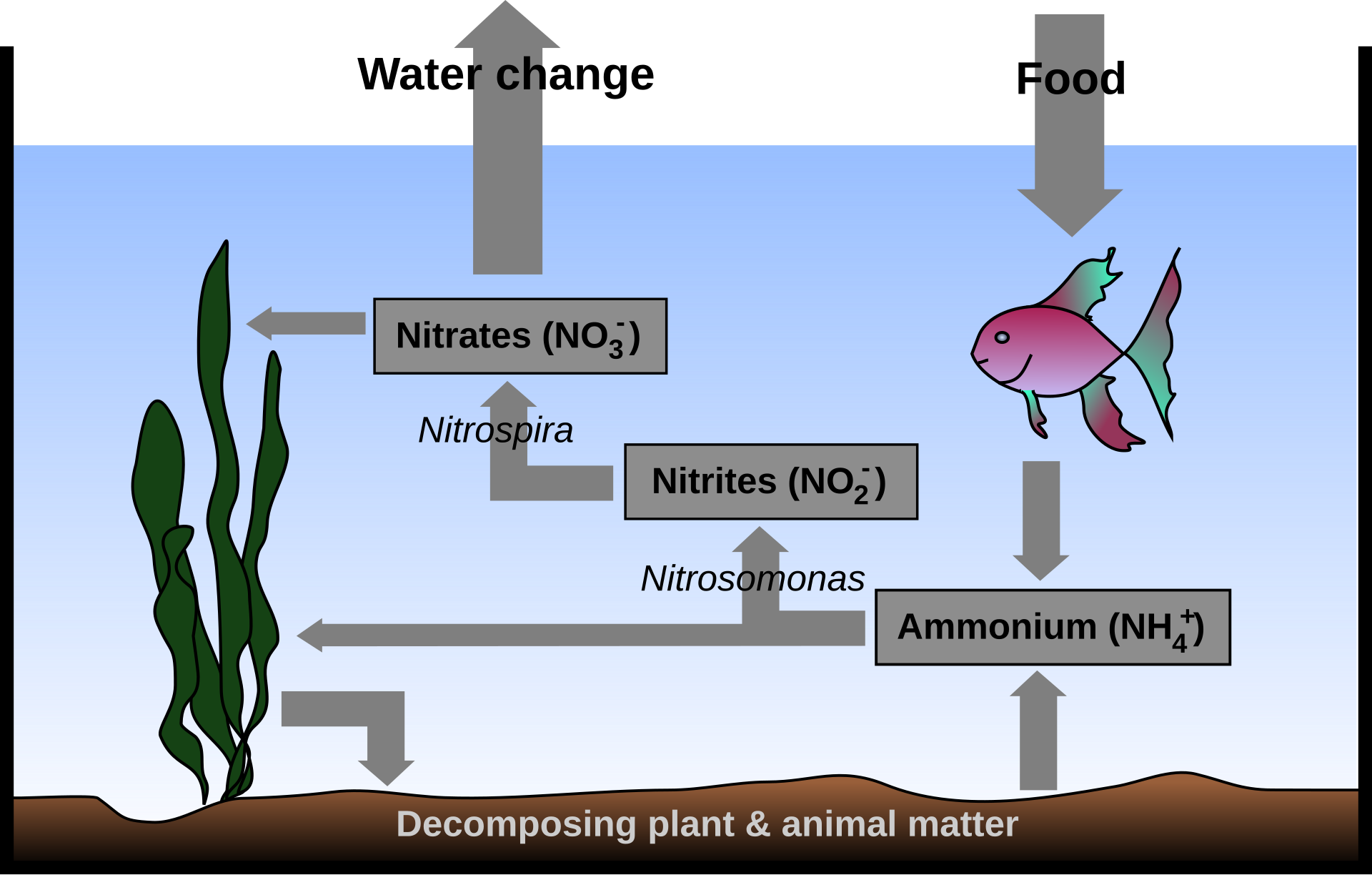
1. The tank was never cycled. The most common by a wide margin. Ammonia is produced continuously by gill excretion, waste and decomposing food, and in a tank without an established bacterial colony there is nothing converting it. Merck notes that a biofilter in a tropical tank can take up to 8 weeks to establish, and identifies new tank syndrome as a first-six-weeks problem. A betta added to a tank filled yesterday is living in an accumulating ammonia bath. How to cycle a tank is the fix, and the nitrogen cycle explains why.
2. The cycle crashed. An established tank can lose its bacteria: a filter rinsed under a chlorinated tap, a medication course that killed the nitrifiers along with the pathogen, a power cut that left the filter media without oxygenated flow for hours, or a filter cartridge thrown away and replaced with a fresh one. Merck also flags alkalinity as a driver here. Total alkalinity at or below 50 mg/L CaCO₃ inhibits the nitrogen cycle, and at least 100 mg/L supports normal biofilter function, so very soft water makes the colony fragile.
3. Overfeeding. Uneaten food decomposes into ammonia on the substrate. A betta needs a small amount of food, and the surplus goes straight into the nitrogen budget. See feeding.
4. The tank is too small for the load. Ammonia production scales with the fish and the food. Water volume is what dilutes it. A 1-gallon container gives a bacterial colony no margin, and a single missed water change becomes a spike. Tank setup covers why 5 gallons is the working floor.
5. Chloramine, dechlorinated. The one nobody expects. If your municipal supply is chloraminated, breaking the chlorine-ammonia bond releases the ammonia into the tank. Merck states it directly: when chloramines are dechlorinated with sodium thiosulfate, ammonia is released into the system. A tested-zero tank that reads ammonia one hour after a water change may be showing you this, not a cycle failure. The fix is a conditioner that binds the released ammonia rather than one that only strips chlorine, covered on best water conditioners.
The emergency protocol
Work through this in order. Steps 2 and 3 happen tonight, not tomorrow.
-
Test ammonia, nitrite and pH. Use a liquid reagent kit. Test strips produce false negatives on ammonia at exactly the concentrations that matter, which is the specific failure covered on best test kits. Write the numbers down; you need them to know whether tomorrow is better or worse.
-
Change 50 percent of the water. Match the new water’s temperature to the tank before it goes in, within a degree or two. Merck’s guidance on thermal change during handling is a maximum of about 1°F, or even 1°C, per hour, so a bucket of cold tap water solves the ammonia problem by adding a thermal shock problem. Dechlorinate the new water before it enters the tank. A 50 percent change removes roughly half the dissolved ammonia immediately, which is the fastest intervention available to you.
-
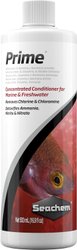
Dose an ammonia-binding conditioner for the full tank volume. Seachem’s documentation for Prime puts the binding duration at up to 48 hours, and sanctions up to 5 times the normal dose for elevated nitrite along with re-dosing every 24 to 48 hours. Binding converts free ammonia into a form the fish’s gills are not exposed to, while leaving it available to the bacteria that need to consume it.
-
Stop feeding for 24 to 48 hours. No food, no new waste, no decomposing surplus. A healthy adult betta is in no danger from a two-day fast, and this measurably slows ammonia production while the water changes catch up.
-
Check the temperature and aeration. Warmer water holds less dissolved oxygen, and a fish with damaged gills has less capacity to extract what is there. Merck puts optimal dissolved oxygen above 5 mg/L, with stress below that and mortality possible at or below 4 mg/L. Increasing surface agitation costs nothing and helps a compromised fish. Keep temperature in the normal 76-82°F range rather than raising it.
-
Repeat the test and the water change daily until ammonia and nitrite both read zero and stay there. Daily. Not every third day when you remember.
-
Do not add medication. There is no drug for ammonia toxicity, and several common treatments suppress the same nitrifying bacteria you are trying to grow. If a secondary bacterial infection develops later, treat it then, in a quarantine tank.
Why the water change comes before the binder. Binding is temporary and does not remove anything. Dilution is permanent and removes ammonia from the system. Doing the binder alone is the common shortcut and it produces a tank that reads high forever while the keeper doses daily and wonders why nothing improves.
Why is my ammonia still reading after I dosed a conditioner?
Often it is the test, not the tank.
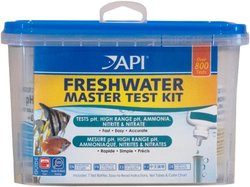
Seachem warns that a Nessler-based ammonia kit will not read properly in the presence of Prime, and that salicylate-based kits must be read immediately because the ammonia-conditioner complex breaks down during the test window and inflates the result. The API Freshwater Master Test Kit is salicylate-based. Read the tube at the stated time.
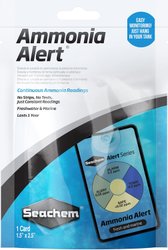
There is also a real limitation to be clear about: a standard hobby kit measures total ammonia, and it does not distinguish bound from free. After dosing a binder, a reading above zero does not necessarily mean the fish is being exposed. This is the argument for keeping a Seachem Ammonia Alert badge in the tank alongside the liquid kit: it responds to free ammonia specifically and sits in the water continuously.
Check price on Amazon Affiliate link. See our disclosure.
What about nitrite, which usually arrives next?
An ammonia spike in a partially cycled tank is normally followed by a nitrite spike a week or two later, as the first bacterial population catches up and the second one has not.
Nitrite has a different mechanism and its own tell. It crosses into the bloodstream and converts hemoglobin to methemoglobin, which cannot carry oxygen. Merck calls the result brown blood disease, and describes affected fish congregating in oxygen-rich areas or piping at the surface. A fish suffocating in fully oxygenated water is the signature.
Merck also names an antagonist: chloride reduces the risk of nitrite toxicity in freshwater systems, which is the mechanism behind the traditional salt dose during a nitrite spike. Aquarium salt covers when that is appropriate for a betta and when it is not.
Treat a nitrite reading with the same protocol as ammonia. Water changes, binder, daily testing.
Recovery, and what it looks like
Water quality corrects in days. The fish takes longer.
Once ammonia and nitrite hold at zero, expect appetite and normal activity to return over roughly one to two weeks in a fish that was caught early. Color usually recovers first, appetite second, and the willingness to spend time in open water last.
Gill damage is the part that does not resolve on that schedule. Lamellar fusion reduces gas-exchange surface, and a fish that spent weeks in measurable ammonia may show elevated respiration and reduced stamina for a long time afterward. That is a reason to test on a schedule rather than after a fish looks unwell.
Watch for a secondary infection during recovery. Compromised gill and skin tissue plus a suppressed immune system is the setup for fin rot and columnaris. If the fins begin eroding after the water is clean, that is a bacterial problem to treat as one.
Preventing it permanently
There is exactly one durable fix, and it is not a bottle.
Cycle the tank before the fish arrives. Merck’s fishless cycling protocol is to set the tank up with no fish, dose ammonia to 1-5 mg/L, and monitor ammonia, nitrite and nitrate until ammonia and nitrite both reach zero before adding fish. Allow up to 8 weeks. That single step removes the cause of most ammonia poisoning in the hobby. Full method on how to cycle a tank.
Around that:
- Test weekly on an established tank, daily during cycling, during any illness, and after any medication dose or filter maintenance. See water parameters for the full schedule.
- Change 25 percent of the water weekly. It keeps nitrate down and gives you a routine occasion to look closely at the fish.
- Rinse filter media in old tank water, in a bowl, never under the tap. Chlorinated water kills the colony living in that sponge.
- Feed an amount the fish finishes. Remove what it does not.
- Keep the ammonia binder in the cabinet before you need it. The night you discover a spike is a bad night to find the bottle empty.