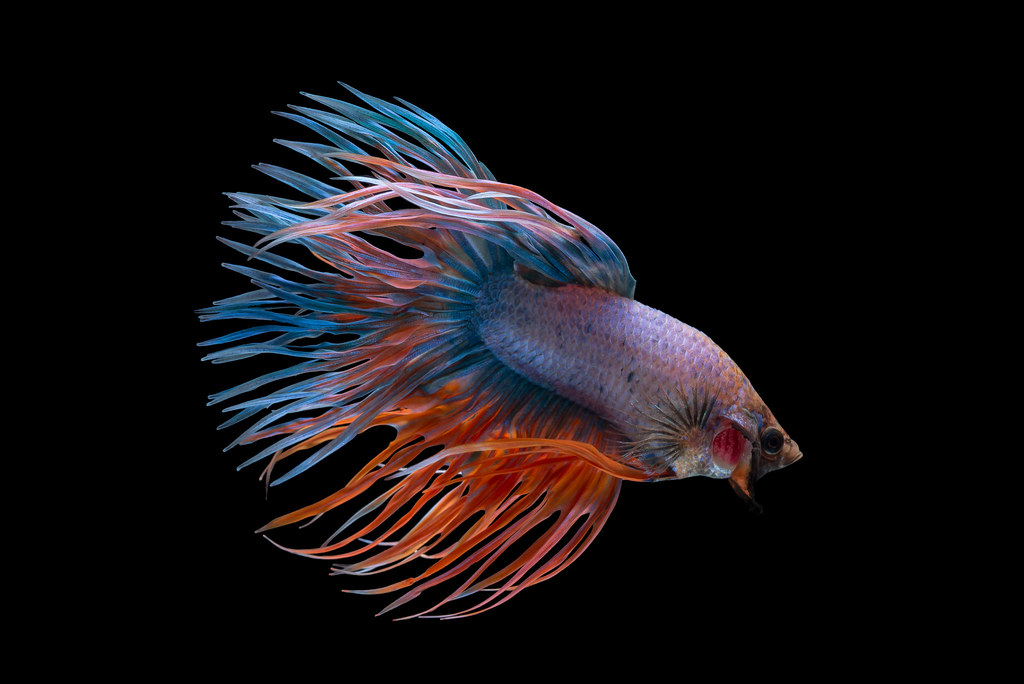
A crowntail needs the same water as any betta plus extra attention to two things: flow and edges. The reduced webbing leaves each ray standing alone, with more exposed surface and no lateral support, so current bends them and rough decor splits them. Gentle air-driven filtration, soft furnishings, stable warm water.
This page has affiliate links. As an Amazon Associate we earn from qualifying purchases. See our affiliate disclosure.
What does reduced webbing change about care?
The structure, and everything downstream of it.
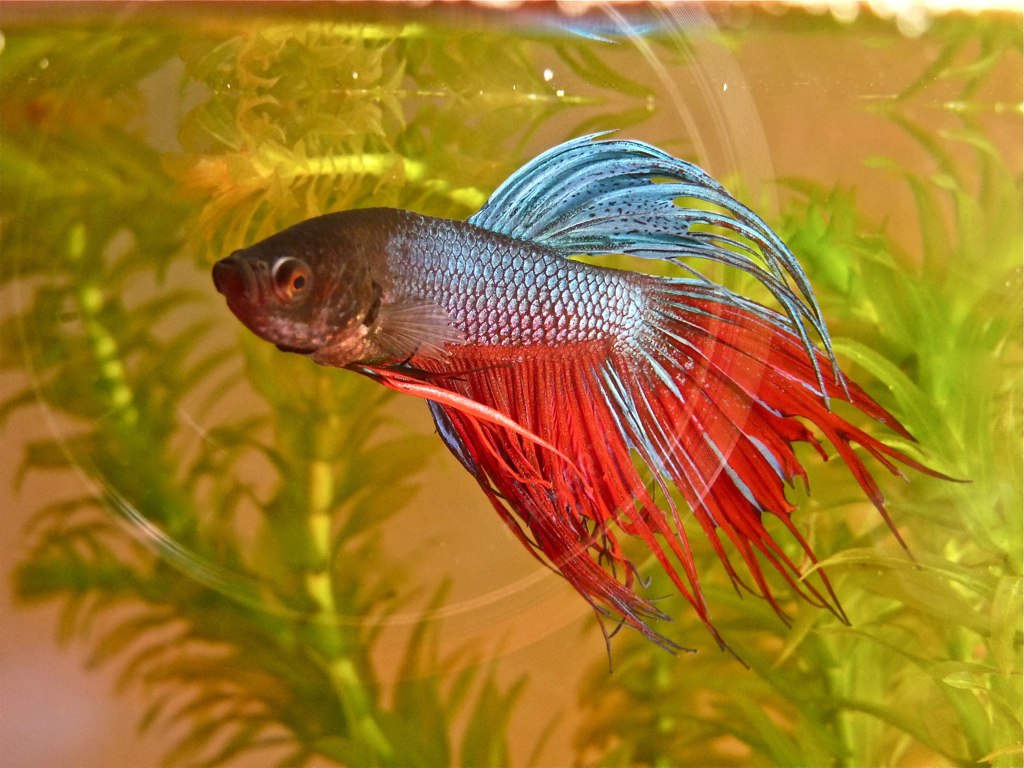
A normal betta fin is a sheet. Bony rays fan out from the base and a membrane spans the gaps between them, so the fin moves as one surface and each ray is braced by its neighbours through the tissue between them. In a crowntail that membrane stops short, leaving the rays exposed as separate spikes. The 2022 genetic survey states the difference in one line: the crowntail breed differs from the halfmoon breed by having reduced webbing tissue between the fin rays. What that gene, the ray-branching names and the show classes mean is on the crowntail form page. This page is the husbandry.
Three consequences follow from the missing membrane, and every care decision below traces to one of them.
- More edge, less area. The same fin now presents a much longer perimeter to the water. Perimeter is where damage starts and where bacteria find purchase.
- No lateral bracing. A ray that catches on something takes the entire force alone, because there is no membrane spreading the load to its neighbours.
- Damage is visible immediately and reads ambiguously. A crowntail’s edge is ragged by design, so a genuine problem hides inside what is supposed to look uneven.
| Care variable | Standard betta | Crowntail | Why |
|---|---|---|---|
| Filtration | Gentle | Gentle, air-driven by preference | Unsupported rays bend individually in current |
| Decor | Nothing sharp | Nothing that catches a nylon stocking | One ray absorbs the whole force of a snag |
| Water changes | Weekly, 25 to 30 percent | Weekly, non-negotiable | Longer perimeter, more entry points |
| Visual inspection | Whenever | Monthly photo at flare | Baseline edge is already irregular |
| Tank mates | Careful | More careful | Exposed rays read as target and tear more easily |
| Temperature | 76 to 82 F, stable | Identical | No difference; the water is just water |
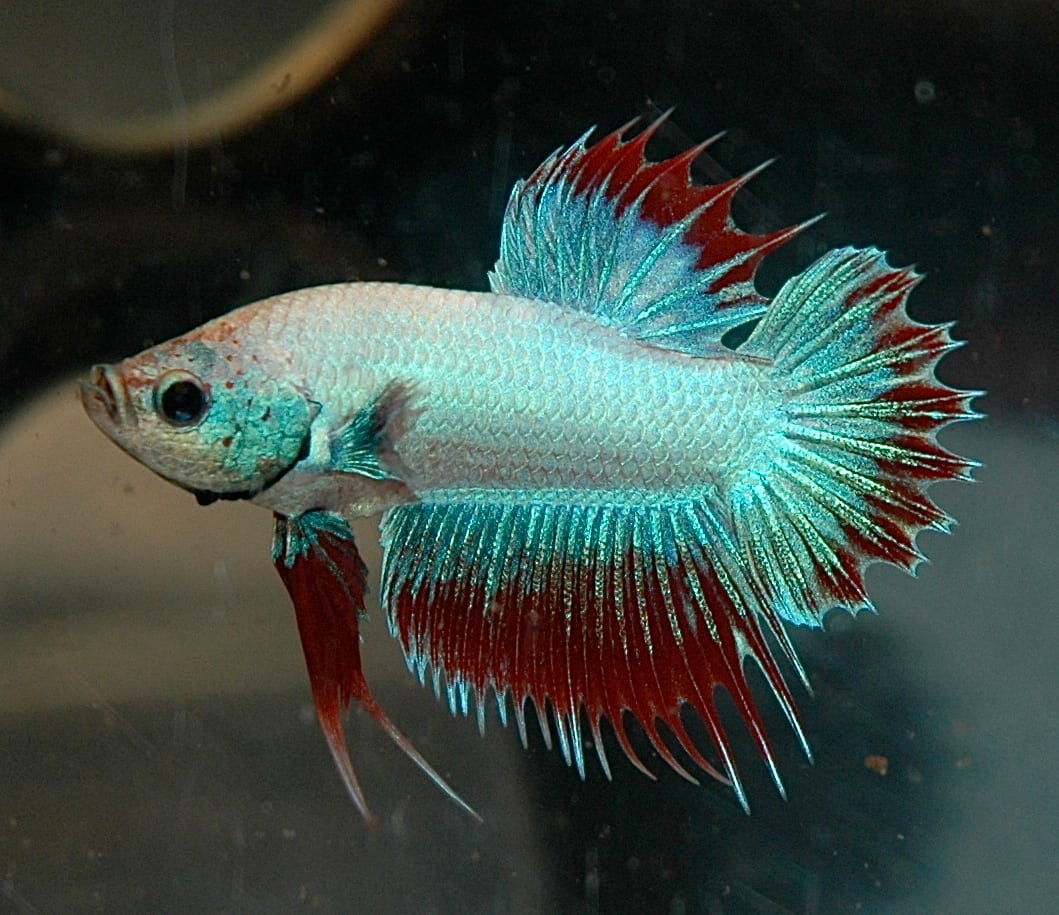
Why is a crowntail more prone to fin rot?
Because fin rot is opportunistic, and a crowntail hands it more opportunities. That said, the claim deserves a straight account of what is established and what is inference.
What is documented: the bacteria behind fin rot, Aeromonas and Pseudomonas species, are ordinary residents of aquarium water. The Merck manual’s position on this group is that they behave as opportunists, colonising tissue that has already been damaged or a fish whose defences are down. That is why the fin rot protocol on this site leads with water quality rather than with medication. The 2022 husbandry review describes the presentation as fins with jagged edges, and the fins may become more transparent and duller in color.
What is mechanical and hard to argue with: a crowntail fin has a longer damage-prone perimeter per unit of fin, and each ray is unsupported, so a snag that would put a small split in a webbed fin instead snaps or splits a single ray at its base.
What is inference rather than measured fact: that these two together produce a measurably higher rate of fin rot in crowntails. No controlled comparison exists that this site can point to. The chain is plausible at every link, keepers report it consistently, and it is still a chain rather than a study. Treat it as a reason to be more careful, not as a diagnosis waiting to happen.
The practical consequence is the same either way. Prevent the mechanical damage and the infection has nothing to start from.
How much flow can a crowntail take?
Less than the box on a filter suggests, and the reason is structural rather than a matter of the fish being delicate.
Membrane is what holds a fin flat and lets it move as a surface. Strip it out and each ray flexes on its own, so a current does not push the fin, it works the rays against each other. Over weeks that produces frayed tips, splits into the remaining webbing, and a fish that spends its day holding position against a pump instead of patrolling.
Seriously Fish recommends, for a sluggish natural environment, an air-powered sponge filter set to turn over gently, and the same profile calls for a well-planted setup with surface cover from floating plants. That is the target: enough water movement to keep the biological colony fed and the surface exchanging gas, and almost none for the fins to fight.
How to get there:
- Air-driven sponge filtration on a small pump. This is the default rather than a compromise, and it is what best filters recommends for this species generally.
- If you are keeping a hang-on-back, baffle it. A cut plastic bottle over the outflow, or a strip of filter foam wedged in the fall, breaks the stream without reducing turnover.
- Read the plants, not the box. If the plants are waving, the fish is working. Stems that drift slowly and floating cover that stays roughly put means you have it about right.
- Watch where the fish rests. A crowntail parked in the one dead corner of the tank every evening is telling you the other three corners are too busy.
Check the NEWKOSEA double sponge filter on Amazon Affiliate link. See our disclosure.
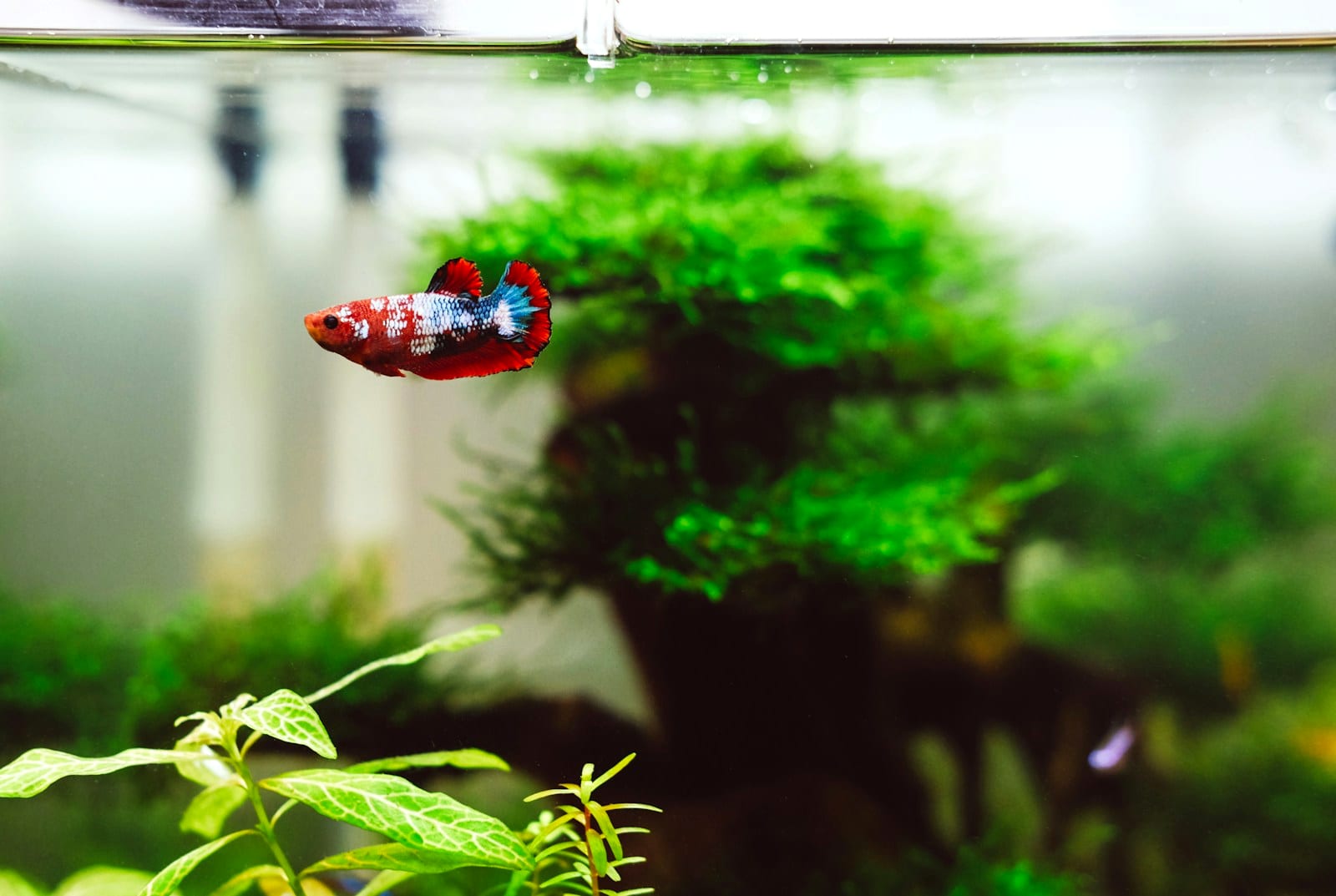
Which decor actually tears a crowntail?
Anything that catches fabric, plus a category most people never suspect.
The reliable test costs nothing. Take a nylon stocking or a square of pantyhose and drag it firmly over every surface going into the tank, including the parts that will face the glass. If the fabric snags, pulls a thread, or squeaks to a stop, a fin ray will do the same. Do this before the item is wet, and do it on the underside of things as well as the top.
The usual offenders:
- Moulded plastic plants, and specifically the seam left where the two halves of the mould met. That ridge runs the full length of every leaf and it is the single commonest source of torn fins in a betta tank. Silk is the standard replacement.
- Ceramic and resin ornaments with hollow openings. Caves, sunken ships, skulls and pirate barrels all have unfinished interior edges the manufacturer never sanded because nobody looks in there.
- Cut driftwood ends and split cholla, which look soft and are not.
- Filter intake slots on a hang-on-back, which will hold a ray against the grille while the pump keeps pulling.
- Sharp gravel for a fish that rests on the bottom, which crowntails routinely do.
The category people miss: the underside of a lid, and the lid’s own cutouts. A betta going up for air at speed can catch a ray on the moulded edge of a feeding hole. That is also a jump risk, which is a bigger problem than a torn fin and is covered on the betta jumping page.
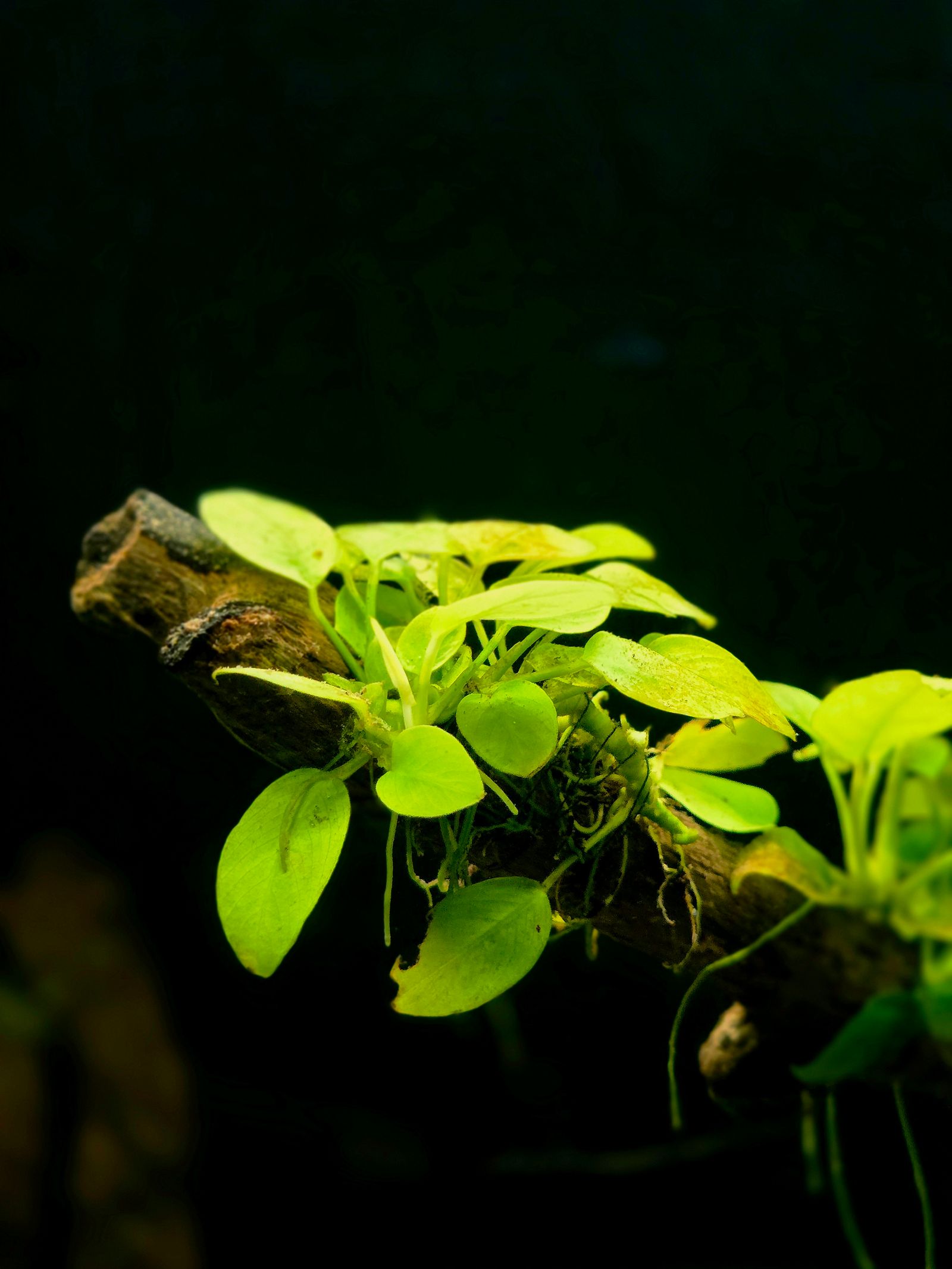
What to use instead is unglamorous and works. Broad-leaf live plants, floating cover, smooth river stone, sanded or naturally worn wood, and catappa leaves on the substrate. Dried leaf litter also brings tannins, which Seriously Fish notes brings with it the growth of microbe colonies; what leaves do and do not do is on the Indian almond leaves page.
Check SunGrow catappa Indian almond leaves on Amazon Affiliate link. See our disclosure.
Does a crowntail need different water?
No, and anyone selling you a crowntail-specific additive is selling you a story.
The targets are the ones on the water parameters table for every Betta splendens: ammonia and nitrite at zero, nitrate held low by weekly changes, temperature stable in the 76 to 82 F band, pH steady wherever your tap sits within the 6.0 to 8.0 range Seriously Fish gives for ornamental strains. The laboratory review names 28 C as the optimum for this species.
Where a crowntail genuinely differs is in how little slack it gives you on those numbers. More exposed edge means more surface where a bacterial population can establish once tissue is compromised, so the weekly water change stops being a good habit and becomes the thing holding the fins together. Skipping a fortnight on a halfmoon usually costs nothing visible. Skipping a fortnight on a heavily reduced crowntail is where the ragged tips start.
Temperature stability carries the same weight for the same reason. Merck gives 1 degree per hour as the maximum safe rate of change, and a cold refill is a double hit: the drop suppresses immune function while the opportunistic bacteria that cause fin rot become more active.
Check the Cobalt Aquatics Neo-Therm Pro 25W heater on Amazon Affiliate link. See our disclosure.
Check the API Freshwater Master Test Kit on Amazon Affiliate link. See our disclosure.
What does good crowntail condition look like?
Six things, and you can only judge four of them while the fish is displaying.
- Rays reaching a consistent length around each fin. A tidy scalloped or spiked outline where the tips sit at a repeating distance from the webbing edge. Not perfectly even, but following a pattern.
- Ray tips straight, not hooked. A slight bend at the very end of the longest rays is common. Tight curl along the length is not.
- Webbing that ends cleanly. The line where membrane stops should be a defined edge, not a fuzzy or milky boundary.
- Full symmetrical spread at flare. Both halves of the caudal opening to the same degree, dorsal standing up, anal extended.
- Colour holding right into the ray tips. Rays that fade to clear at the last few millimetres are usually thinning rather than pigmented that way.
- Behaviour matching the fins. Patrolling, flaring at a reflection, taking food at the surface without hesitating.
Grade all of that while the fish is displaying, because at rest the fins fold and the reduction pattern collapses into an unreadable bundle. A mirror held to the glass for fifteen seconds, no longer, is enough to get the fins open.
The habit worth building on day one: one sharp side-on photograph a month, taken at flare, in the same spot with the same light. Memory is not good enough for a fin that is supposed to look ragged. A three-month photo series makes ray loss obvious in a way that daily observation never does.
Broken rays, curled tips and regrowth
Broken rays regrow. That is the good news and it is worth saying before anything else, because a snapped ray on a show-quality fish looks like a permanent disaster and usually is not.
Regrowth takes weeks rather than days and typically leaves a visible kink at the old break, which stays. A fish that catches the same ray twice ends up with a distinct step in the outline. That is cosmetic.
The distinction that decides whether to reach for medication is direction of travel:
- Mechanical damage is static. A ray snaps or a piece of webbing splits along an existing line, the break is sharp, and it looks identical tomorrow.
- Infection advances. Margins go dark, milky or fuzzy, erosion moves toward the body between one day and the next, and it crosses ray lines rather than respecting them.
Fin damage versus fin rot works through that comparison properly, and it matters more on this fin type than on any other, because the baseline is already irregular.
Curled ray tips are the complaint that brings most crowntail keepers looking for answers, and the honest position is that the mechanism has not been settled in published literature. Keepers report improvement after moving to softer water with more frequent changes, which is an association from practice rather than a demonstrated cause. The full treatment of that question is on the crowntail form page. From a care standpoint the useful moves are: rule out flow first, because curl at the tips of the longest rays on one side is usually mechanical; hold parameters steady rather than chasing an ideal value; and raise water change frequency before adding anything to the tank.
Tank mates, and why the rules are stricter here
Anything that nips fins is worse for a crowntail than for a webbed fish, because an exposed ray is a thin isolated target rather than part of a continuous surface.
The usual suspects apply with more force: tiger barbs, serpae tetras, most gouramis and anything sold as a “community nipper” are already off the list for a long-finned betta and stay off it here. So is any tank where the betta is the slowest fish present, because a crowntail dragging unsupported rays through a busy tank collects damage passively without anyone actively biting it.
What generally works stays the same, and tank mates has the full assessment. The adjustment for this fin type is to weight the decision toward fewer, calmer, slower companions, and to accept that a species-only tank is a legitimate answer rather than a failure.
The monthly routine
- Weekly: 25 to 30 percent water change, temperature matched, dechlorinated. Test ammonia, nitrite and nitrate.
- Weekly: look at the fins in good light while the fish is active. You are looking for change, not for perfection.
- Monthly: one photograph at flare, side on, same spot. Compare against last month.
- Monthly: run the stocking test over anything new that has gone into the tank, including a replacement plant or a piece of wood you moved.
- Whenever the filter is serviced: check that flow has not increased. A cleaned sponge moves more water than a clogged one, which is a change the fish notices even when you do not.
Related on this site
- Crowntail Betta: Reduced Webbing and Extended Rays
- Betta Fin Types: Halfmoon, Crowntail, Plakat, IBC Forms
- Betta Fin Rot: Bacterial Cause, Medication Protocol, Prevention
- Fin Damage vs. Fin Rot: How to Tell Them Apart and What Each Needs
- Best Filters for Betta Tanks in 2026: Sponge Filters Win, Here’s Why
- Betta Fish Water Parameters: The Complete Reference Table
- Betta Tank Mates: What Actually Works and What Doesn’t
- Indian Almond Leaves for Betta Fish: What They Actually Do