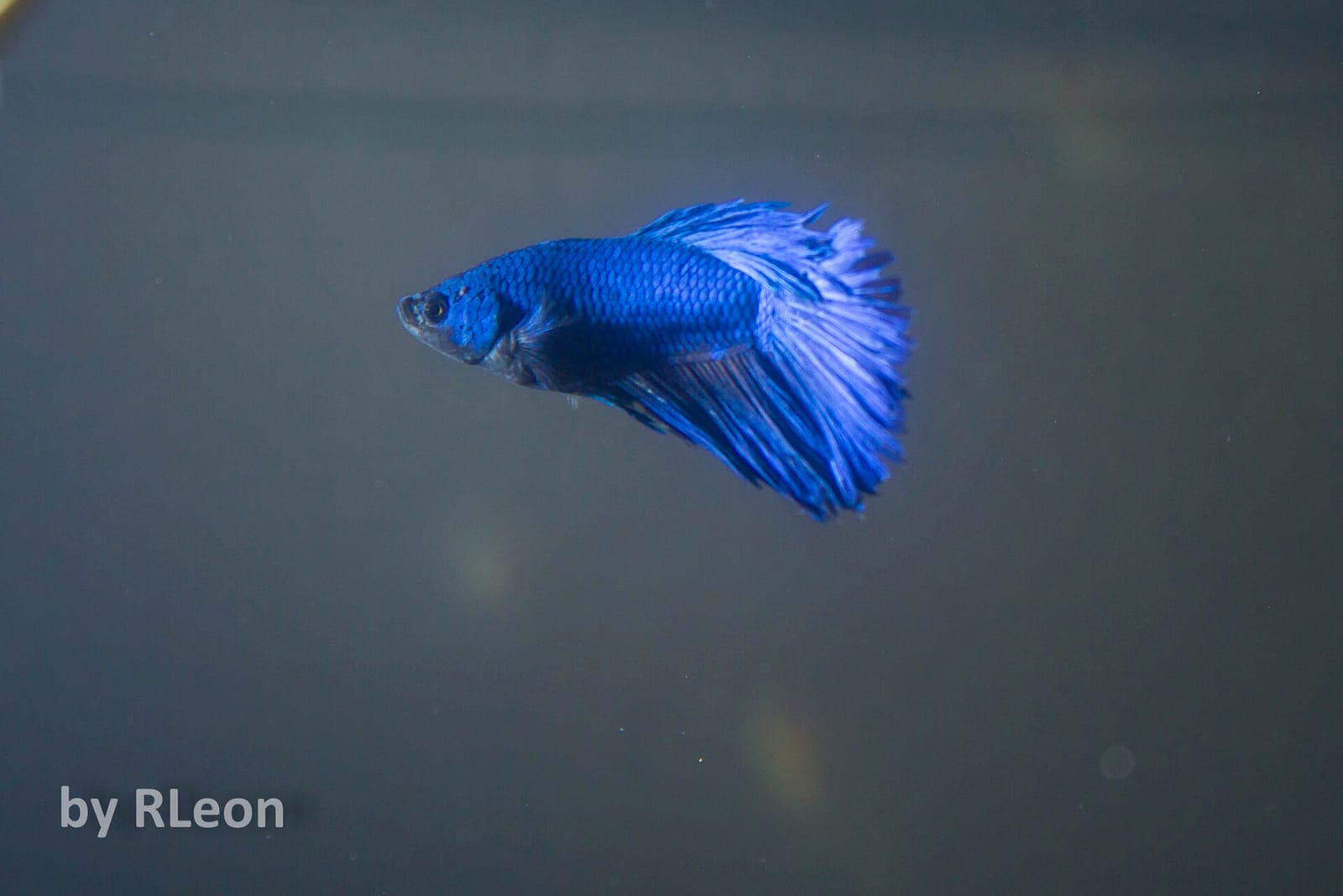
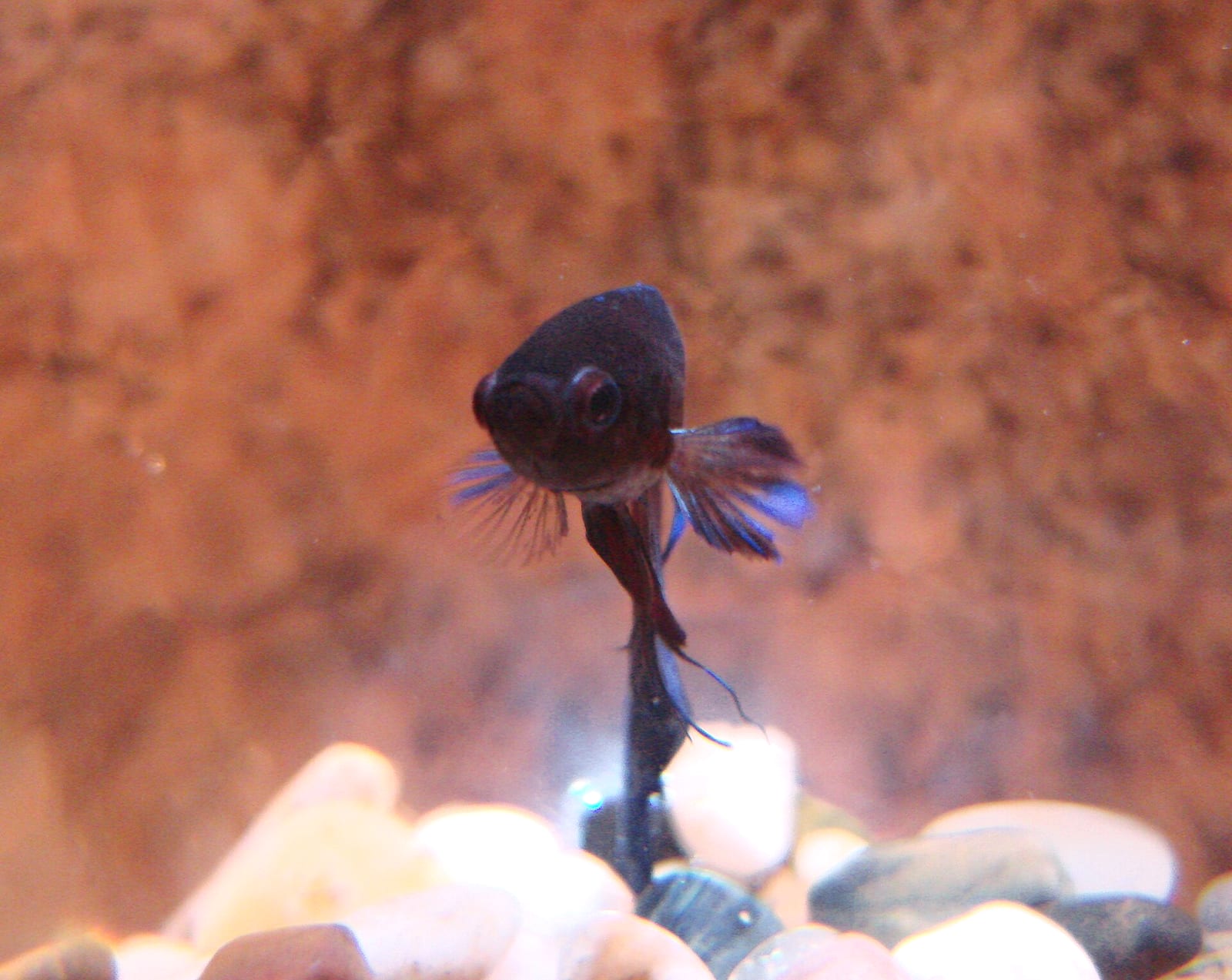
A dumbo betta, sold interchangeably as elephant ear or EE, has oversized pectoral fins. The pectorals are the small paired fins sitting just behind the gill covers, one on each side, and in a dumbo fish they grow wide and long enough to look like ears flapping as the fish hovers. The tail is not involved. The trait is inherited independently of tail shape and independently of colour, which is why the trade sells dumbo halfmoons, dumbo plakats and dumbo crowntails as separate things.
That anatomical point is the one most listings get wrong, and it is worth being precise about before anything else.
Which fins are actually enlarged?
The pectorals, and only the pectorals. A betta carries seven fins: a caudal (tail), a dorsal (top), an anal (underside, running most of the body length), a small ventral pair hanging below the throat, and the pectoral pair behind the gills. Betta anatomy has the full layout.
On a standard fish the pectorals are small, clear and easy to miss because they beat almost constantly. On a dumbo they can reach several times that area, and in many lines they are opaque white or cream against a coloured body, which makes them look larger still.
You will occasionally see a listing describe a dumbo as a tail type or place it on the same list as halfmoon and crowntail. It is not on that axis at all. A fish can be a dumbo and a halfmoon simultaneously, and Seriously Fish records half moon elephant ear among the documented ornamental strains for exactly that reason.
What genetics produce the dumbo pectoral?
The 2022 Science Advances betta survey (PMC9491723) ran this as an explicit case-control study: 64 dumbo fish against 663 non-dumbo controls. It describes the breed as showing overgrowth of the paired pectoral fins, with more and elongated fin rays. The count matters as much as the length. A dumbo pectoral is not simply a stretched version of a normal one; it is built from additional rays.
Two signals came out, both strong:
| Signal | Location | P value |
|---|---|---|
| Chromosome 11 | 8.87 to 9.72 Mb | 3.99 × 10⁻³⁵ |
| Chromosome 19 | 4.25 to 4.47 Mb | 1.13 × 10⁻⁵² |
The lead variant sits in a region containing a cluster of eight genes from the hoxa family, which the authors note is essential for forming fin skeleton and digits in teleost fish. That is a coherent candidate: hox genes set positional identity during limb and fin development, and a change in that neighbourhood producing extra, longer rays in one fin pair is the kind of result the developmental biology predicts.
Note what two independent genome-wide signals imply. Hobby genetics has long described elephant ear as a simple recessive requiring two copies for full expression, and crosses do often behave that way in the tank. A two-locus mapping result does not sit comfortably inside a clean single-gene model. The honest summary is that expression is strongly heritable, partial expression is common, and the underlying architecture involves more than one region. Treat published single-locus descriptions of this trait, including older ones on this site’s fin types catalog, as the practical breeding shorthand rather than the mapped result.
Can a dumbo be a halfmoon, a plakat or a crowntail?
Yes to all three, and the combinations are sold under stacked names.
- HM dumbo or EE halfmoon: 180-degree caudal spread plus enlarged pectorals. See halfmoon.
- HMPK dumbo: short-finned body, halfmoon spread, enlarged pectorals. The most structurally sound of the combinations, because it adds fin area in one place while removing it everywhere else.
- CT dumbo: reduced webbing plus enlarged pectorals, which is visually busy and mechanically the most delicate. See crowntail.
Colour stacks on top of all of these independently again, so koi dumbo halfmoon is three separate facts in one label.
Show classification follows the IBC exhibition standards rather than trade naming, and the current standards book is the document to check before entering a fish under any combined form.
Does the enlarged pectoral affect swimming?
Almost certainly, though the specific measurement has not been published for this trait, and it is better to say that than to guess a number.
What is established is what pectorals do. In fish generally, the pectoral pair handles low-speed manoeuvring: hovering in place, braking, turning tightly, and holding station. That is precisely the swimming mode a betta spends most of its day in. Enlarging the surface a fish beats several times per second changes the energy cost of that mode, and the direction of the change is not in doubt even if the magnitude is unmeasured.
Keepers consistently report that dumbo fish tire faster in current and manoeuvre less crisply than standard-pectoral fish of the same line. That is a practice-level observation rather than a controlled result, and it should be labelled as such. The 2022 laboratory care review (PMC9334006) documents husbandry for the species without addressing fin morphology and swimming performance, so there is no published figure to cite either way.
What tank suits a dumbo?
Three adjustments, all of them mild.
Low flow. The single most useful change. Air-driven filtration or a baffled outflow keeps a dumbo from fighting current all day. A double sponge filter (affiliate) on a small pump is the straightforward answer, and best filters covers the alternatives.
Lateral room over height. Enlarged pectorals cost more in turning than in straight-line swimming, so floor area matters more than depth. A wider footprint at the same volume is the better choice; the general requirements are in tank setup.
Resting furniture at mid-water. Broad-leaved plants, a leaf hammock, or driftwood shelves near the surface give the fish somewhere to park. Bettas use these anyway, and a fish carrying extra fin area uses them more.
Nothing else changes. Temperature, water chemistry, feeding and tank size follow the standard targets in water parameters.
How do you spot a real dumbo in a photograph?
Proportion against a fixed reference, because photographs have no scale.
- Compare pectoral length to the head. On a standard fish the pectoral is roughly eye-to-gill-cover in length. On a dumbo it commonly runs past the mid-body.
- Look for opacity. Many dumbo lines carry white or cream pectorals rather than clear ones. Useful as a hint, not as proof, since clear-pectoral dumbos exist.
- Check whether the fin holds its shape. A dumbo pectoral is stiffened by extra rays and fans out; a stretched clear fin flutters.
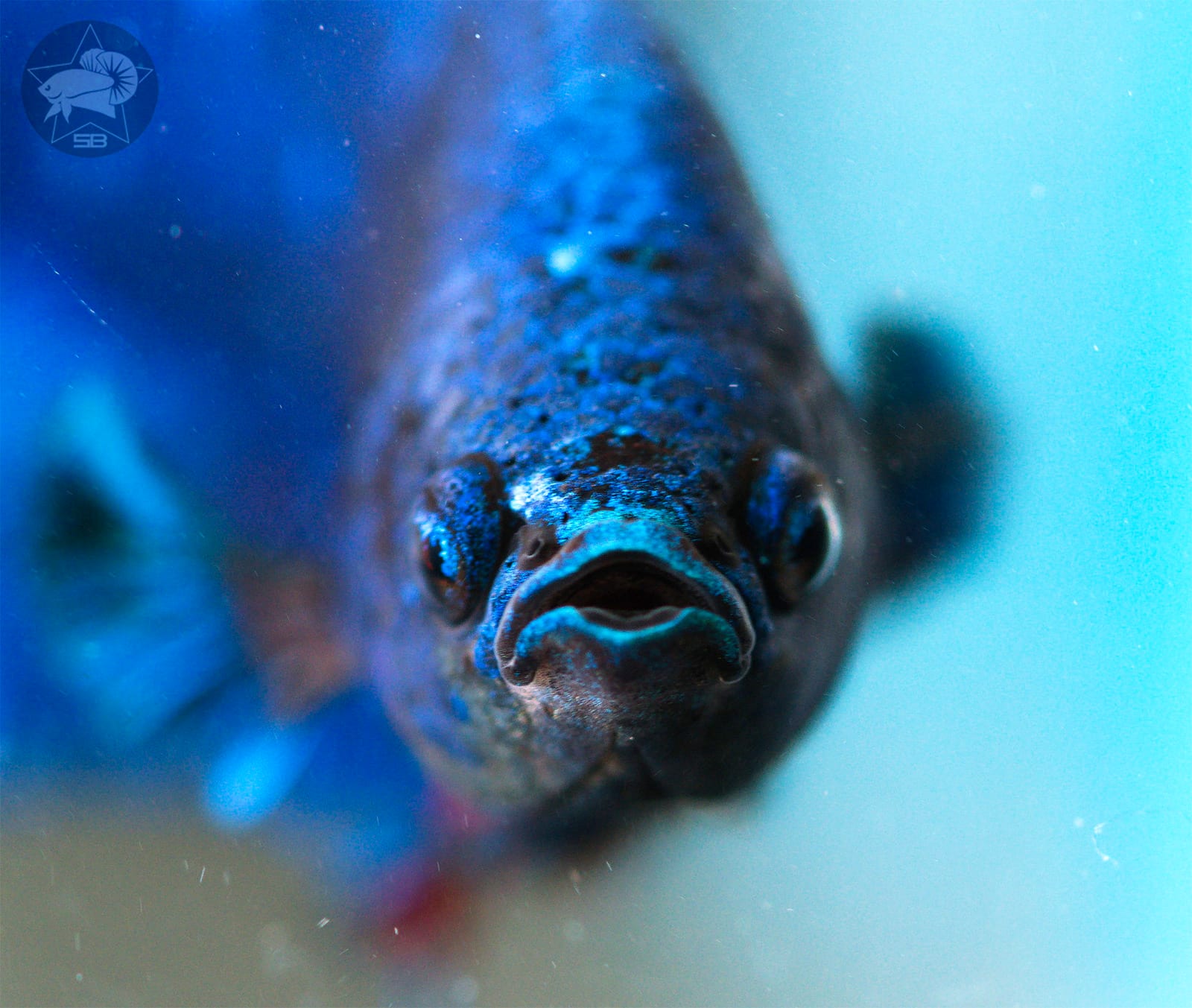
- Beware the angled shot. A fish photographed nose-on has both pectorals spread toward the camera and looks far more dumbo than it is. Ask for a side-on image.
- Partial expression is common. Plenty of fish sit between standard and full dumbo, and are often sold at full-dumbo prices.
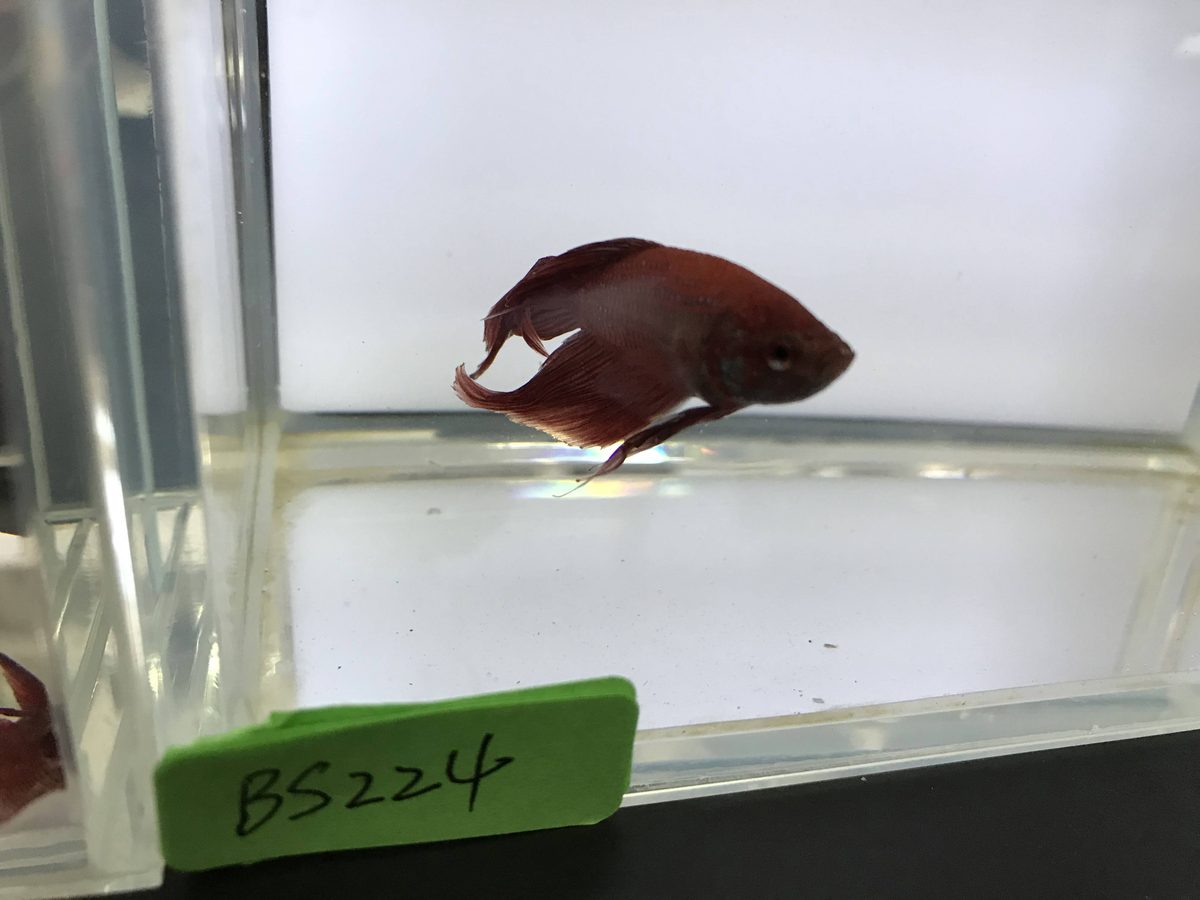
Breeding dumbo
Expression is heritable and graded rather than binary, so selection works but rarely gives a clean split.
- Dumbo to dumbo raises both the share of expressing fry and the average size of the pectoral in the next generation.
- Dumbo to standard typically yields a spread from unaffected through intermediate, which is useful for outcrossing vigour into a line at the cost of a generation of expression.
- Grade at three to four months. Pectorals are still developing before then and intermediates are easy to mistake for full expression early.
- Select against asymmetry. A noticeably larger fin on one side persists and looks worse as the fish matures.
Because the trait combines freely with tail form and colour, most dumbo projects are really two projects being run at once. Pair selection covers grading multiple traits in one spawn.