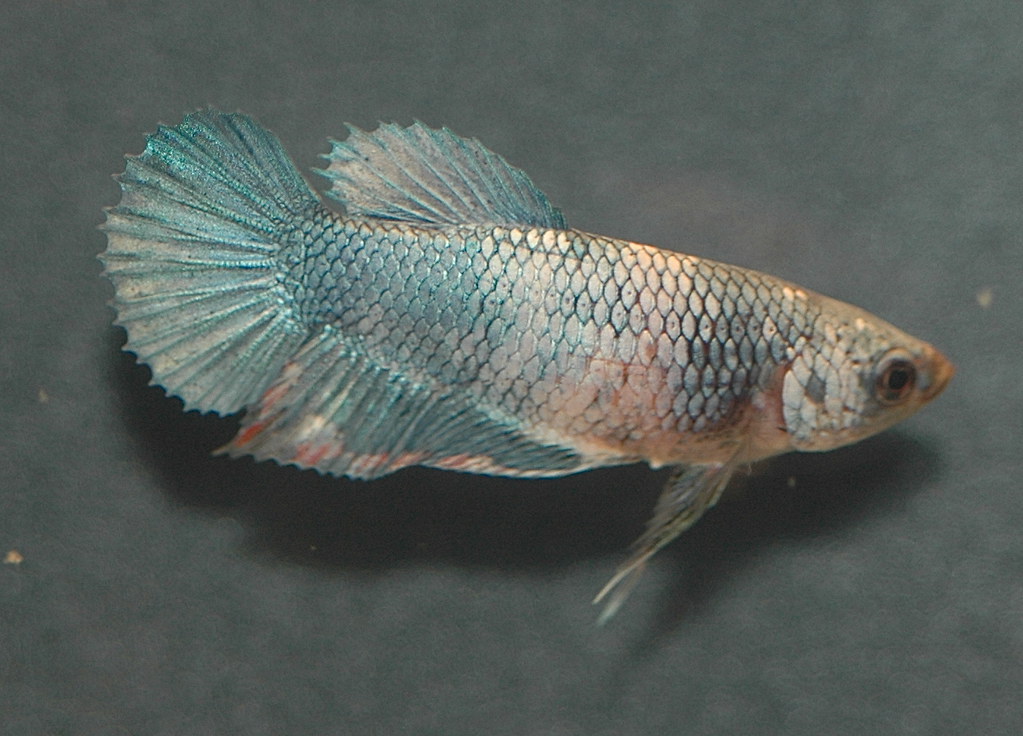
Most black spots on a betta body are not a disease. The commonest cause by far is the marble gene rewriting the fish’s pattern through life. Ammonia damage, a healing injury and ordinary maturation account for most of the rest. Black spot trematode is real, and effectively impossible in a closed aquarium.
This page has affiliate links. As an Amazon Associate we earn from qualifying purchases. See our affiliate disclosure.
What are you actually looking at?
Before naming a cause, answer three questions about the marking itself. They separate the possibilities faster than any photo comparison.
Is it flat or raised? Run your eye along the fish’s profile against the light. Pattern sits in the skin and follows the scale grid. A cyst is a small bump that breaks the line of the body.
Did it appear over days or over weeks? Pigment changes creep. Damage arrives.
Is the fish behaving normally? Eating, patrolling, flaring, building a nest. A fish doing all four while wearing new markings is telling you the markings are cosmetic.
| What you see | Timeline | Fish behaviour | Most likely cause | Action |
|---|---|---|---|---|
| Irregular patches spreading across body and fins, edges soft | Weeks to months | Normal | Marble gene | None |
| Whole fish darkening evenly, colour dulled | Days | Hiding, clamped, off food | Stress or water quality | Test today |
| Dark smudge on one flank where a scale was lost | Days after an incident | Normal | Healing injury | None, watch it |
| Fin edges going black and receding | Days, progressive | Sometimes clamped | Fin rot, not pigment | Treat |
| Colour deepening on a young fish, symmetrical | Months | Normal | Maturation or a melano line | None |
| Black speckling like ground pepper, slightly raised, uniform size | Appeared with a new fish | Flashing, rubbing | Trematode cyst, rare in aquaria | See the section below |
| Horizontal dark stripe running nose to tail | Hours to days | Hiding, pale otherwise | Stress striping | Test and fix the cause |
Only two rows on that table are urgent, and one of them is not a pigment problem at all.
Is it the marble gene?
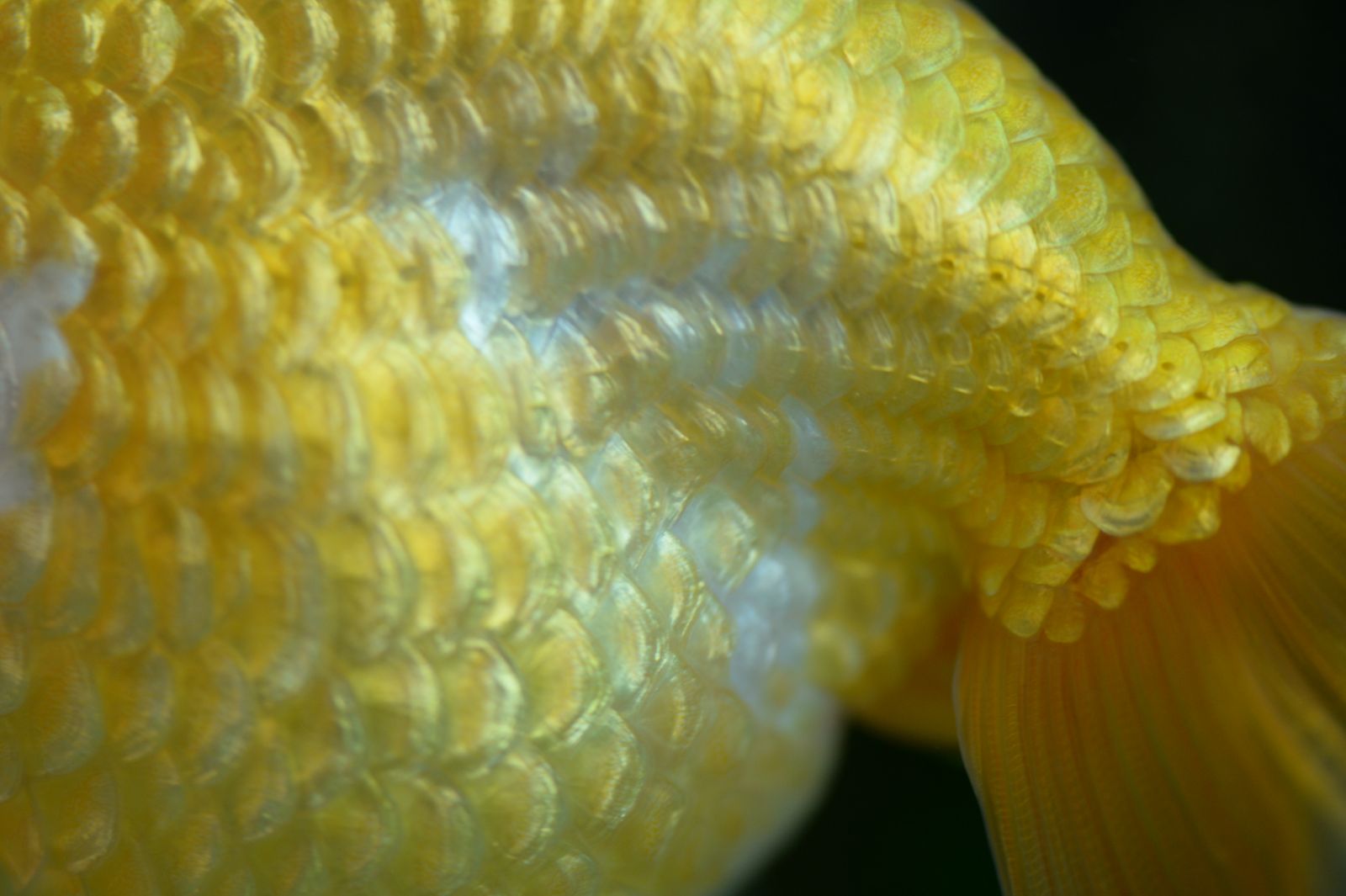
If your fish is changing pattern rather than developing lesions, this is nearly always the answer, and it needs no treatment because it is not a problem.
Marble bettas rewrite themselves for life. A fish sold as a solid red can go patchy black across a season, then lose the black again, then gain a white face. The direction is not predictable, the endpoint is not fixed, and two fish from the same spawn can end up looking unrelated.
The honest state of the science here is smaller than the hobby suggests. The 2022 genetic-architecture survey ran a case-control comparison of 209 solid fish against 55 mosaic fish and found the pattern to be polygenic rather than driven by one gene, and the authors say plainly that the underlying molecular basis has not been investigated. Anyone telling you exactly which transposable element is jumping is telling you hobby folklore. The marble gene page has the full argument and the retraction of the version this site used to run.
What you can use practically:
- Marbling moves. Track it with a photo a month. Pattern that migrates is pattern.
- It crosses body and fins. A marking that appears on the body and separately in the caudal is following a pigment lineage, not an injury.
- Koi and galaxy fish are marbles. If the fish was sold under either name, unstable pattern is the product you bought, not a fault in it.
- It does not itch. No flashing, no rubbing, no clamping.
Can ammonia actually cause black spots?
This is where the hobby and at least one careful source disagree, so here is the disagreement rather than a verdict dressed up as one.
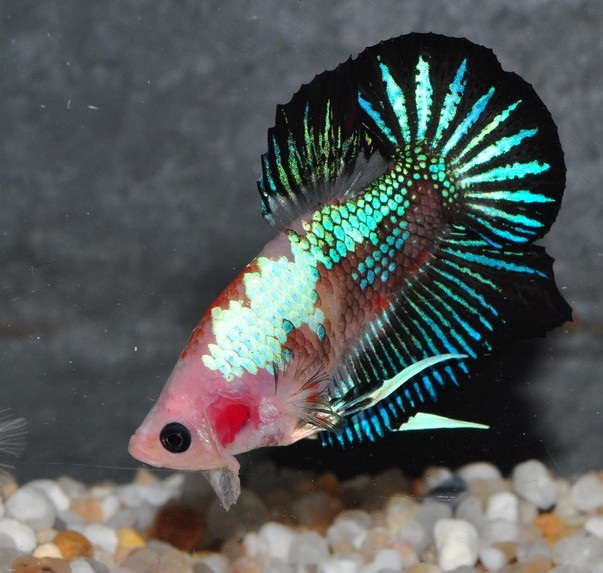
The widely repeated claim is that black patches are healing ammonia burns, and that they fade as the fish recovers. Aquarium Science rejects it without hedging, writing of the people who say so: I cannot sugar coat it. These people are simply wrong.
Check that against the veterinary literature and the picture is consistent with the rejection, though not quite as loud. Ammonia toxicity in the Merck Veterinary Manual presents as lethargy and poor appetite, progressing at acute concentrations to spinning, disorientation and convulsions. The UF/IFAS extension guidance describes gill damage, stress, susceptibility to bacterial infection and poor growth. Neither names discrete black patches on the flank. The lab husbandry review for this species lists the general illness signs as clamped fins, lethargy, and disinterest in food.
What the literature does support is the adjacent thing, and it gets conflated with the first: a stressed fish darkens. Skin pigmentation in fish is under hormonal control, and alpha melanocyte-stimulating hormone drives melanophore dispersion while also participating in the stress response, so stressors raise both cortisol and the signal that spreads pigment. That mechanism produces general darkening and stress markings, which is exactly what the stress stripes page covers. It is not a mechanism for a black patch the size of a fingernail on one flank.
Where this site lands, and the reason it matters practically:
Do not diagnose ammonia from a spot. Diagnose it from a test.
A fish in ammonia has clamped fins, sits on the bottom, refuses food and may show red or inflamed gills, and the tank reads above zero on a kit. If your fish has black markings, is eating, and the tank reads clean, the ammonia hypothesis has failed its own test and you should stop treating for it. If the tank reads above zero, you have an ammonia problem to fix regardless of what the spots turn out to be, and ammonia poisoning has the emergency protocol.
Check the API Freshwater Master Test Kit on Amazon Affiliate link. See our disclosure.
Check the Seachem Ammonia Alert on Amazon Affiliate link. See our disclosure.
What about a healing injury?
Localised, singular, and stationary. Those three words cover most of this category.
A betta that catches a scale on a decoration, loses a scale to a snagged fin, or gets nipped in a divided tank often shows a dark smudge over the site while tissue rebuilds. It sits in one place, it does not spread across the body, and over several weeks it usually pales as the scale regrows or the skin reorganises. On a light-coloured fish it looks alarming out of proportion to what it is.
The tell that separates this from infection is direction of travel. Healing shrinks. Infection advances, and it advances between one day and the next. Fin damage versus fin rot works through the same distinction on the finnage, where it matters more, because a fin edge going black and receding toward the body is not pigment at all. It is fin rot, and it needs a different page and a different response.
Is this melanism, or a young fish maturing?
Both exist, both are genetic, and neither is a health event.
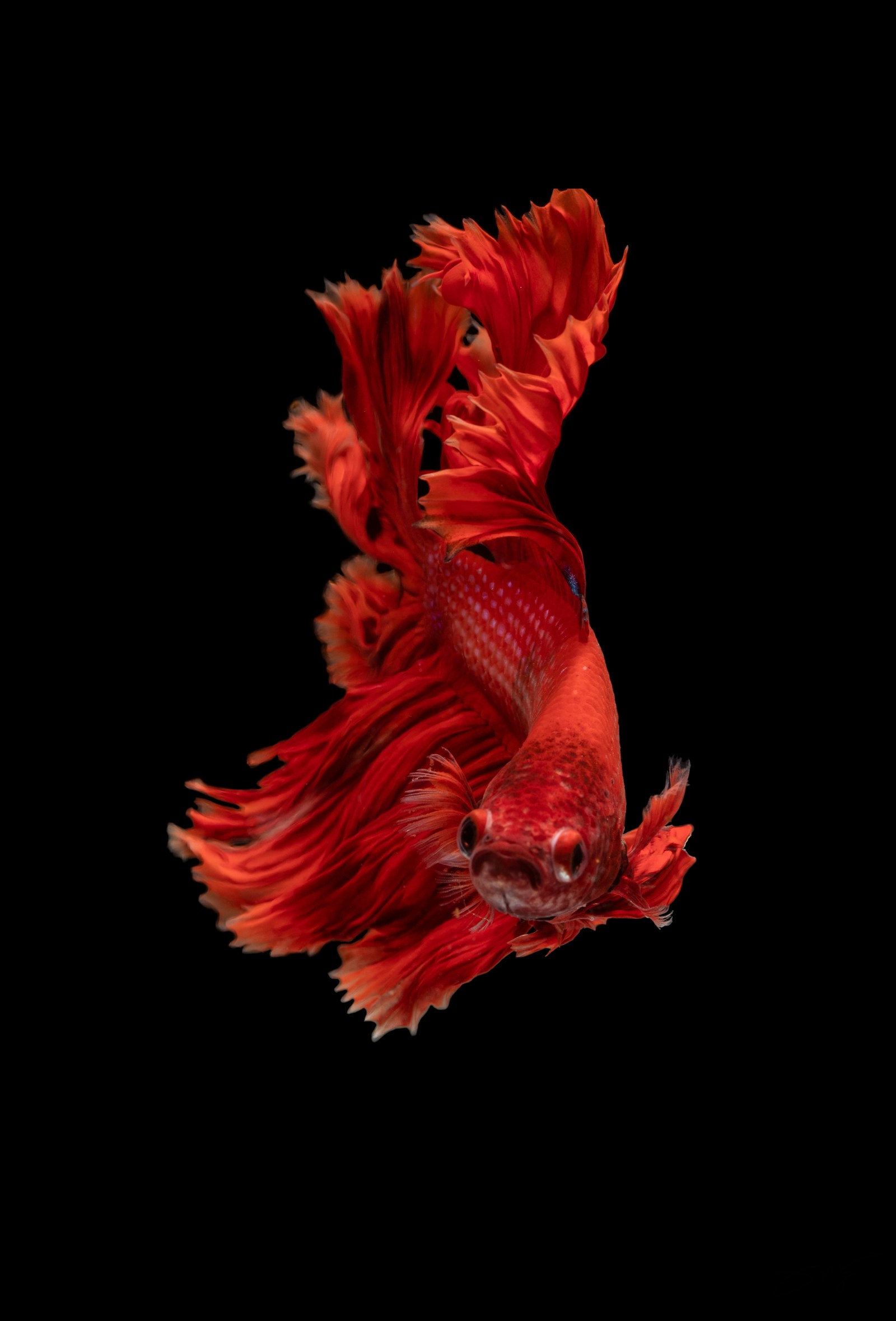
Black pigment in this species runs through documented lines. The melano allele produces the deepest matte black phenotype when homozygous, and carries a genuine breeding consequence in that homozygous females are infertile, which is why the black melano page exists as a breeding article rather than a health one. Copper, black orchid and steel lines all deepen with age. So does iridescence layered over a dark base, which reads as a spreading dark sheen rather than a spot.
Young fish also simply finish. A four-month-old betta is not showing its adult colour, and pigment arriving symmetrically over months, on both flanks, in a fish that is eating and growing, is development. Betta color morphs catalogues which lines do what.
The distinguishing question is symmetry. Genetics tends to arrive on both sides in comparable places. Damage does not.
What about the actual black spot parasite?
It is a real disease with a real name, and you almost certainly do not have it.
Black spot, also called diplopstomiasis, is caused by digenean trematode metacercariae, typically Neascus or Uvulifer species. The larvae encyst under the skin and the fish’s own immune response deposits pigment around each cyst, which is what makes the spot black. The Minnesota DNR describes the result as resembling black pepper sprinkled on fins or flesh.
The reason it does not belong in your differential is the life cycle. It needs three hosts in sequence: eggs released by fish-eating birds, intermediate development in snails, then free-swimming stages that penetrate fish and encyst, with the loop closing when a bird eats the fish. The Merck manual makes the general point for the group, that trematodes have a complex life cycle that includes a variety of host animals, typically beginning with a mollusc. Aquarium Science draws the practical conclusion: black spot is almost always found in fish raised in ponds, because a closed aquarium has no heron in it.
So the pattern that would make this plausible is narrow. An outdoor-raised or wild-caught fish, spots of roughly uniform small size that are slightly raised, and irritation behaviour, meaning flashing and rubbing on decor. Merck lists flashing and rubbing as the behavioural signature of external parasites generally.
Even then the prognosis is mild. The cysts are dormant, they do not multiply on the fish, and existing spots fade over months as the encysted larvae die. Praziquantel treats it. Aquarium Science does not think treatment is usually warranted, describing the condition as self limiting.
If a new fish arrives with unexplained spots, the useful response is not medication. It is a quarantine tank and a month of observation, which also catches the several things that genuinely are contagious.
When black markings do mean act now
Three combinations, and none of them is about the colour.
- Fin edges blackening and receding toward the body. That is tissue loss with pigment at the margin, and it is fin rot until proved otherwise. Test the water, then treat.
- A whole fish darkening while going off food and clamping. Read that as the water, not the pigment. Test ammonia, nitrite, nitrate and temperature before anything else.
- Spots plus flashing. Rubbing against substrate and decor means irritation, and irritation on a betta usually means water chemistry or an external parasite rather than pigment.
Everything else on this page is a photograph you can take once a month and compare.
Check Seachem Prime on Amazon Affiliate link. See our disclosure.
What not to do
Do not medicate a pattern. Antibiotics and antiparasitics have real costs: they stress the fish, several of them damage the filter colony, and none of them acts on melanophores. Treating a marble with kanamycin achieves nothing except a stalled cycle.
Do not dose salt as a general precaution. Aquarium salt has specific uses, and cosmetic pigment change is not one of them.
Do not raise the temperature to fight it. That protocol belongs to ich and it makes an already-stressed fish work harder.
Do not assume the shop was lying. Marble sold as solid is not usually fraud. It is a fish whose pattern had not moved yet.
Related on this site
- The Marble Gene: Why Marble Bettas Change Pattern for Life
- Betta Fish Stress Stripes: What They Mean and How to Make Them Go Away
- Betta Ammonia Poisoning: Signs, Emergency Response, Recovery
- Fin Damage vs. Fin Rot: How to Tell Them Apart and What Each Needs
- Betta Fin Rot: Bacterial Cause, Medication Protocol, Prevention
- Betta Black Melano Genetics: Why Females Are Infertile
- Betta Color Morphs: Modern Catalog and Genetics
- Betta Quarantine Tank: Setup, Duration, and What to Watch For