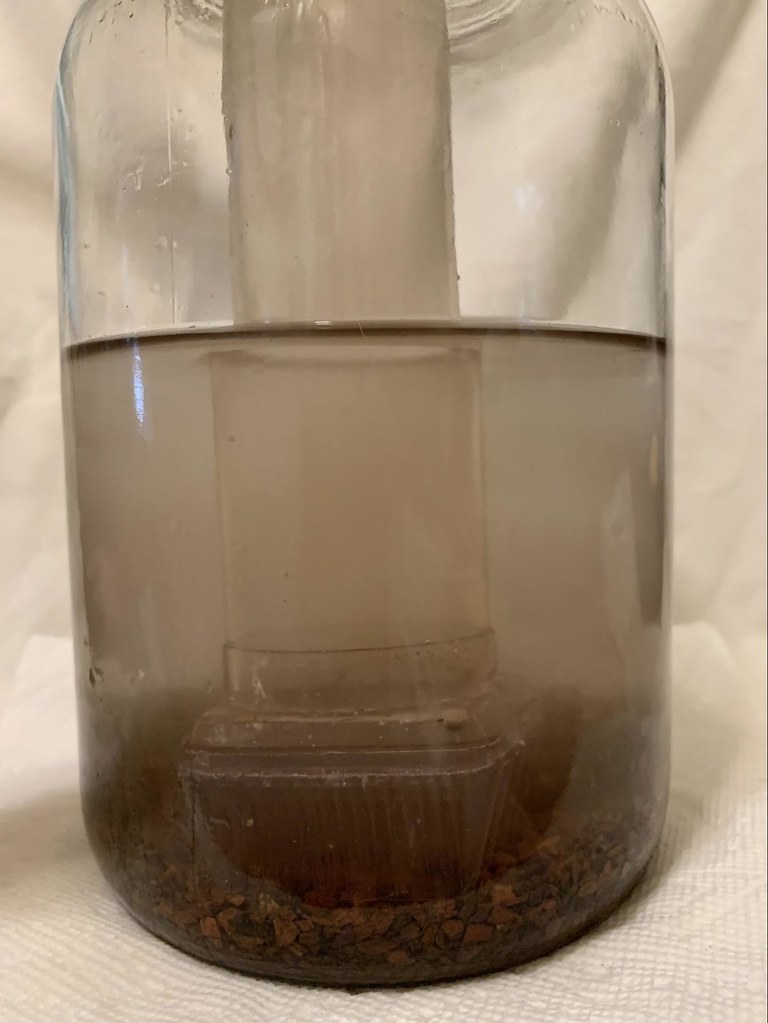
There is no single correct interval. A cycled, lightly stocked 5-gallon with a sponge filter usually needs 25 to 30 percent once a week. An uncycled tank with a fish in it needs a change every day until ammonia and nitrite read zero. The test kit sets the schedule, not the calendar.
This page has affiliate links. As an Amazon Associate we earn from qualifying purchases. See our affiliate disclosure.
What actually decides the interval?
Four things, and the calendar is not one of them.
Volume. A 3-gallon holds three times less dilution than a 10-gallon and the same fish produces the same waste in both. Small tanks are not easier, they are less forgiving. Seriously Fish puts the working floor for a single male at a 45 by 30 cm footprint, which at a normal fill depth works out somewhere between 7 and 10 US gallons.
Biological filtration. A mature filter converts ammonia to nitrite and nitrite to nitrate continuously, between changes, while you are asleep. Without one, the only thing standing between the fish and its own waste is you and a bucket. The nitrogen cycle page has the chemistry.
Stocking and feeding. One betta in a planted 10-gallon and one betta plus five snails in a bare 5-gallon are different tanks. So is the same tank before and after a week of double feeding.
What the test says. This is the one that overrules the other three. A tank whose numbers are clean does not need water changed because a Sunday arrived.
| Setup | Typical routine | Trigger to change sooner |
|---|---|---|
| Cycled 5-gallon, filtered, one betta, planted | 25 to 30 percent weekly | Nitrate climbing past the usual reading |
| Cycled 10-gallon or larger, filtered, one betta | 25 percent every 10 to 14 days | Any ammonia or nitrite above zero |
| Cycled tank with snails, shrimp or a divider | 30 percent weekly | Missed feeding cleanup, a death you did not find |
| Uncycled tank with a fish in it | 50 percent daily, minimum | Ammonia at 0.25 ppm or higher at any hour |
| Unfiltered bowl or vase of any size | 50 percent every other day, plus 100 percent weekly | Any visible waste, any cloudiness, any smell |
| Hospital or quarantine tank under medication | Per the medication label, usually 50 percent every 48 hours | Refusal to eat, worsening symptoms |
Read that table as a starting position you then correct with test results, not as a rule you follow while the numbers drift.
How often for a cycled, filtered tank?
Weekly, at 25 to 30 percent, is the interval that survives most real households.
That number is not magic. It comes from what a betta tank accumulates between changes: nitrate, dissolved organics, and whatever minerals evaporation concentrates. A weekly quarter-change keeps nitrate from stacking up and takes out the detritus a gravel vacuum can reach, without stripping the tank so hard that the fish spends every Sunday in different water.
Here the hobby genuinely disagrees, and it is worth knowing why before you pick a side.
Aquarium Science argues that the only reason to change water at all is to hold nitrate in a reasonable range, and recommends greater than 50 percent every two weeks for a heavily stocked tank, every six weeks for a moderately stocked one, and every five months for a lightly stocked one. On the other end, the 2022 laboratory husbandry review for this species describes a facility that replaces 15 percent of total system volume daily with fresh reverse osmosis water and holds ammonia, nitrite and nitrate at nondetectable.
Those two positions are five months apart and both are defensible, because they are solving different problems. A research facility with continuous filtration and daily staff is buying stability. A hobbyist with one lightly stocked tank and an accurate nitrate reading genuinely does not need to change water every week to keep a fish healthy.
Where this site lands: weekly, because a weekly habit gets done and a five-month habit does not. A schedule you actually keep beats an optimal schedule you forget in March. If you test regularly and your nitrate genuinely sits flat, stretching to every ten days or two weeks is not negligence.
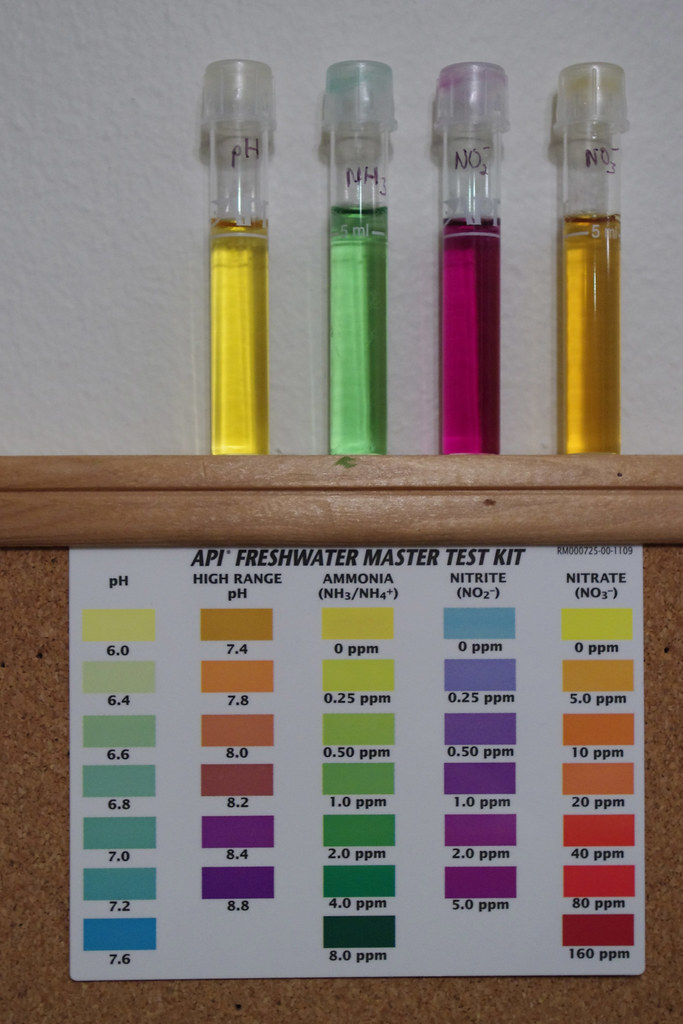
Check the API Freshwater Master Test Kit on Amazon Affiliate link. See our disclosure.
Strips are cheaper and they read nitrate badly. Best test kits covers which readings you can trust from which product.
What changes if the tank is not cycled?
Everything. An uncycled tank is a different animal and the weekly schedule does not apply to it.
In a tank with no established bacterial colony, ammonia goes up from the moment the fish arrives and nothing removes it. The thresholds are not close to generous. The UF/IFAS extension guidance on ammonia states that damage to fish tissue can occur any time un-ionized ammonia exceeds 0.05 mg/L, and that sensitive fish typically die at 2.0 mg/L. The Merck Veterinary Manual puts the same threshold on histology: un-ionized ammonia at 0.05 mg/L is high enough to cause histologic changes to gill tissue. For this species specifically, the 2022 husbandry review sets the practical line at 0.25 ppm total ammonia.
So the fish-in schedule is:
- Test daily. Both ammonia and nitrite.
- Change 50 percent whenever either reads above zero. Test again after the change. If it still reads, change again.
- Dose an ammonia-binding conditioner with every change, which converts free ammonia to a less toxic form for a day or so without stalling the filter.
- Feed less. Uneaten food is the largest controllable input, and the extension guidance names reducing or stopping feeding as the first move when ammonia appears.
- Do not clean or replace filter media. The colony you are waiting for lives on it.
Merck notes a biofilter can take up to 8 weeks to become established in a tropical tank. Two months of daily testing is the price of stocking before cycling, which is the argument for fishless cycling in the first place.
Check Seachem Prime on Amazon Affiliate link. See our disclosure.
Is a large water change dangerous?
Mostly no, and the fear of it causes more harm than the practice does.
The received wisdom is that anything over 25 percent shocks a fish. What the veterinary literature actually flags is the rate of temperature change, not the volume: Merck gives a general rule of 1 degree Fahrenheit, or even 1 degree Celsius, per hour as a maximum. A 50 percent change with matched water moves temperature by nothing. A 25 percent change with water ten degrees colder moves it a lot.
Three real hazards do exist, and none of them is the percentage on its own:
- Untreated tap water. Chlorine or chloramine going in at volume, covered below.
- Well water. It arrives with almost no dissolved oxygen. Aquarium Science recommends capping changes at 25 percent on a well, or letting the water stand a day first.
- A tank left dirty for months. Water that has drifted a long way from tap chemistry gets a genuinely large correction all at once. The fix is to bring it back over several moderate changes rather than one enormous one.
On a routine tank in good condition, none of those apply, and a 50 percent change is a normal Saturday.
Does the new water need to match temperature?
Yes, and it is the part people skip because it is boring.
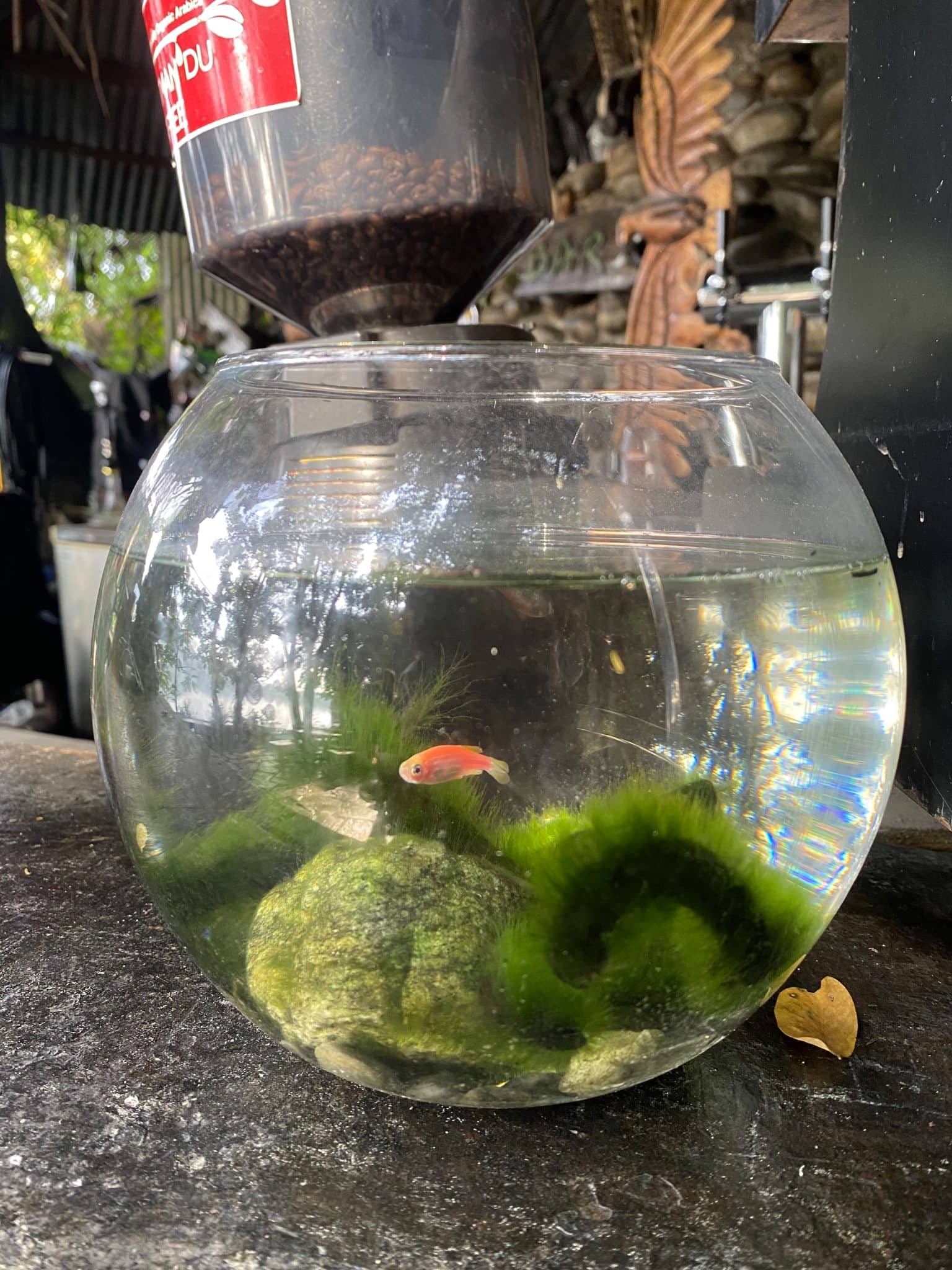
Match the replacement water to the tank by feel and then check it, rather than trusting a hot tap. A betta wants stability in the 76 to 82 F band, with the full argument on the temperature page, and the damage from a cold refill is not the reading itself. It is that a temperature drop suppresses immune function while several common pathogens speed up, which is the mechanism behind fin rot showing up three weeks after a careless winter water change.
Practical version: fill the bucket, let it sit until it stops feeling cold on the inside of your wrist, then confirm with a thermometer before it goes in. On a 25 percent change a couple of degrees of difference is diluted four to one before it reaches the fish, which is the quiet advantage of a smaller, more frequent change.
Do I still need dechlorinator on a small change?
Every time, including the 10 percent top-up you told yourself does not count.
Municipal water is treated with chlorine or with chloramine, and both are toxic to fish and to the bacteria in your filter. Chloramine is the harder of the two. Illinois American Water states it plainly: unlike chlorine, which dissipates when water sits for a few days, chloramines may take weeks to disappear, and answers the standing-water question with a flat no. Boiling does not work either. The only practical removal methods are a conditioner containing a dechlorination chemical, or granular activated carbon.
Merck reaches the same conclusion from the fish side: dechlorinators should be used to treat any new water that goes in the aquarium.
Two details worth knowing. Chloramine is chlorine bound to ammonia, so breaking it releases ammonia into your tank, which is why a conditioner that also binds ammonia is the sensible default rather than a plain dechlorinator. And if your water utility switched treatment recently, the change is usually announced but rarely noticed; best water conditioners covers what each product actually does.
Does a planted tank need fewer changes?
Usually yes, and the reason is measurable rather than mystical.
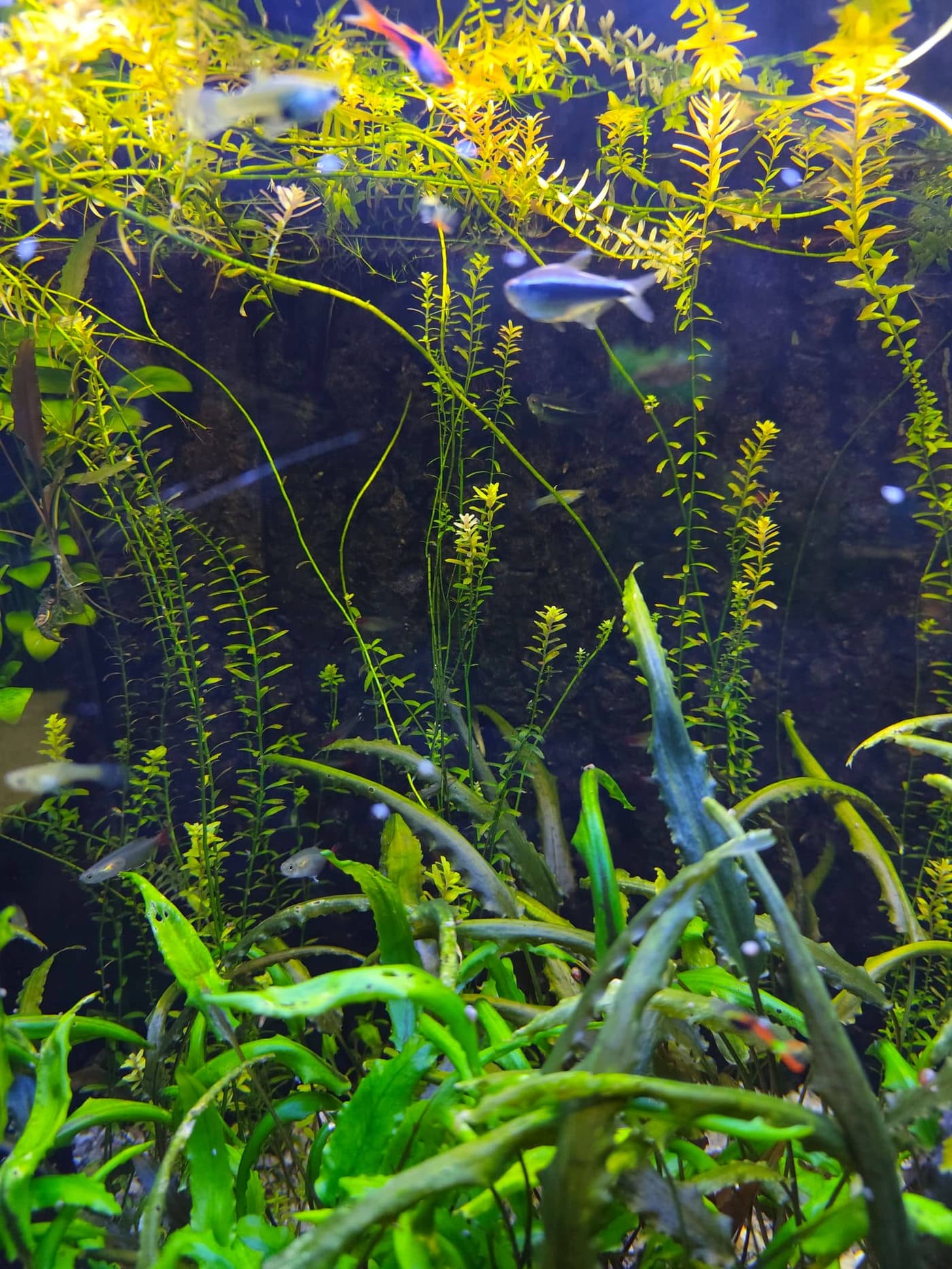
Plants take up nitrogen. In a well-planted tank with fast growers, nitrate accumulates more slowly, so the reading that triggers your change arrives later. That is a real effect and it shows up on a test kit within a few weeks of planting up.
What plants do not do is remove the need to test. A planted tank can still crash, still traps detritus under leaf litter, and still holds a fish whose gills care about ammonia. Fast growers such as hornwort, water sprite and floating salvinia move the needle; a single anubias tied to a rock does not, because it grows too slowly to consume much of anything.
What should I be siphoning, and how much?
The substrate, in sections, until the water coming up runs clear.
A water change that only removes water from the top half of the tank leaves the waste where it is. Detritus settles into gravel and sits there breaking down, and lifting it out is most of the point. Work a gravel vacuum into the bed, let the lighter material rise into the tube while the substrate falls back, then move to the next patch. On a 5-gallon you will reach the whole floor in one session; on anything larger, doing half the floor each week is normal practice.
Check the Aqueon mini siphon gravel cleaner on Amazon Affiliate link. See our disclosure.
Two things to leave alone while you are in there. The filter media, per the cloudy water page, because rinsing it under a tap is how people restart a cycle without meaning to. And decor that has grown biofilm, which is doing quiet work.
How do I know the schedule is working?
Nitrate that returns to roughly the same number every week, and ammonia and nitrite that never move off zero.
That is the whole test. If nitrate is higher at each weekly reading than it was at the last one, the interval is too long or the volume is too small, and the fix is one more change per week before it is anything else. If ammonia appears in a tank that was stable, something changed on the input side: a heavier feed, a dead snail, a filter rinsed under a tap, or a heater that failed and dropped the tank cold enough to slow the colony.
The water parameters table has the target and emergency numbers in one place. Worth keeping in mind that a betta shows water-quality damage late; lethargy and a refused meal arrive well before anything looks visibly wrong, and ammonia poisoning covers what that progression looks like.
A permanently mounted ammonia badge is a reasonable belt-and-braces addition for anyone who tests weekly rather than daily, since it changes colour between tests rather than only when you remember.
Check the Seachem Ammonia Alert on Amazon Affiliate link. See our disclosure.
The mistakes that cause the most trouble
Changing water because it looks dirty. Cloudy is not the same as toxic, and four of the five common causes of cloudiness resolve without a bucket. Test first.
Changing 100 percent every week on a filtered tank. This is a habit carried over from bowl-keeping. On a cycled tank it strips the water column, removes the substrate biology along with the substrate detritus, and gains nothing a 30 percent change did not already give you.
Rinsing the filter cartridge on water change day. The two jobs got welded together by cartridge-based filter marketing, which sells a replacement part on a schedule. Media gets swished in old tank water only when flow actually drops.
Topping up evaporation and calling it a water change. Evaporation removes water and leaves everything dissolved in it behind, so topping up raises mineral concentration instead of lowering it. Merck flags this one directly.
Skipping the dechlorinator because it is only a small amount. Covered above and it remains the single most avoidable way to kill a filter colony.
Related on this site
- The Nitrogen Cycle: Why Uncycled Tanks Kill Bettas
- How to Cycle a Betta Tank: Fishless, Fish-In, 6-Week Timeline
- Betta Fish Water Parameters: The Complete Reference Table
- Betta Ammonia Poisoning: Signs, Emergency Response, Recovery
- Betta Fish Cloudy Water: Causes, and What Actually Fixes It
- Betta Water Temperature: 76–82°F and Why Stability Wins
- Best Water Test Kits for Betta Tanks: What to Buy and Skip
- Best Water Conditioner for Betta Fish: Prime and the Rest